What is Astrology?
Before going further, let's understand Astrology or Jyotish Shastra” first. It is a study of the position of the sun, moon and planets at the exact time you were born to know about “YOU”.
The kind of person you are, your personality, your skills, your challenges, and the different experiences we may go through in life. Basically, astrology studies all the ongoing movements of your planets in your kundali.
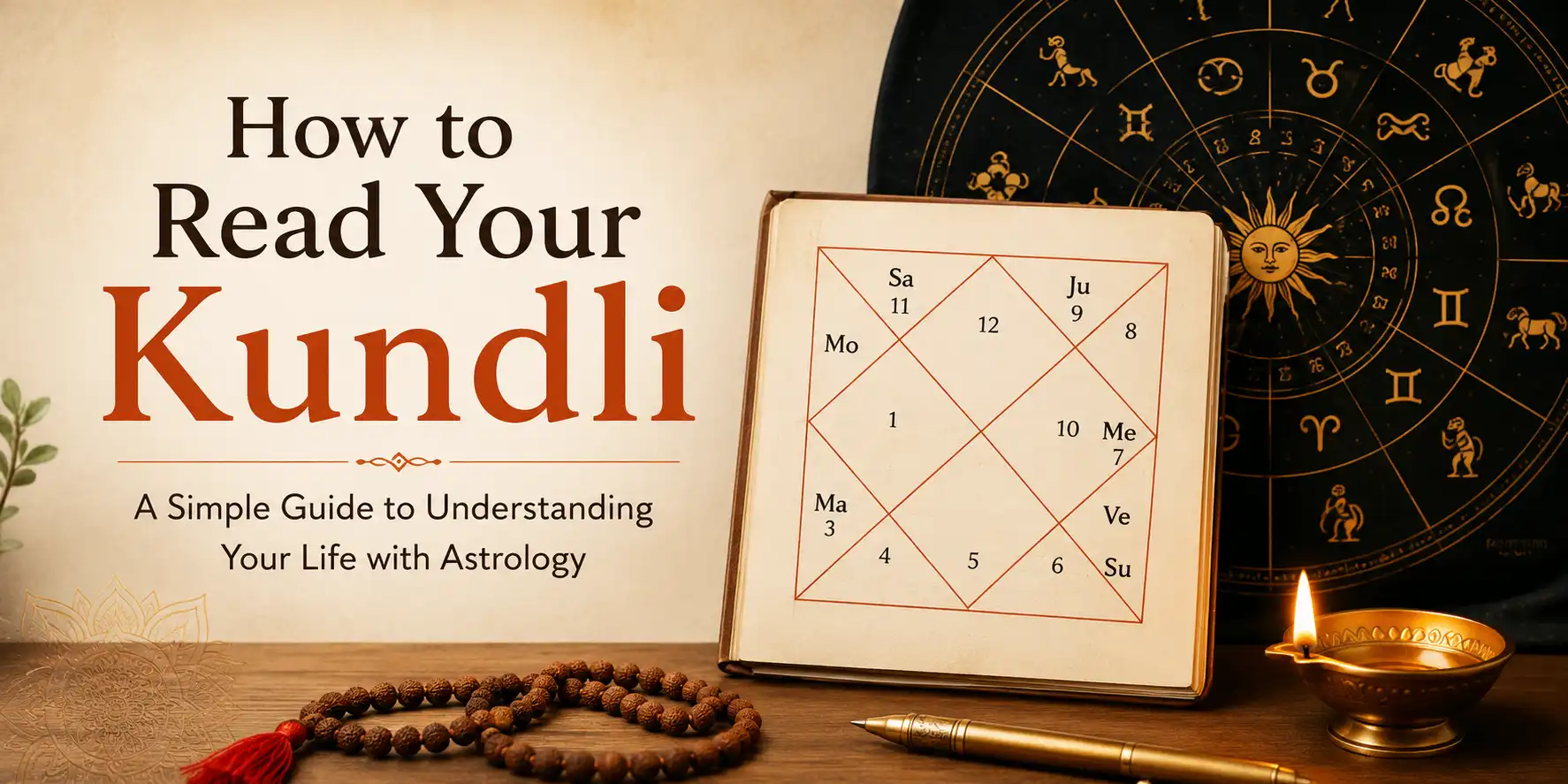
Now, as we have mentioned, Kundali (birth chart), let's understand what exactly it is, imagine a kundali as like taking a picture of where the sun, moon, and all the planets were located, at the time of your birth and drawing it out on paper. That drawing is your Kundali.
But it does not entirely control your life, you are your own person, but your kundali is read to understand yourself better and get to know the ups and downs of your life. Astrology just gives you a roadmap, and you have full freedom to shape it however you want.
Now that we understand what astrology is, let's look at how this ancient knowledge began.
How Did Astrology Begin?
Astrology has been in India in the name of Yotish Shastra, it is one of the six Vedangas. It is like, Veda is a body and astrology is one of the parts of it, in Veda “Jyoti” means light and “Ish” means master, so that words come as “jyotish” - the master of light or science of light.
Over the years, it has been evolving and passing down from guru to shishya as a form of knowledge. It was a part of the Indians to calculate the calendar, understand time, and know the muhrat (auspicious time) for rituals.
Now, if we calculate the data, the number of people believing in astrology has increased, which signifies that astrology is a human need to connect with themself better.
Important Astrology (Jyotish Shastra) Terms Everyone Should Be Familiar With
To understand astrology better, we need to understand these 7 things before getting into a deep dive into it. These are the terms that help to build the foundation of astrology.
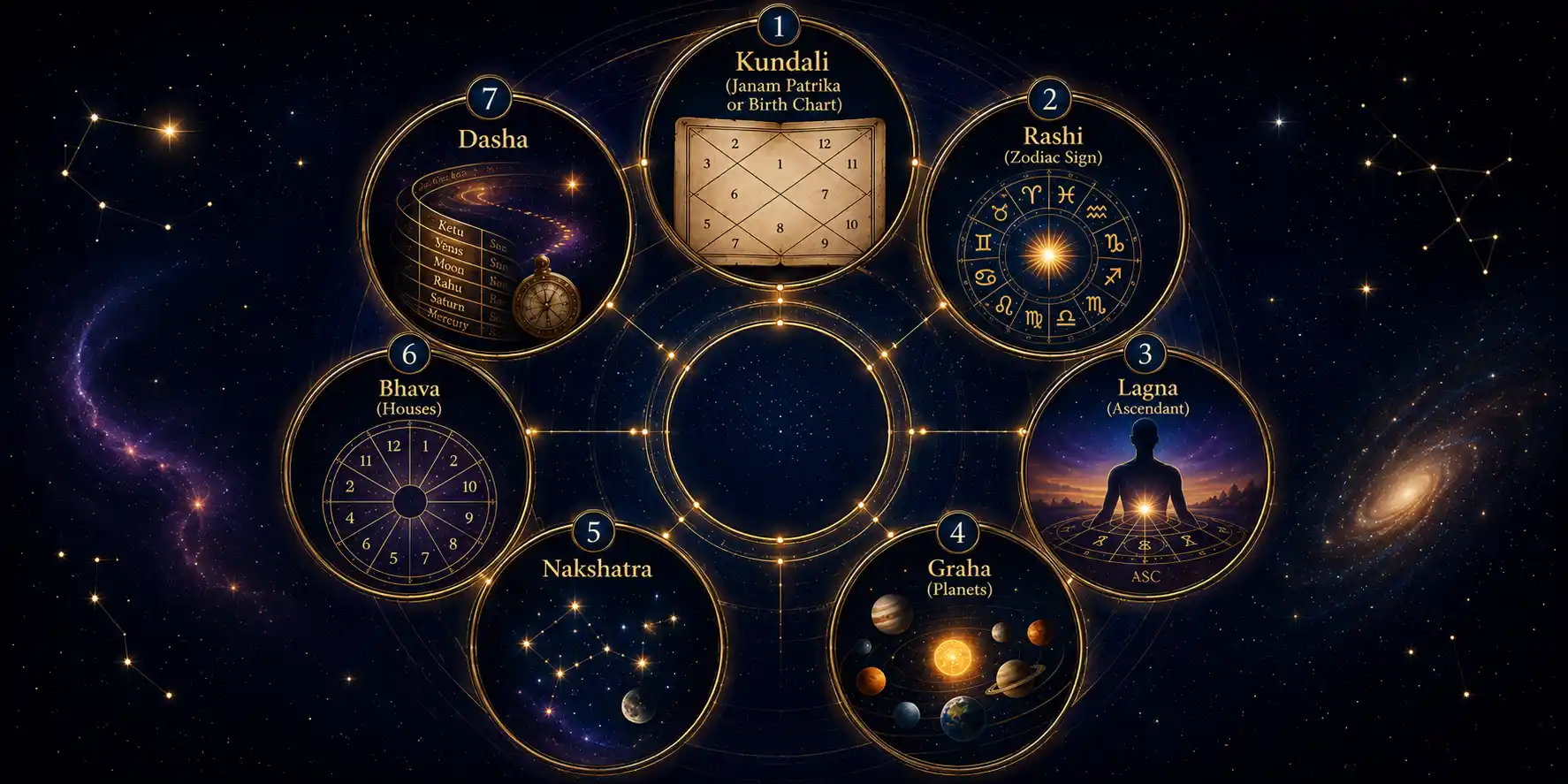
Kundali (Janam Patrika or Birth Chart)
This is your complete astrological map. It shows where every planet was positioned the moment you were born. Everything in Vedic astrology is read from this chart.
Now that you know what a kundali is, you can generate a free kundali online using your date, time of birth and place of birth and with it you can know about your planetary positions, dasha and yog.
Rashi (Zodiac Sign)
There are 12 Rashis (Zodiac Sign) in Vedic astrology (Jyotish Shastra) your, rashi is usually set by where the Moon or Sun was at the time of your birth.
Lagna (Ascendant)
The zodiac sign that was rising on the eastern horizon at the exact moment you were born. In Vedic astrology, the Lagna is considered even more important than your Rashi. It changes every two hours, so even people born on the same day can have very different Lagnas.
Graha (Planets)
The planets, in Vedic astrology, are nine grahas: Surya (Sun), Chandra (Moon), Mangal (Mars), Budxha (Mercury), Guru/Brihaspati (Jupiter), Shukra (Venus), Shani (Saturn), and two shadow planets - Rahu and Ketu.
Nakshatra
Nakshastra is called moon house, nakshastra is made when the sky is divided into 27 or sometimes 28 times. The Rashis are the 12 broad sections, but Nakshastras are the smaller and more specific sections. They are set by the moon’s position and are very important, especially at the kundali matching at the time of marriage.
Bhava (Houses)
The 12 divisions of the Kundali, each representing a different area of your life, like career, family, wealth, relationships, and so on.
Dasha
Planetary periods, each planet "rules" a specific period of your life. How you experience different life phases is largely read through which planet's Dasha is running.
“These are the terms you must know before going further into the astrology journey, each one has a different meaning and its own significance. We will discuss them in the vast form now.”
Kundali
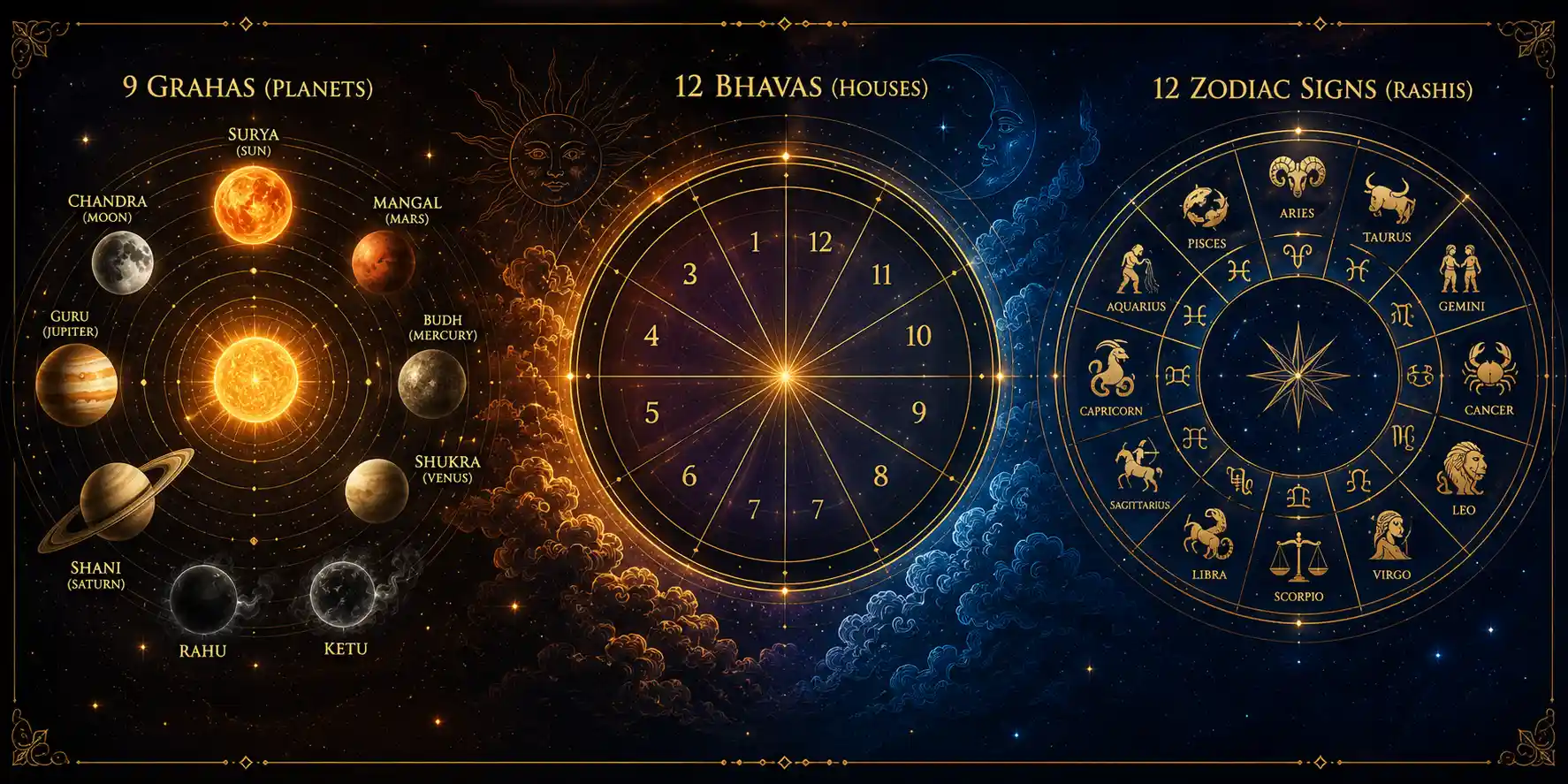
Kundali in India, also known as janam patrika or birthchart, is a map of the sky at the time when you were born, to understand a kundali, we need 12 Rashis, 9 garahas, 12 bhavas (houses). They all together make a kundali, to read a kundali better, we need to understand these better,
- 9 Garahas (Planets): They represent different areas of your life, and they bring a specific energy wherever they sit in your kundali.
- 12 Bhavas (Houses): They represent different areas of life like your career, family, relationship, health and so on.
- 12 Zodiac Signs (Rashish): They represent your personality, nature and character.
As we build the foundation of kundali, we have one more interesting thing about kundali, in India, kundali has 3 different formats.
-
South Kundali
-
North Kundali (mostly used)
-
Bengali Kundali
The North Indian kundali is widely used throughout the world. As it is drawn in a grid shape, the houses remain fixed in their positions, but the rashis rotate based on your lagna.
The Three Most Important Placements in Your Kundali
In Vedic astrology, before anything else, you need to know three things about your chart. These three together give you the most immediate and personal picture.
Let's look at each of them individually and understand what they reveal about you.
The Lagna (Your Rising Sign)
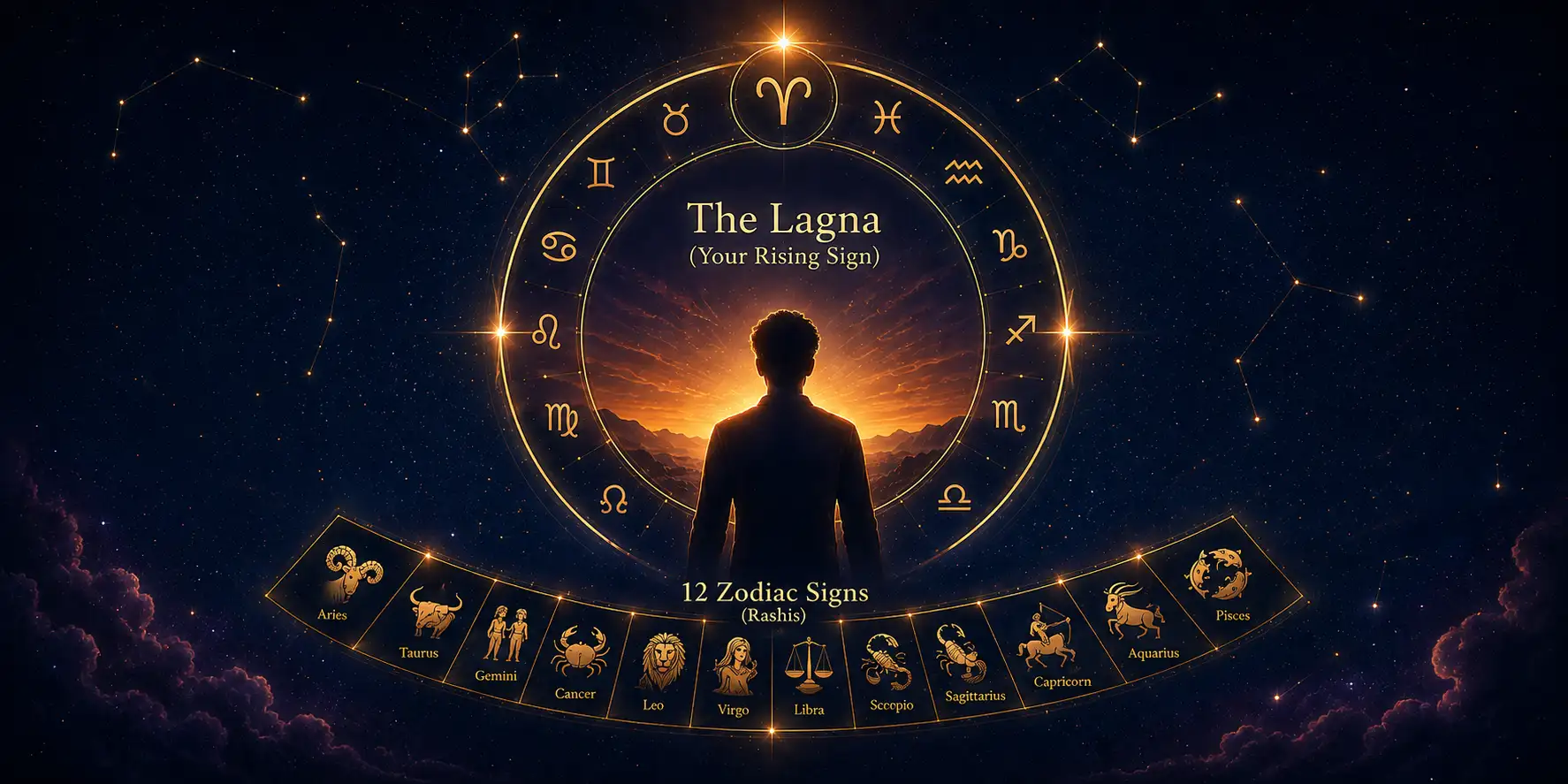
This is the most important placement in Jyotish Shastra (Astrology), even more important than your Rashi. The Lagna is the zodiac sign that was rising on the eastern horizon the moment you were born. It tells the entire structure of your Kundali, like which houses fall where, and how the rest of the chart is organised.
Your Lagna is your personality, your physical self, the way you show up in the world. It's how people see you before they know you deeply. Because the rising sign changes every two hours, this is why an exact birth time is so important in Vedic astrology. Even 15–20 minutes of difference can change the Lagna.
The Chandra Rashi (Moon Sign)
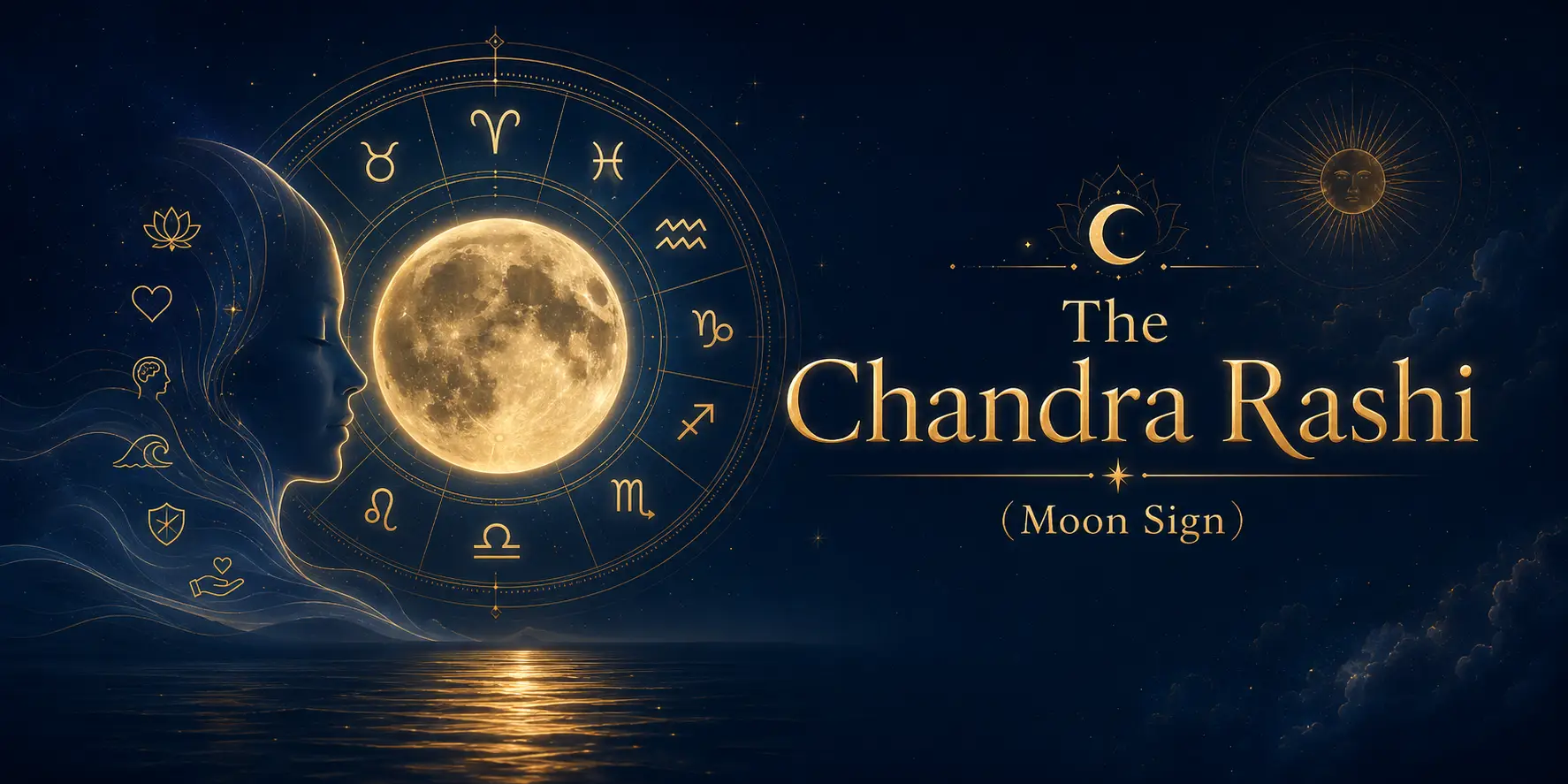
In Vedic astrology (Jyotish Shastra), your Moon sign is where the moon was when you were born, it is what people traditionally refer to as your "rashi". This is different from Western astrology, where your Sun sign is the main one.
The Moon represents your mind, your emotions, your inner world, and your instincts. It's the most personal and sensitive placement in your chart. Your Chandra Rashi tells you how you feel things, what makes you feel safe, and what your emotional patterns look like. This is also why, when you read a Vedic horoscope (rashifal), it's based on your Moon sign, not on your Sun sign.
The Surya Rashi (Sun Sign)
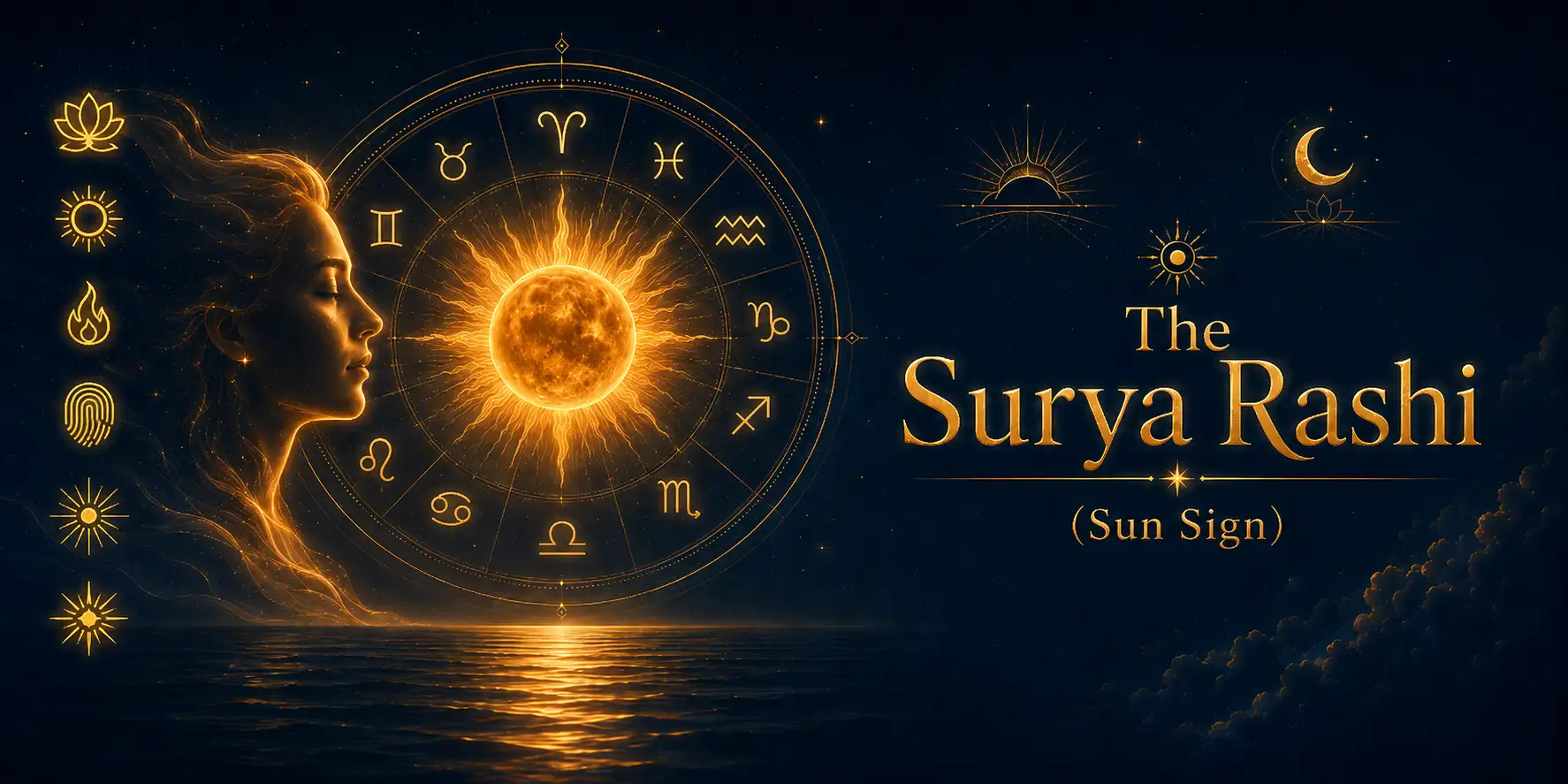
Yes, the Sun sign matters too, it represents your soul, your purpose, your energy, and the deeper sense of who you are. But in Vedic astrology, it plays more of a supporting role compared to the Lagna and Moon sign.
The 12 Rashis Explained
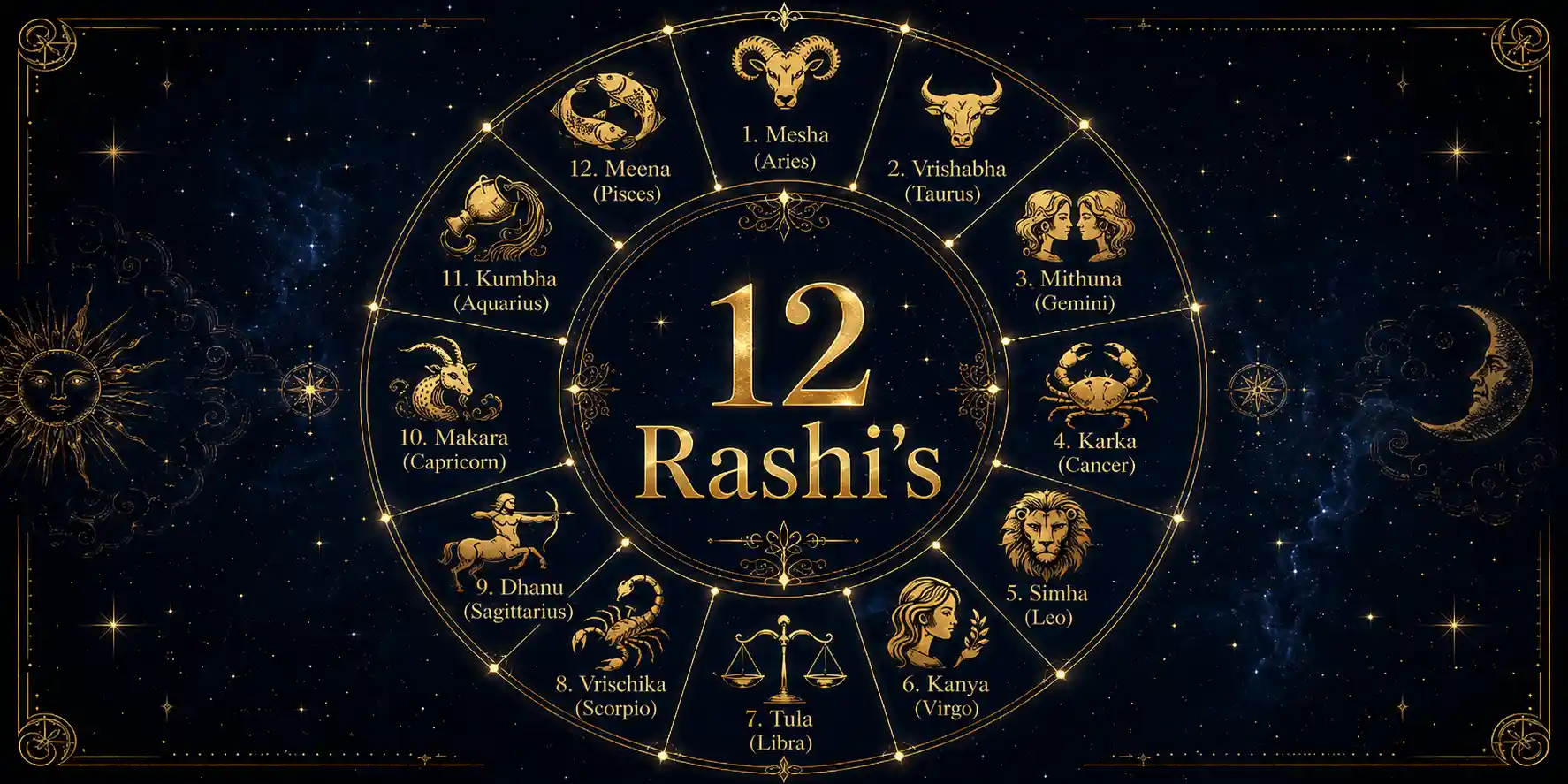
Mesh (Aries) - Ruled by Mangal (Mars)
Bold, energetic, and always first to act. Mesh people are natural leaders with a charm that's hard to ignore. They dive into arguments, adventures, and opportunities without hesitation. Their challenge? Patience and not finishing the task they have been working on.
Vrishabha (Taurus) - Ruled by Shukra (Venus)
Vrishabha people know how to enjoy life. Good food, comfort, stability, and loyalty are their language. They move slowly and build carefully, but once they commit, they stay. Their challenge is stubbornness.
Mithun (Gemini) - Ruled by Budha (Mercury)
Curious, quick, and excellent communicators. Mithun people want to know everything and are sharp at business and analysis. Their challenge is that their minds run in too many directions at once.
Karka (Cancer) - Ruled by Chandra (Moon)
Deeply emotional and deeply caring, just like a mother. Karka people love with their whole heart and feel things very intensely. They are protective, nurturing, and sensitive. Their challenge is that once they get hurt, they hold on to it. The world can feel a little overwhelming when you feel more than most people do.
Singh (Leo) - Ruled by Surya (Sun)
Singh runs on the Sun's energy, they shine. They naturally want others to see them, to lead, and to make things happen. The Sun gives them charisma and leadership, but also a strong sense of self-respect and ego. If they commit to something, they stay with passion and dignity until the very end.
Kanya (Virgo) - Ruled by Budha (Mercury)
One of the most interesting Rashis. Kanya people have a youthful, ambitious energy, they are detail-oriented, organised, and talkative. They notice what others miss. Their challenge is that this same sharp eye can turn into overthinking and self-criticism.
Tula (Libra) - Ruled by Shukra (Venus)
Tula means balance, and that's exactly who they are. They look at every angle, never jump to conclusions, and give equally in relationships. This makes them wonderful partners but sometimes frustrating decision-makers, because they truly want to weigh everything before committing.
Vrishchika (Scorpio) - Ruled by Mangal (Mars)
Mysterious and deeply observant. Vrishchika people are introverts who don't speak much but they notice everything and process it internally before making their point. They are naturally drawn to the spiritual, the occult, and deep psychology. Their observation power is extraordinary.
Dhanu (Sagittarius) - Ruled by Guru (Jupiter)
Positive, generous, and full of genuine wisdom. Dhanu people love knowledge and will advise you because they genuinely want to help. Their challenge: they sometimes give advice nobody asked for which can create conflicts sometimes in their life.
Makar (Capricorn) - Ruled by Shani (Saturn)
Disciplined, goal-oriented, and willing to take the slow road if it's the right one. Makar people are workaholics at heart. Shani's influence makes them firm believers in earning everything they get, nothing more, nothing less. Socially adaptable, but work always comes first.
Kumbha (Aquarius) - Ruled by Shani (Saturn)
Kumbha is layered. Just when you think you know them, there's always more. They are introverts in a very specific way. They are helpful and broad-minded, but not always good at expressing it. They care deeply for their people, in their own quiet way.
Meen (Pisces) - Ruled by Guru (Jupiter)
Meen comes last, and can describe them as "pure." There is a softness and completeness to them. Sensitive, compassionate, charming, and highly imaginative. They are more practical than people give them credit for. Gurus bring intuition and wisdom into their lives.
The 9 Planets of Kundali
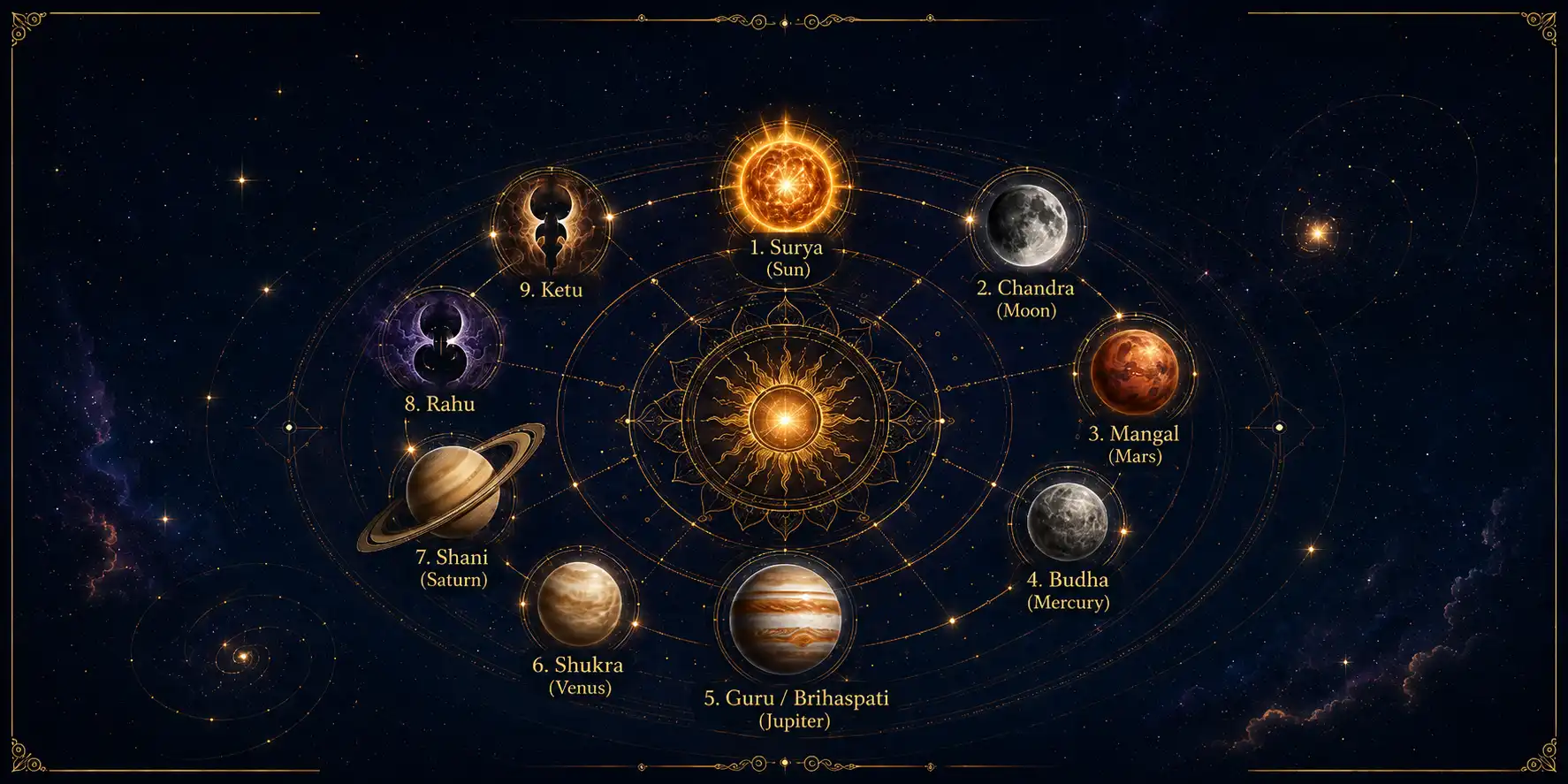
So now we know about the 12 rashis, but knowing rashis alone isn't enough. We need to focus on the planets of kundali to understand astrology better. Each planet has its own personality and energy, and whenever they sit in the chart, they bring their specific personality with them.
In Vedic astrology, we work with 9 planets, and these are not the same as the planets you studied in science class. Here, the Sun and Moon are also counted as planets, and there are two special shadow planets that have no physical body but play a very special role.
Let's get to know each one briefly -
-
Surya (Sun) - Surya represents your soul, your identity, your confidence, and your relationship with people. It also represents your father. A strong Sun in your chart means you have natural leadership qualities, confidence and a charming personality in you.
-
Chandra (Moon) - Chandra is your mind and your emotions. It represents your mother and the kind of relationship you would have with her and your inner world. The Moon changes its position every 2.5 days, which is also why our moods keep shifting. A strong Moon means a calm, clear, and emotionally balanced mind.
-
Mangal (Mars) - Mangal is your energy, your drive, your courage, and yes, your anger too. It represents your siblings and the physical strength you carry. Mangal is a passionate planet, and wherever it sits, it brings intensity.
-
Budha (Mercury) - Budha controls how you think, how you communicate, and how you process information. It's the planet of intelligence, business sense, and sharp analysis. If Budha is strong in your chart, you're probably the one people come to when they want a clear, logical explanation of something.
-
Guru / Brihaspati (Jupiter) - Guru is exactly what the name says, the teacher. It represents wisdom, knowledge, blessings, children, and spirituality. Jupiter is considered the most helpful planet in Vedic astrology. Wherever it sits, it brings growth and good fortune.
-
Shukra (Venus) - Shukra tells about love, beauty, luxury, and relationships. It's the planet that tells you how you experience comfort and affection in life, what you're attracted to, and what things make you feel happy and loved.
-
Shani (Saturn) - Shani is the most feared planet, but also one of the most important. It represents karma, discipline, hard work, and the lessons life is trying to teach you. Shani doesn't give things easily, but what it gives after patience and effort, it gives permanently.
If you are someone who has Shani in their life, be ready to do hard work (mehnat) in your life.
-
Rahu - Rahu is one of the two shadow planets, meaning it has no physical body, it's an invisible point in the sky. Rahu represents desire, ambition, and the hunger for things the soul hasn't experienced yet. Rahu's Mahadasha lasts 18 years and often brings rapid, unexpected change in life.
-
Ketu - Ketu is always placed exactly opposite to Rahu in the chart, always, without exception. It represents detachment, past life karma, and spirituality. Where Rahu wants more, Ketu wants to let go. Ketu's Mahadasha lasts 7 years.
Rahu and Ketu are important aspects when talking about Kaal Sarp Dosh. To know a detailed explanation of it related to your Kundali, you can visit our Kaal Sarp Dosh guide
Together, these 9 planets are constantly moving through the sky, and their movement through your Kundali is what creates the timing and different chapters of your life.
The 12 Houses - The Different Rooms of Your Life
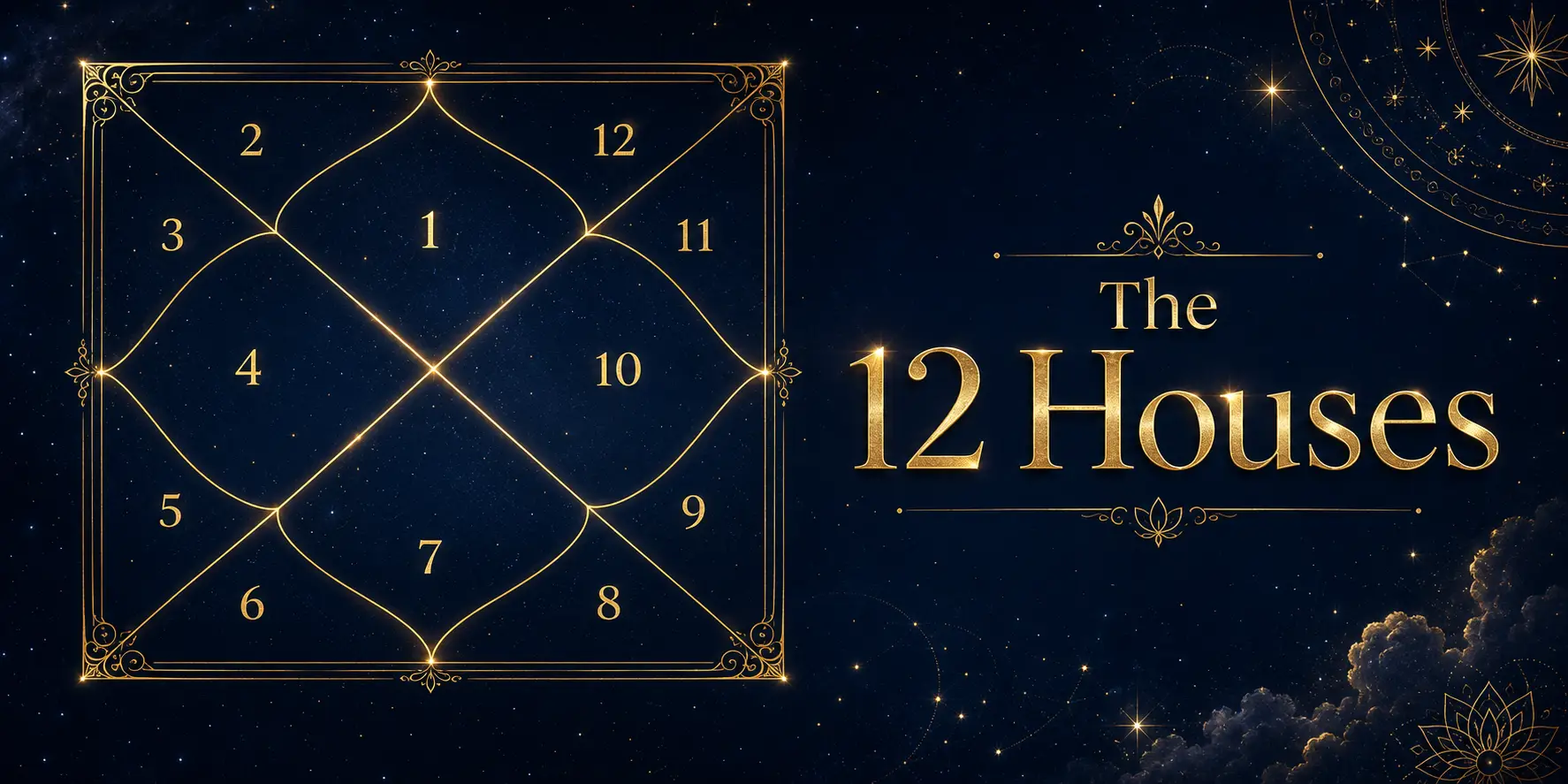
We've been talking about houses since the beginning, but now let's understand what each house actually means in a simple way. Your Kundali is divided into 12 bhavas (houses). Each house is a different department of your life, from your personality to your career to your marriage to your spiritual journey, everything falls in these 12 houses.
Here's what each house represents -
1st House
It is the house of self, which means it represents - You. Your personality, your physical appearance, your overall health, and the way you show up in the world. This is the Lagna house.
2nd House
The 2nd house represents your family, your speech, your savings, and your early wealth. It also represents your right eye and the way you talk to people.
3rd House
It represents your siblings, how many and what kind of personality they would have, your courage, short distance travel, and media and communication. This house tells you about your drive to take action.
4th House
The 4th house is of your mother, your home, your inner happiness, your property, and your vehicles. This house is about your emotional foundation and the security you feel within yourself.
5th House
The 5th house tells about your children, your creativity, romance, intelligence, and your primary education. It also carries the energy of your past life, the good karma you're carrying forward.
6th House
The 6th house, your enemies, your debts, and your health challenges. But this house also tells you about your ability to overcome obstacles. A strong 6th house means you're someone who can fight back.
7th House
The 7th house tells about your future life partner, your marriage, and your business partnerships. The 7th house tells you about the nature of your most important one-on-one relationships.
8th House
It represents sudden change, transformation, secrets, and hidden things. This is also the house connected to occult science and deep mysteries. It's intense, but it's also the house of deep transformation.
9th House
It tells about your luck, your dharma, your relationship with God, long distance travel, and your father's blessings. A strong 9th house person is someone who is genuinely fortunate in life.
10th House
It is about your career, your profession, your public reputation, and your contribution to the world. This is the house of what you do and how the world sees it.
11th House
It is of your income, your gains, your elder siblings, and the fulfilment of your goals and desires. This house is about what actually comes to you in life.
12th House
It is the house of expenses, losses, foreign lands, and spirituality. This is the house of letting go and moving forward toward moksha.
Every planet sitting in one of these houses brings its energy to that area of life. That's the combination you're always reading, like which planet is where, and what does that mean for that department of life.
Nakshatras - The Detail Layer of Astrology
The sky is divided into 27 Nakshatras, sometimes 28. Each Nakshatra is a smaller section of the sky, and together they cover the full 360 degrees. While the 12 Rashis give you the broad personality picture, Nakshatras give you the specific details like the texture and the depth.
To know your janam nakshastra, you need to know where the moon was at the time of your birth. This is the first thing we look for in Vedic astrology, especially when naming a newborn baby. The first letter of the name is also decided on the basis of this.
During the time of marriage, when we match the kundali of the bride and groom, Nakshatra plays an important role in that. The 36-point (Guns) matching system is entirely based on the nakshastra position. Each Nakshatra has its own ruling planet, its own symbol, and its own specific qualities. It makes this one of the most personal and detailed tools in Vedic astrology.
Maha Dasha in Astrology
Have you ever wondered how astrology tells you about events in your life, like what happened 3 years ago? Well, that’s actually possible with the help of the dasha system, which tells us which planet is active right now and which one was active at the time of something big happening in your life.
In Vedic astrology(Jyotish Shastra), each planet rules a specific period of your life, which is known as mahadasha. They rule of around total of 120 years with a fixed sequence, they are always in order like - Ketu (7 years), Shukra (20 years), Surya (6 years), Chandra (10 years), Mangal (7 years), Rahu (18 years), Guru (16 years), Shani (19 years), and Budha (17 years).
But don’t worry. The period does not start at birth. The dasha depends on the nakshatra your Moon was in at birth. So, when you were born, your dasha may have already started.
Read More: What Is Mahadasha and How It Shapes Your Life
The Myths of Astrology - Which You Really Want to Know
There are a lot of myths in astrology that people have been believing for years, but are they actually real? Let’s find out together.
-
"Your fate is fixed in the Kundali, and you can't change it."
This is one of the most common myths surrounding Vedic astrology. A Kundali does not predict a fixed future instead, it reveals the energies, strengths, challenges, and possibilities present in your life. Vedic astrology has always recognised the role of both karma and free will. Your birth chart is like a map it can guide you, but the choices you make ultimately shape your journey.
-
"Mangal Dosh means your partner will die or your marriage will fail."
Not at all, Mangal Dosh happens when Mars is placed in those houses that are related to your marriage. Mars has intense energy, and it needs to be matched with someone who has the same energy. But there are also other factors that can help in neutralising the effect.
-
"Shani always brings bad things."
This is something that everybody is scared of, as Shani seems challenging and not easy to handle, but it is also the planet of justice and reward for your hard work.
Some of the biggest achievements, their success, mostly come after or during the shani phase.
-
"Rahu and Ketu always give a bad impact in life."
Rahu and Ketu are called the intense planets, but that does not automatically make them bad. Rahu shows your hunger towards your ambition and desire.
Whereas Ketu shows what you have already mastered in your past life, they create transformation, which can be uncomfortable but not destructive.
Conclusion
Learn Astrology Online: The Next Step in Your Journey
You started with your kundali. Now you have built a strong base in astrology. This is only the start, astrology goes much deeper than most people think. If you want to learn astrology online, this can help you know yourself better. You can also use it as a skill to help others, and it can also help you earn income.