Written by Jyoti Chauhan, Content Writer · Reviewed by Gurudev Shrie Kashyap, Chairman & Founder, All India Institute of Occult Science · Published 11 Nov 2026
Key Takeaways
- The 27 nakshatras are the lunar mansions of Vedic astrology: 27 equal segments of the zodiac, each spanning 13°20'.
- Each nakshatra has a ruling planet (lord), a presiding deity and 4 padas (quarters) of 3°20', giving 108 padas in total.
- The 9 lords repeat 3 times in a fixed order: Ketu, Venus, Sun, Moon, Mars, Rahu, Jupiter, Saturn, Mercury.
- Your janma nakshatra (birth star) is the nakshatra the Moon occupied when you were born; it also sets the starting point of your Vimshottari dasha.
- Nakshatra meanings describe traditional tendencies, not fixed fate. Read them together with the full birth chart.
Ask an Indian grandmother your birth star and she may know it faster than your zodiac sign. "Rohini", "Swati", "Revati": nakshatra names appear in baby names, wedding cards and temple sankalpa prayers, yet many people have no idea what they actually mean.
Nakshatras are one of the most distinctive parts of Vedic astrology, and one of the most useful. This guide gives you all 27 nakshatras in one table with their spans, lords and deities, explains padas, shows you how to find your own birth nakshatra step by step, and covers the traditional meaning of each star in plain language.
What Are Nakshatras?
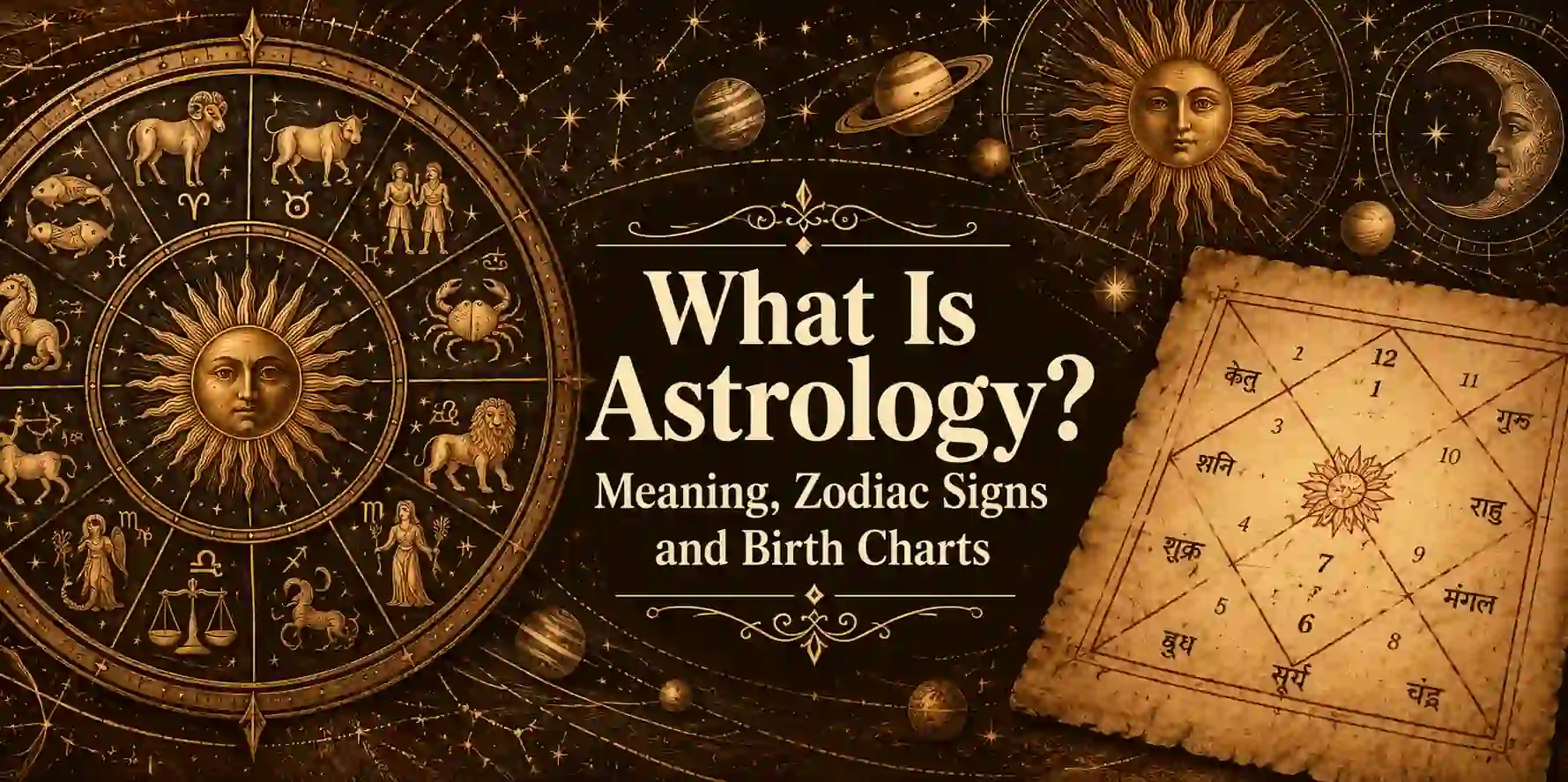
Nakshatras are the 27 "lunar mansions" of Vedic astrology. The Moon takes about 27.3 days to circle the zodiac, so ancient astronomers divided the sky into 27 equal parts, roughly one for each day of the Moon's journey. Each part is named after a prominent star or star group in that region of the sky.
The idea is very old. The Taittiriya Samhita and later Vedic texts list the nakshatras with their deities, and the system of lunar mansions is older in India than the 12-sign zodiac. Classical works such as Brihat Parashara Hora Shastra, especially in its chapters on the dasha systems, later built nakshatras into chart reading, timing and compatibility.
While the 12 zodiac signs describe broad qualities, nakshatras add a finer layer of detail. Two people with the Moon in Taurus can feel very different if one Moon sits in Krittika and the other in Rohini. If you are new to signs, read our guide to the 12 zodiac signs first.
How the 27 Nakshatras Fit Into the Zodiac
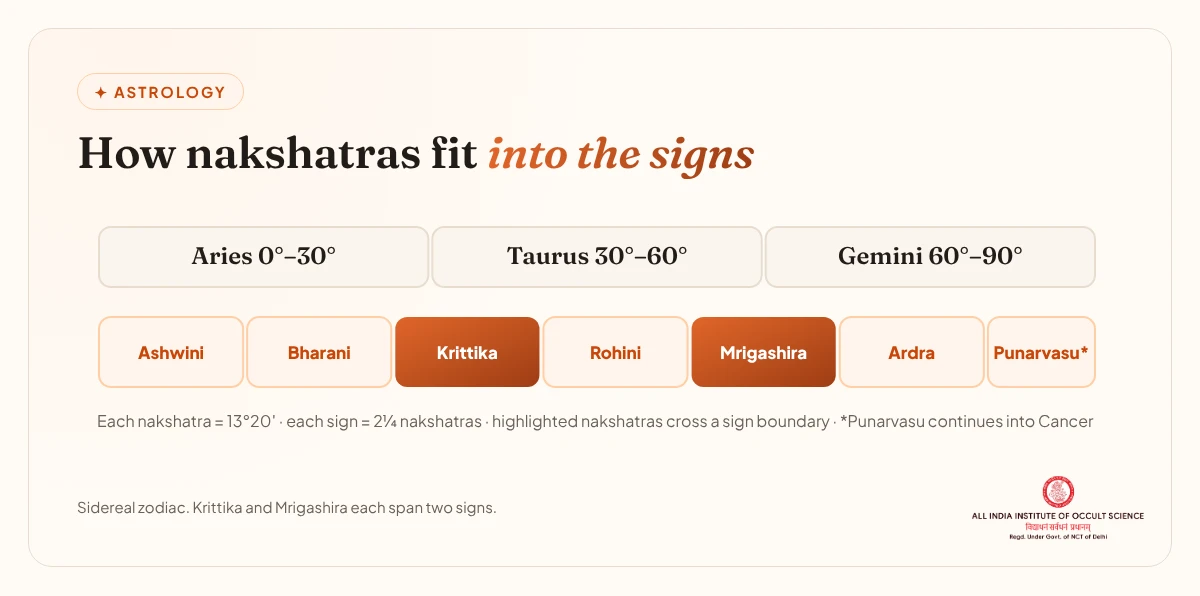
The zodiac is a circle of 360°. Divided by 27, each nakshatra spans 13°20'. The 12 signs are 30° each, so every sign contains 2¼ nakshatras. That is why some nakshatras sit across two signs: Krittika, for example, starts in Aries and ends in Taurus.
Vedic astrology uses the sidereal zodiac, which is fixed to the stars, rather than the tropical zodiac used in Western astrology. Nakshatra positions in your kundali are calculated using an ayanamsa, most commonly the Lahiri ayanamsa adopted by the Government of India's calendar reform committee.
The 27 Nakshatras: Complete List With Lords and Deities
This table lists every nakshatra in order, with its span in the sidereal zodiac, ruling planet, presiding deity and the keyword most commonly associated with it in the tradition.
| # | Nakshatra | Span (sidereal) | Lord | Deity | Traditional keyword |
|---|---|---|---|---|---|
| 1 | Ashwini | 0°00' – 13°20' Aries | Ketu | Ashwini Kumaras | Speed, healing, new starts |
| 2 | Bharani | 13°20' – 26°40' Aries | Venus | Yama | Restraint, responsibility, transformation |
| 3 | Krittika | 26°40' Aries – 10°00' Taurus | Sun | Agni | Sharpness, purification, courage |
| 4 | Rohini | 10°00' – 23°20' Taurus | Moon | Brahma (Prajapati) | Growth, beauty, creativity |
| 5 | Mrigashira | 23°20' Taurus – 6°40' Gemini | Mars | Soma | Curiosity, searching |
| 6 | Ardra | 6°40' – 20°00' Gemini | Rahu | Rudra | Storms, effort, renewal |
| 7 | Punarvasu | 20°00' Gemini – 3°20' Cancer | Jupiter | Aditi | Return, optimism, recovery |
| 8 | Pushya | 3°20' – 16°40' Cancer | Saturn | Brihaspati | Nourishment, care, stability |
| 9 | Ashlesha | 16°40' – 30°00' Cancer | Mercury | Nagas (serpents) | Insight, intensity, persuasion |
| 10 | Magha | 0°00' – 13°20' Leo | Ketu | Pitris (ancestors) | Heritage, authority, tradition |
| 11 | Purva Phalguni | 13°20' – 26°40' Leo | Venus | Bhaga | Pleasure, rest, creativity |
| 12 | Uttara Phalguni | 26°40' Leo – 10°00' Virgo | Sun | Aryaman | Partnership, loyalty, support |
| 13 | Hasta | 10°00' – 23°20' Virgo | Moon | Savitar | Skill, craft, dexterity |
| 14 | Chitra | 23°20' Virgo – 6°40' Libra | Mars | Tvashtar (Vishwakarma) | Design, beauty, building |
| 15 | Swati | 6°40' – 20°00' Libra | Rahu | Vayu | Independence, flexibility, trade |
| 16 | Vishakha | 20°00' Libra – 3°20' Scorpio | Jupiter | Indra and Agni | Goals, determination |
| 17 | Anuradha | 3°20' – 16°40' Scorpio | Saturn | Mitra | Friendship, devotion, teamwork |
| 18 | Jyeshtha | 16°40' – 30°00' Scorpio | Mercury | Indra | Seniority, protection, responsibility |
| 19 | Mula | 0°00' – 13°20' Sagittarius | Ketu | Nirriti | Roots, investigation, letting go |
| 20 | Purva Ashadha | 13°20' – 26°40' Sagittarius | Venus | Apas (waters) | Conviction, renewal |
| 21 | Uttara Ashadha | 26°40' Sagittarius – 10°00' Capricorn | Sun | Vishvedevas | Lasting success, ethics |
| 22 | Shravana | 10°00' – 23°20' Capricorn | Moon | Vishnu | Listening, learning |
| 23 | Dhanishta | 23°20' Capricorn – 6°40' Aquarius | Mars | Vasus | Rhythm, music, prosperity |
| 24 | Shatabhisha | 6°40' – 20°00' Aquarius | Rahu | Varuna | Healing, research, privacy |
| 25 | Purva Bhadrapada | 20°00' Aquarius – 3°20' Pisces | Jupiter | Aja Ekapada | Intensity, idealism |
| 26 | Uttara Bhadrapada | 3°20' – 16°40' Pisces | Saturn | Ahir Budhnya | Depth, patience, wisdom |
| 27 | Revati | 16°40' – 30°00' Pisces | Mercury | Pushan | Guidance, safe journeys, completion |
Deity names follow the Vedic lists; spellings vary slightly between sources. For the deities in more detail, Wisdom Library's entry on nakshatras collects references from many texts.
The Nakshatra Lords and Why Their Order Matters
The nine planets rule the nakshatras in a fixed sequence that repeats three times: Ketu, Venus, Sun, Moon, Mars, Rahu, Jupiter, Saturn, Mercury. Ashwini, Magha and Mula all start a cycle with Ketu; Revati, Jyeshtha and Ashlesha all end one with Mercury.
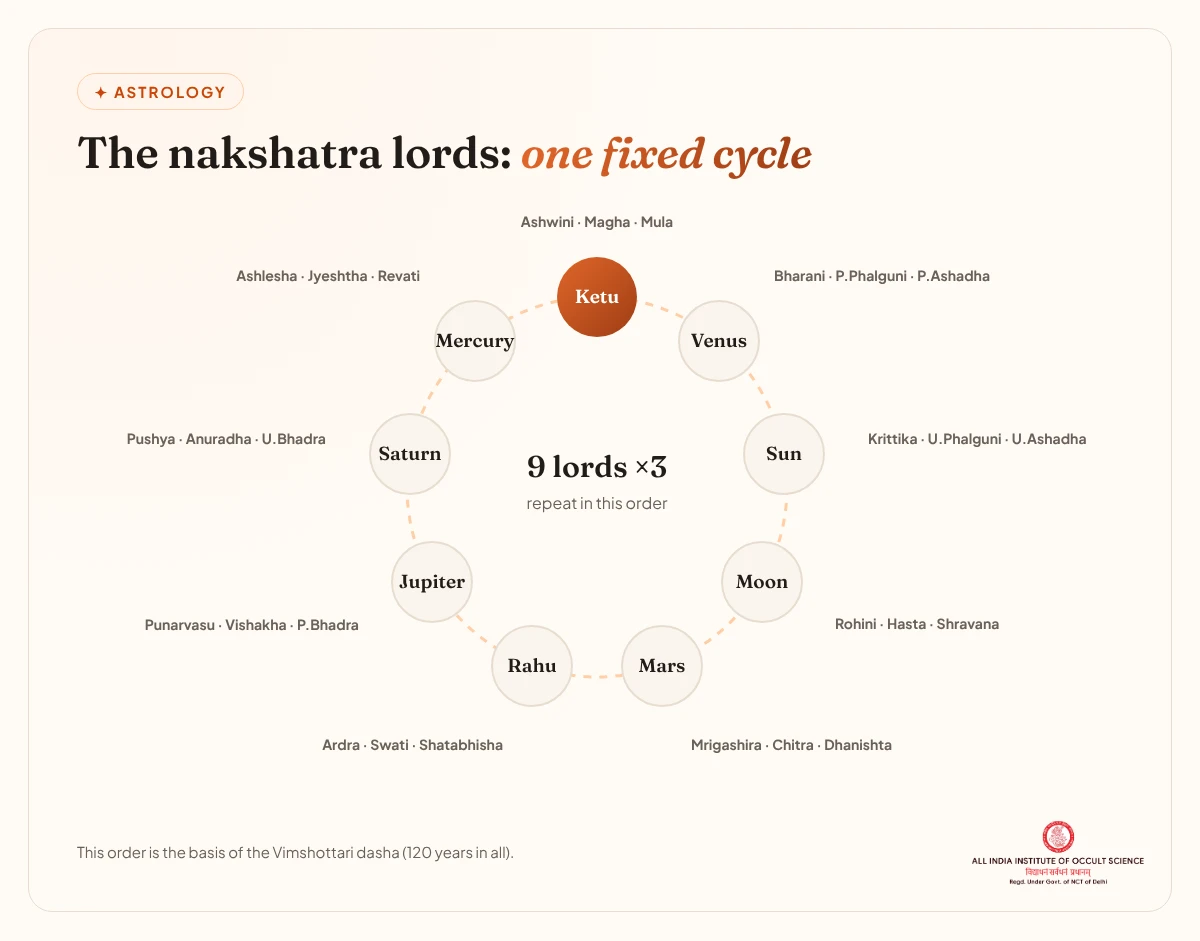
This order is not just a list to memorise. It is the backbone of the Vimshottari dasha system, the most widely used timing method in Vedic astrology. The lord of your birth nakshatra decides which mahadasha (major planetary period) you were born in, and the remaining periods follow in the same order. Our guide to what a mahadasha is and how it shapes your life explains the timing in detail.
| Lord | Nakshatras ruled | Vimshottari mahadasha length |
|---|---|---|
| Ketu | Ashwini, Magha, Mula | 7 years |
| Venus | Bharani, Purva Phalguni, Purva Ashadha | 20 years |
| Sun | Krittika, Uttara Phalguni, Uttara Ashadha | 6 years |
| Moon | Rohini, Hasta, Shravana | 10 years |
| Mars | Mrigashira, Chitra, Dhanishta | 7 years |
| Rahu | Ardra, Swati, Shatabhisha | 18 years |
| Jupiter | Punarvasu, Vishakha, Purva Bhadrapada | 16 years |
| Saturn | Pushya, Anuradha, Uttara Bhadrapada | 19 years |
| Mercury | Ashlesha, Jyeshtha, Revati | 17 years |
The nine periods add up to 120 years, the traditional full human lifespan used in the system.
What Are Nakshatra Padas?
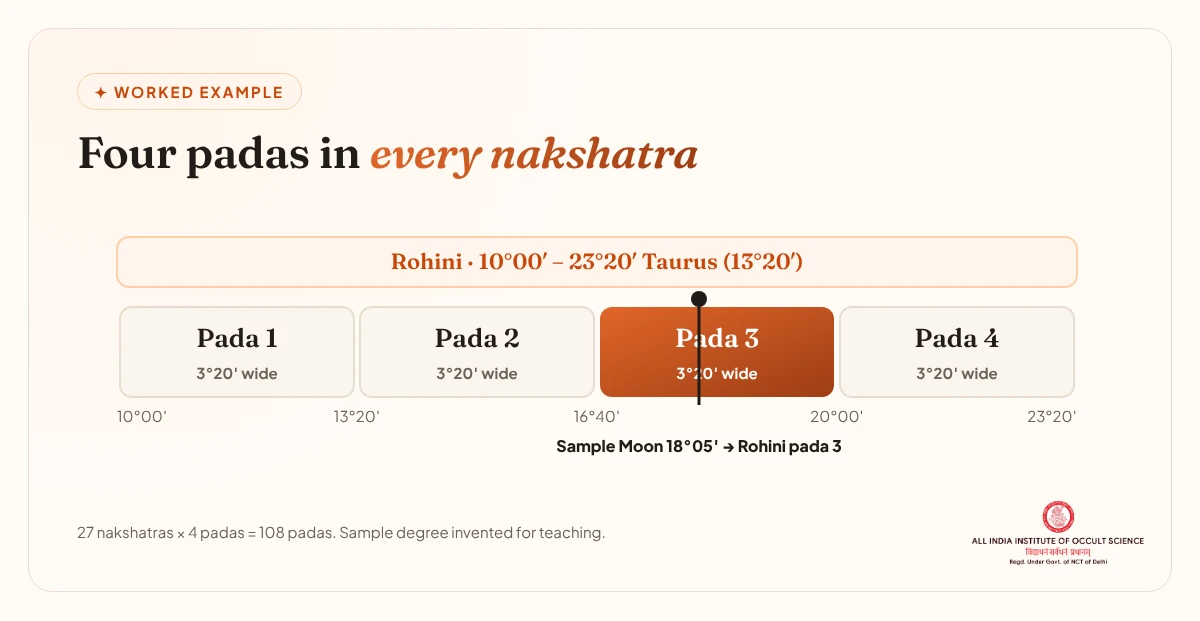
Each nakshatra is divided into four equal quarters called padas, each spanning 3°20'. With 27 nakshatras and 4 padas each, there are 108 padas in the zodiac, one reason 108 is a sacred number in Indian tradition.
- Navamsa link: each pada corresponds to one sign in the navamsa (D9) chart, the divisional chart used for marriage and inner strength. The padas cycle through the signs from Aries to Pisces again and again.
- Naming: each pada has a traditional starting syllable used in choosing baby names, which is why families sometimes ask an astrologer for the "name letter" of a newborn.
- Finer reading: two people born in the same nakshatra but different padas can show different emphasis, for example more practical or more idealistic expression of the same star.
How to Find Your Birth Nakshatra
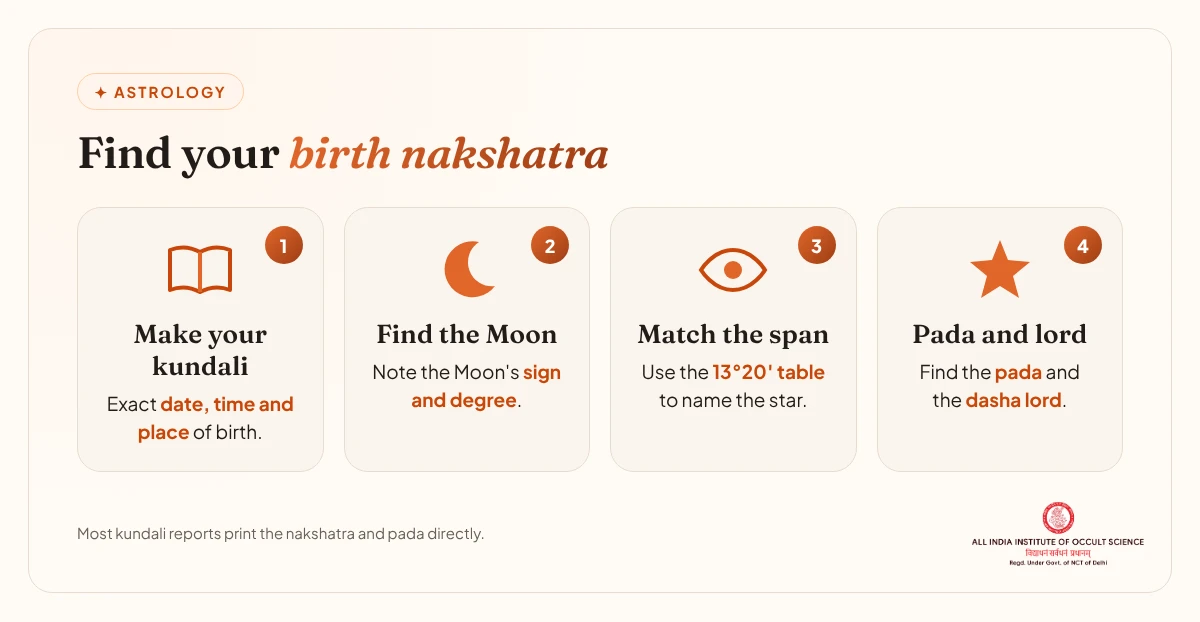
Your janma nakshatra (birth star) is the nakshatra the Moon was in at the moment of your birth. Here is how to find it.
Step 1: Get an accurate birth chart
You need your date, exact time and place of birth. Enter them in the free kundali calculator. A difference of even an hour can change the nakshatra, because the Moon moves about 13° a day.
Step 2: Find the Moon's position
In the planetary table of your kundali, find the Moon's sign and degree. Most kundali reports also print the nakshatra and pada directly.
Step 3: Match the degree to the table
If your report only gives a degree, use the list above. Sample: Moon at 18°05' Taurus (invented for teaching). Rohini runs from 10°00' to 23°20' Taurus, so the birth nakshatra is Rohini.
Step 4: Work out the pada
Rohini's padas are 10°00'–13°20', 13°20'–16°40', 16°40'–20°00' and 20°00'–23°20'. At 18°05', the Moon is in the 3rd pada of Rohini.
Step 5: Note the lord
Rohini is ruled by the Moon, so this person's Vimshottari dasha begins with a Moon mahadasha, and the balance remaining at birth depends on how far the Moon has travelled through Rohini.
The 27 Nakshatras in Brief
Here is the traditional character of each nakshatra in a sentence or two. These are tendencies described by classical and modern astrologers, not predictions.
Nakshatras 1–9 (Aries to Cancer)
- Ashwini: quick, energetic and pioneering; associated with healers and first responders.
- Bharani: strong-willed and responsible; associated with handling life's big transitions.
- Krittika: sharp, honest and protective, like the fire of its deity Agni.
- Rohini: warm, creative and attractive; traditionally linked with growth and abundance.
- Mrigashira: curious and gentle; always searching for knowledge or experience.
- Ardra: intense and hard-working; associated with growth through challenge.
- Punarvasu: hopeful and forgiving; the star of returning to balance.
- Pushya: caring and dependable; often considered one of the most auspicious nakshatras.
- Ashlesha: perceptive and persuasive; associated with deep insight.
Nakshatras 10–18 (Leo to Scorpio)
- Magha: dignified and respectful of tradition and family roots.
- Purva Phalguni: creative, social and fond of comfort and celebration.
- Uttara Phalguni: reliable, generous and committed in partnerships.
- Hasta: skilful with the hands; practical, clever and resourceful.
- Chitra: artistic and design-minded; associated with architects and craftspeople.
- Swati: independent and adaptable, like the wind of its deity Vayu.
- Vishakha: goal-oriented and determined; patient in pursuing a target.
- Anuradha: loyal, friendly and good at teamwork and devotion.
- Jyeshtha: protective and responsible; often takes the role of the elder.
Nakshatras 19–27 (Sagittarius to Pisces)
- Mula: investigative and philosophical; gets to the root of things.
- Purva Ashadha: confident and persuasive; associated with renewal.
- Uttara Ashadha: principled and persistent; linked with lasting achievements.
- Shravana: a good listener and learner; associated with teaching and knowledge.
- Dhanishta: rhythmic and energetic; traditionally linked with music and wealth.
- Shatabhisha: private and analytical; the "hundred healers" star of research and healing.
- Purva Bhadrapada: intense and idealistic; drawn to big causes.
- Uttara Bhadrapada: calm, wise and patient; depth beneath a quiet surface.
- Revati: gentle and caring; the guide who helps others complete their journey.
The Three Ganas: Deva, Manushya and Rakshasa
Each nakshatra is also given a gana, or temperament, which is used mainly in kundali matching. The names sound dramatic, but they describe styles of behaviour, not good or evil people.
| Gana | Nakshatras | Traditional temperament |
|---|---|---|
| Deva (divine) | Ashwini, Mrigashira, Punarvasu, Pushya, Hasta, Swati, Anuradha, Shravana, Revati | Gentle, idealistic, cooperative |
| Manushya (human) | Bharani, Rohini, Ardra, Purva Phalguni, Uttara Phalguni, Purva Ashadha, Uttara Ashadha, Purva Bhadrapada, Uttara Bhadrapada | Balanced, practical, worldly |
| Rakshasa (fierce) | Krittika, Ashlesha, Magha, Chitra, Vishakha, Jyeshtha, Mula, Dhanishta, Shatabhisha | Independent, intense, strong-willed |
A "Rakshasa gana" nakshatra does not make anyone a bad person. In matching, the gana koota simply checks whether two temperaments are likely to be comfortable together, and it is only one of eight factors. Many successful marriages have "mismatched" ganas.
How Nakshatras Are Used in Practice
Nakshatras appear in almost every branch of Vedic astrology:
- Personality: the Moon's nakshatra is read for emotional nature; the ascendant's nakshatra adds detail to temperament.
- Timing: the Vimshottari dasha starts from the birth nakshatra, and daily panchang lists the nakshatra of the day.
- Compatibility: several kootas in kundali matching (such as Nadi, Yoni and Gana) are calculated from the partners' birth nakshatras; an online kundali matching report shows them.
- Muhurat: auspicious times for events such as weddings or griha pravesh are chosen partly by nakshatra.
- Names: the starting syllable of a child's name is often taken from the birth pada.
Is Abhijit the 28th Nakshatra?
Some texts mention a 28th nakshatra, Abhijit, placed in the last part of Uttara Ashadha and the first part of Shravana (in Capricorn). It is used mainly in muhurat (electional astrology) and in some special charts. In standard chart reading and the Vimshottari dasha, astrologers use 27 nakshatras of equal size.
Common Myths About Nakshatras
- "Some nakshatras are bad to be born in." Every nakshatra has strengths and challenges. Traditional cautions (for example around Mula or Ashlesha) are about specific situations and are read with the whole chart; they are not a judgement on a person.
- "Your nakshatra decides your destiny." The nakshatra is one layer among many: houses, planetary strength, aspects and dashas all matter.
- "Nakshatras are the same as Western star signs." They are a separate, lunar-based system, measured in the sidereal zodiac.
- "You must perform a remedy for your birth star." No remedy is needed simply because of a birth nakshatra. Be cautious of anyone selling fear.
What Your Nakshatra Can and Cannot Tell You
It can: give a rich, traditional description of emotional style and tendencies, help you understand dasha timing, and add depth to chart reading and compatibility.
It cannot: predict exact events, guarantee success in marriage or career, or override your own choices. Astrology is a traditional system whose predictions have not been scientifically proven. Use nakshatra insights for reflection, and make important decisions with practical information and professional advice where needed.
How to Learn Nakshatras Properly
Memorising the table is the easy part. Reading nakshatras well means combining them with houses, planets, padas, navamsa and dashas on real charts. If you are just starting, our guides on what astrology is and the guide for astrology most beginners wish they had earlier give you the foundation.
The Institute's astrology course teaches nakshatras step by step across three levels: Certificate in Astrology (about 2 months), Diploma in Astrology (about 5 months) and Master in Astrology (about 8 months), open to anyone who has passed 10th standard, with live online classes in batches of 10 to 15 students.
Conclusion
The 27 nakshatras divide the sky into 13°20' lunar mansions, each with a lord, a deity, four padas and a traditional character. Your birth nakshatra, the Moon's star at birth, links your emotional nature with the timing of your dashas. Want to see yours? Enter your birth details in the free kundali calculator and look up the Moon's nakshatra with this table beside you.
This article shares traditional astrology knowledge for educational purposes. It is not a substitute for professional medical, legal or financial advice. Please read our disclaimer.