Written by Jyoti Chauhan, Content Writer · Reviewed by Gurudev Shrie Kashyap, Chairman & Founder, All India Institute of Occult Science · Published 12 Nov 2026
Key Takeaways
- The Akashic Records are described in spiritual traditions as a non-physical "library" of every soul's thoughts, words, actions and lessons, past and present.
- The word comes from the Sanskrit akasha (space or ether), the 5th of the panch mahabhuta (five great elements).
- The phrase "Akashic Records" is modern: it was popularised by the Theosophical Society, founded in 1875, and later by Rudolf Steiner and Edgar Cayce.
- Practitioners believe a reading shows patterns, lessons and choices rather than fixed predictions; there is no scientific evidence that the Records exist as an objective record.
- At least 10 common myths, from "only special people can read them" to "the Records are an ancient Vedic scripture", do not hold up.
Have you ever felt that some lessons keep returning to your life in different forms? The same kind of friendship ending the same way, the same fear showing up before every big decision, the same pull towards a place you have never visited. Many people who ask "why does this keep happening to me?" eventually come across one idea: the Akashic Records.
The idea sounds mysterious, and a lot of what is written about it online is either too vague or too dramatic. This guide explains what the Akashic Records are, where the word and the idea come from, what practitioners believe a reading shows, the most common myths, and how people learn the practice.
What Are the Akashic Records?
The Akashic Records are described as an energetic record of every soul's journey: its thoughts, emotions, choices, relationships and lessons across time. Practitioners often call it a "soul library" or "the book of life". It is not a physical place or a document; it is understood as information held in the subtle field of akasha, which a trained, calm mind can tune into.
In practice, people turn to the Records to understand patterns rather than to get predictions. A typical question is not "will I get this job?" but "what is the lesson in the repeated conflicts I face at work, and how can I respond differently?"
Other names for the Records
Depending on the teacher and tradition, you may also see the Records called the "Book of Life", the "Akasha Chronicle", the "soul records", the "cosmic memory" or the "Hall of Records". The names differ, but they point to the same basic idea: a subtle record of experience that can be reflected on in a meditative state.
Akasha: The Word Behind the Records
The Sanskrit word akasha comes from a root meaning "to shine" or "to be visible", and is usually translated as space, sky or ether. Wisdom Library's collection of definitions shows how widely the word is used across Vedic, philosophical and devotional texts.
In the Taittiriya Upanishad, the elements are described as arising in sequence from the Self: first space (akasha), then air, fire, water and earth. Because everything else appears within space, akasha came to be seen as the subtle medium that holds all things.
Indian philosophy also links akasha with sound (shabda): Nyaya and Vaisheshika thinkers treated sound as the special quality of akasha. This idea of a subtle, all-pervading medium that "carries" impressions is the bridge that later writers used when they spoke of a cosmic record held in akasha.
Akasha among the five elements
| Element (Sanskrit) | English | Associated sense |
|---|---|---|
| Prithvi | Earth | Smell |
| Jala (Apas) | Water | Taste |
| Agni (Tejas) | Fire | Sight |
| Vayu | Air | Touch |
| Akasha | Space or ether | Sound (hearing) |
Akasha is the subtlest of the five: it has no form of its own, yet everything exists within it. That quality is why later writers chose it as the "place" where a record of all events could be held.
Where Does the Modern Idea Come From?
Theosophy and the modern term
The phrase "Akashic Records" itself is modern. It was popularised in the late 19th century by writers of the Theosophical Society, the movement founded by Helena Blavatsky, Henry Olcott and others in New York in 1875. Theosophy drew heavily on Indian and Buddhist ideas, and its writers borrowed Sanskrit terms such as akasha, karma and prana to describe their teachings.
Theosophists such as A. P. Sinnett and C. W. Leadbeater wrote about an indelible record of all events impressed on the "astral light" or akasha, which a trained seer could perceive. The Society later moved its headquarters to Adyar in Chennai, which helped the vocabulary travel back to India in a new form.
Rudolf Steiner's "Akasha Chronicle"
In the early 1900s, the Austrian philosopher Rudolf Steiner, who was associated with Theosophy before founding his own Anthroposophical movement, wrote a series of essays describing what he called the "Akasha Chronicle". These were later collected in English under the title Cosmic Memory. Steiner presented the Chronicle as a spiritual record that could be read through disciplined inner development.
Edgar Cayce and the "Book of Life"
In the United States, the intuitive Edgar Cayce (1877–1945) gave thousands of trance readings and often said his information came from the "Book of Life" or the Akashic Records. His popularity in the 20th century made the term familiar to a wide Western audience, well beyond Theosophical circles.
So the Akashic Records sit at a meeting point: an ancient Indian element (akasha) and a modern spiritual framework built on it.
A Short Timeline of the Idea
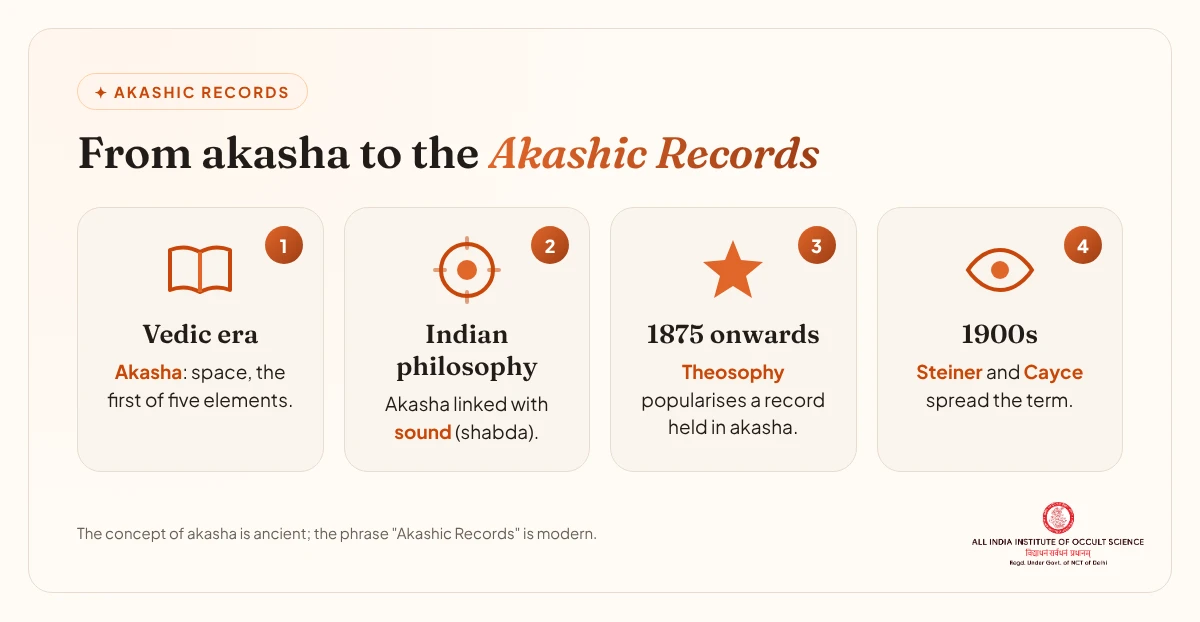
| Period | Development |
|---|---|
| Vedic and Upanishadic era | Akasha described as space or ether, the first and subtlest of the five elements |
| Classical Indian philosophy | Nyaya and Vaisheshika schools link akasha with sound; Samkhya places it among the subtle elements |
| 1875 | Theosophical Society founded in New York by Helena Blavatsky, Henry Olcott and others |
| 1880s | Theosophical writers popularise the idea of an indelible record of events held in akasha |
| Early 1900s | Rudolf Steiner publishes essays on reading the "Akasha Chronicle", later collected as Cosmic Memory |
| 1920s–1940s | Edgar Cayce refers to the "Book of Life" in thousands of readings, spreading the term in the US |
| Late 20th century onwards | Structured courses teach a prayer-and-meditation method for reading one's own Records |
This timeline shows why careful writers separate the ancient concept (akasha) from the modern practice (Akashic Records readings). Both are part of the story, but they are not the same thing.
How the Meaning Has Changed Over Time
The idea has not stayed fixed. For Theosophists in the 1880s, reading the "astral light" was an advanced ability of trained seers and adepts. Steiner presented the Akasha Chronicle as something perceived through years of inner discipline, and used it mainly to describe the distant history of humanity. Cayce, by contrast, connected the Book of Life with the personal lives and past lives of the people who came to him for readings.
In recent decades the focus has shifted again. Most modern courses present the Records as something ordinary people can learn to reflect on for their own growth, with an emphasis on consent, ethics and practical, present-day choices. Knowing this history helps readers judge claims calmly: when someone says the Records "prove" a particular story, it is fair to ask which tradition they are following and how the claim could be checked.
What Practitioners Believe the Records Hold
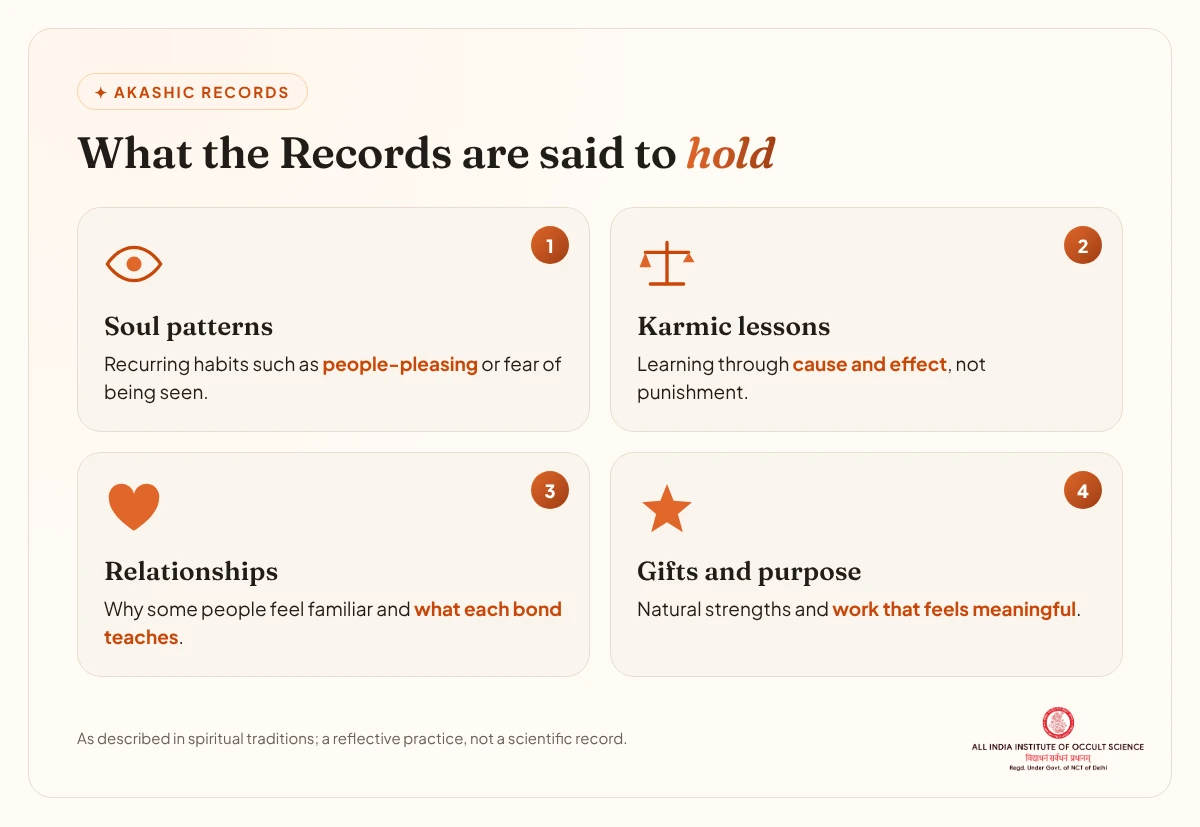
Different schools describe the Records slightly differently, but most agree on four themes:
- Soul patterns: recurring emotional and behavioural habits, such as people-pleasing or fear of being seen.
- Lessons: the learning a soul is said to be working through, often linked with the idea of karma as cause and effect, not punishment.
- Relationships: why certain people feel deeply familiar and what each relationship is teaching.
- Gifts and purpose: natural strengths and the kind of work or service that feels meaningful.
Many practitioners also speak of past lives. At the Institute we teach students to treat such impressions as symbolic stories that help the present, not as historical facts to be proved or argued about.
What Practitioners Believe a Reading Shows
A reading, as most practitioners describe it, takes place in a calm, meditative state, usually opened and closed with a prayer or clear intention. The reader asks open-ended questions and notes the words, images or feelings that arise. Practitioners believe these impressions reflect the seeker's patterns and lessons; the value of a reading is judged by the clarity it brings, not by predictions.
A short example makes this concrete. The person and situation below are invented for teaching.
Sample seeker: a 34-year-old teacher who has changed jobs four times in six years, each time after feeling "unseen" by a manager. Question: "What is the pattern behind my repeated job changes?" Impressions: an image of a child waiting to be called on in class, and the word "permission". Reading: the pattern seems to be waiting for others to recognise her before she values her own work; the practical step is to share her ideas proactively before deciding to leave.
Notice what the reading does not do: it does not name a date, promise a promotion or blame anyone. That is what practitioners consider a responsible reading.
Are the Akashic Records Real?
This is the most common question, and it deserves an honest answer. There is no scientific evidence that the Akashic Records exist as an objective record that can be read or verified. Readings cannot be tested the way a medical test or a historical document can, and two readers may describe the same person very differently.
Practitioners usually answer the question differently: they describe the Records as a spiritual reality experienced in deep meditation, and judge a reading by whether it brings clarity, compassion and better choices rather than by whether it can be proved. Both views can be held respectfully. At the Institute we encourage students to stay humble about claims, use cautious language ("what came through for me was...") and never present impressions as facts about another person's life.
How to judge a reader responsibly
If you decide to try a reading, a few simple checks help you stay safe and grounded:
- No fear: a responsible reader never tells you that something terrible will happen unless you pay for a remedy.
- No guarantees: be cautious of anyone who promises money, marriage or healing.
- Consent and privacy: the reader works only on your own Records, with your permission, and keeps what you share private.
- Space for your judgement: a good reader encourages you to question what comes through and to make your own choices.
- Respect for professional care: the reader supports, not replaces, medical, psychological, legal or financial advice.
Is an Akashic Reading a Psychic Reading?
Not in the usual sense. A typical psychic reading promises information about events, people or the future. An Akashic Records reading, as most practitioners teach it, is a guided reflection focused on the seeker's own patterns, lessons and choices. Readers are usually trained to avoid predictions, health diagnoses and questions about third parties, and to return responsibility to the seeker.
It also differs from tarot card reading, which uses a deck of 78 cards as its tool, and from astrology, which uses a chart calculated from the date, time and place of birth. Many people who explore the Records are also drawn to calming practices such as Reiki. Some readers combine methods, but each has its own logic.
Why the Idea Appeals to People Today
The Akashic Records have grown in popularity over the last few decades, especially among people interested in personal growth. Practitioners and students usually give a few reasons:
- A focus on patterns, not fate: the practice invites people to understand themselves rather than wait for predictions.
- A gentle, meditative method: it needs no cards, charts or tools, only quiet attention.
- A language for repeating experiences: it gives people words for feelings of familiarity, recurring lessons and purpose.
- Personal responsibility: a good reading always returns the choice to the seeker.
Common Myths About the Akashic Records
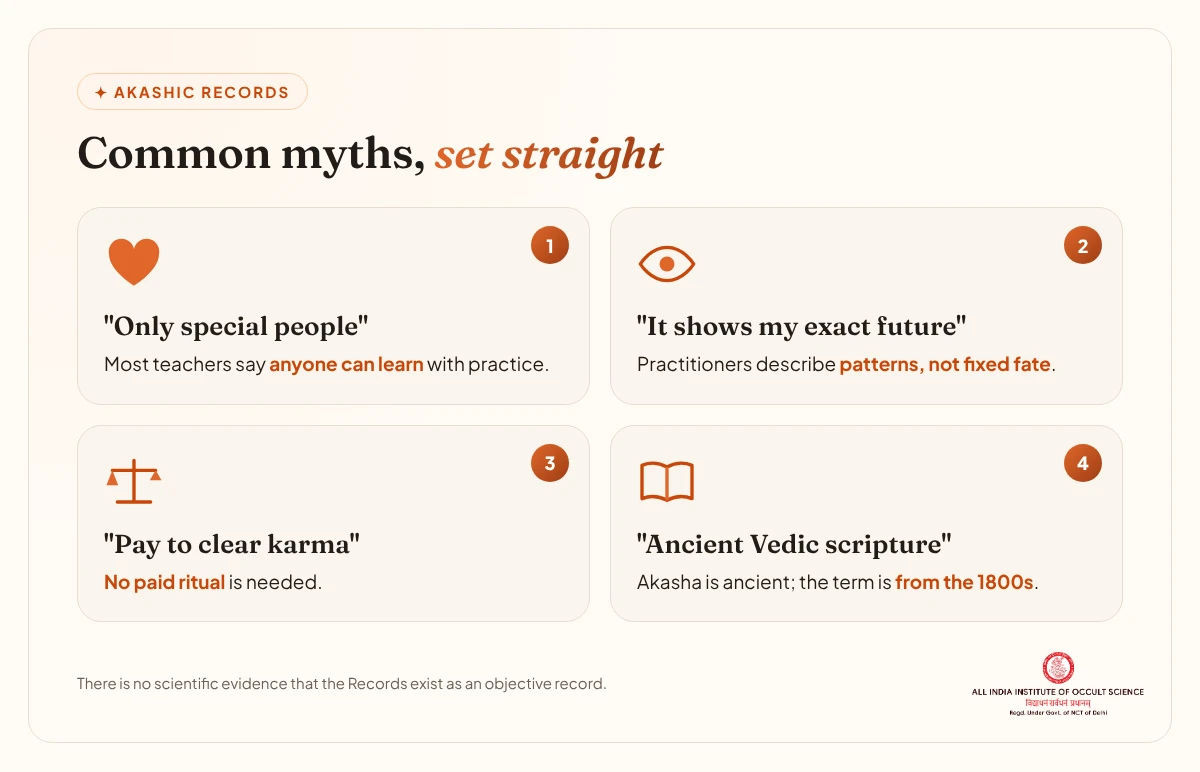
- "Only special people can access them." Most teachers say anyone with patience, practice and a calm mind can learn the basics.
- "The Records will tell me my future exactly." The Records are described as showing patterns and possibilities. Your choices still shape what happens.
- "Opening the Records is dangerous." There is no reason to fear the practice. Teachers describe it as a simple, respectful meditative routine.
- "You must pay for expensive rituals to clear your karma." No paid ritual is needed. Understanding a pattern and acting differently is the real work.
- "Past-life stories explain everything." Impressions are best treated as symbolic. They are useful when they help you act better today.
- "A reader can open anyone's Records without permission." Ethical practitioners work only with the seeker's consent and do not read for people who have not asked.
- "The Records are an ancient Vedic scripture." The concept of akasha is ancient; the phrase "Akashic Records" is a modern term from the late 1800s.
- "You must belong to a particular religion to work with the Records." Students come from many faiths and from none. Most teachers describe the practice as spiritual rather than religious.
- "Every unusual feeling during meditation is a message from the Records." Teachers encourage students to stay grounded: many impressions are simply the mind at work, which is why careful journalling and guidance matter.
- "A reading can tell you who your soulmate is." Responsible readers do not name or predict partners. A reading can help you understand your own patterns in relationships.
What the Akashic Records Can and Cannot Tell You
What a reading can do: offer a fresh perspective on repeating patterns, help you form better questions about your life, support emotional clarity and encourage responsibility for your choices.
What it cannot do: there is no scientific evidence that the Akashic Records exist as an objective record, and a reading cannot verify historical facts, diagnose illness, predict exam results or decide legal and money matters for you. If you are dealing with a health condition, anxiety or depression, please consult a qualified doctor or mental health professional; spiritual practice can sit alongside that care, never in place of it.
This honest view matches the Institute's founder Gurudev Shrie Kashyap's teaching: practice without understanding becomes superstition, while practice with understanding becomes a discipline.
How People Learn the Akashic Records
Most people start by reading about the idea, then learn a structured method from a teacher. A good course usually covers the history of the concept, meditation and grounding, the opening and closing method taught in that lineage, how to frame questions, ethics and consent, and supervised practice readings with feedback. Learning with a teacher helps students tell the difference between real insight and their own wishes or worries.
The Institute's Akashic Records course is a Diploma in Akashic Records of about 2 months, open to anyone who has passed 10th standard or equivalent. Classes are live and online through the Institute's app, in small batches of 10 to 15 students, with recordings uploaded within 4 hours and doubt-clearing in class and in the app's discussion section. A certificate is given on successful completion, including the examination.
Conclusion
The Akashic Records join an ancient Indian idea, akasha, with a modern spiritual practice shaped by Theosophy, Steiner and Cayce. Practitioners believe a reading reveals patterns and lessons, not fixed fate; science has not shown the Records to exist as an objective record. Approached honestly, the practice can be a thoughtful tool for reflection. If you would like to learn it properly, explore the Institute's Akashic Records course or book a free live demo class.
This article shares traditional spiritual knowledge about the Akashic Records for educational purposes. It is not a substitute for professional medical, psychological, legal or financial advice. Please read our disclaimer.