Written by Jyoti Chauhan, Content Writer · Reviewed by Gurudev Shrie Kashyap, Chairman & Founder, All India Institute of Occult Science · Published 14 Nov 2026
Key Takeaways
- Head line palmistry: the head line (mastishk rekha) runs across the middle of the palm and is traditionally read for thinking style, focus and decision-making.
- Read 5 features in order: start, length, slope, depth and marks (breaks, forks, islands, chains).
- A straight line is linked with practical, logical thinking; a sloping line with imagination and creative thinking.
- A joined start with the life line for about 1-2 cm is traditionally read as caution and close family ties in early life.
- The head line says nothing about intelligence, IQ or mental health, and lines can change over the years.
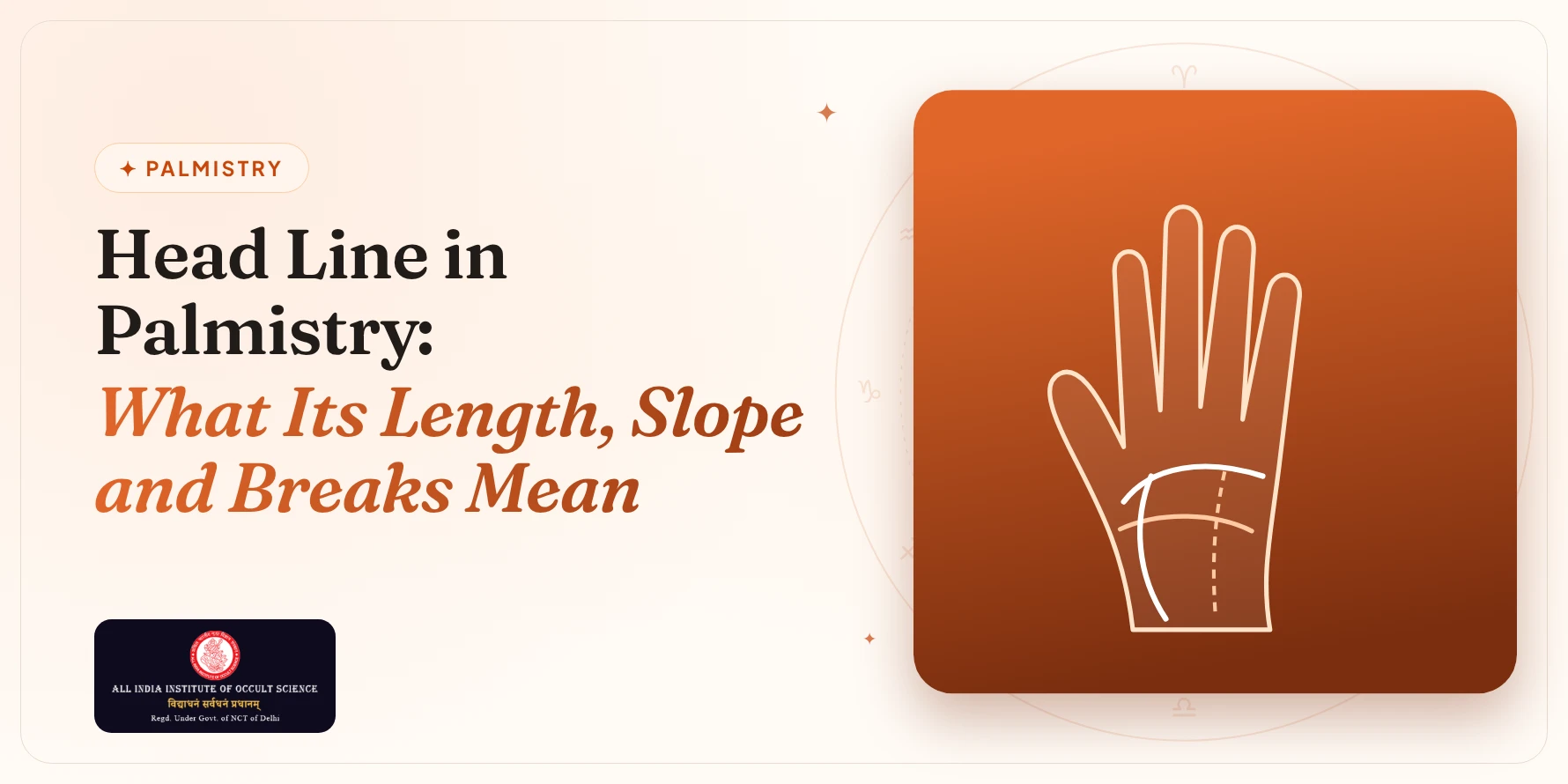
Hold your palm open under a good light and look at the line that crosses the middle of your hand, between the heart line above and the life line curving around the thumb. That is your head line, and in Indian palmistry it is called mastishk rekha, the line of the mind.
People often ask, "Does a short head line mean I'm not clever?" Classical palmistry says no such thing. The head line describes how you tend to think, not how much you can think.
This guide shows you how to find the head line, how to read its length, slope and depth, what breaks, forks and islands traditionally mean, and how to put it together with the other lines. If you are completely new to palm reading, start with our palmistry guide for beginners.
Where Is the Head Line on the Palm?
The head line usually begins on the thumb side of the palm, between the thumb and the index finger, close to the start of the life line. It runs across the palm towards the outer edge (the little-finger side), either straight or curving downwards. It sits below the heart line and above the centre of the palm.
Some hands show a single horizontal crease where the head and heart lines merge. This is called a simian line in Western palmistry, and it is read separately.
Which hand should you read? Most palmists compare both hands: the non-dominant hand for natural tendencies and the dominant hand for how they have developed. Our post on right hand vs left hand palmistry explains this in detail.
How to Read the Head Line in 5 Steps
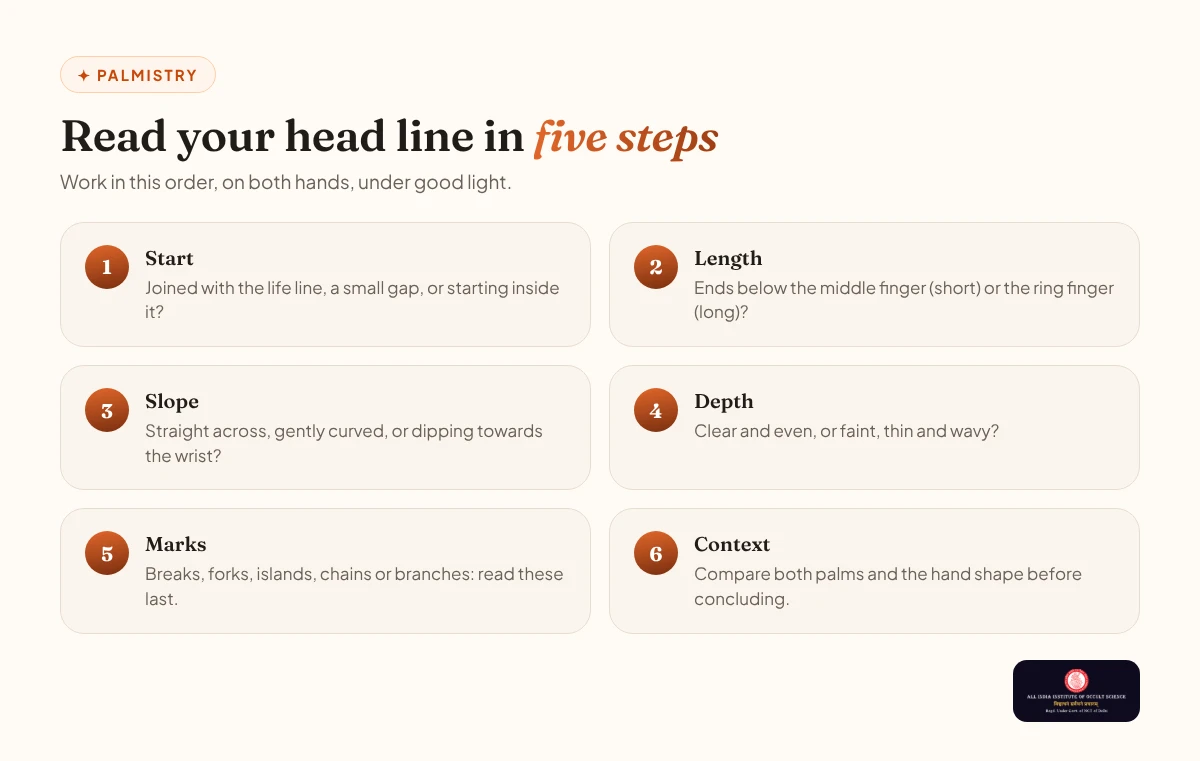
Step 1: Look at where it starts
Check whether the head line touches the life line at the start, begins just above it with a small gap, or starts lower, inside the life line on the mount of Mars.
Step 2: Measure its length
Imagine vertical lines dropping from the middle of each finger. A head line ending below the ring finger is usually called long; one ending below the middle finger is called short.
Step 3: Note the slope
Does the line run straight across, curve gently downwards, or dip steeply towards the wrist (the mount of the Moon)?
Step 4: Check depth and clarity
A clear, evenly deep line is read as steady focus. A faint, thin or wavy line is read as a mind that shifts attention easily.
Step 5: Look for marks
Finally, scan for breaks, forks, islands, chains, crosses or small branches. Read them last, and always in the context of the whole line.
Head Line Length: Long vs Short
According to Cheiro's Language of the Hand and later palmists, length shows the range of interests, not intelligence.
- Long head line: traditionally linked with thinking things through, wide interests and planning ahead. Very long lines can suggest overthinking.
- Medium head line: balanced, practical thinking.
- Short head line: linked with quick, direct decisions and a preference for action over long analysis. Many sportspeople and hands-on professionals have short, clear head lines.
Straight vs Sloping Head Line
Slope is the most talked-about feature of the head line. Here is how tradition reads the main shapes.
| Shape | How it looks | Traditional reading |
|---|---|---|
| Straight | Runs flat across the palm | Logical, practical, prefers facts and clear plans |
| Gently sloping | Curves slightly towards the wrist | Balance of logic and imagination; adaptable |
| Steeply sloping | Dips deep towards the mount of the Moon | Strong imagination, creative and emotional thinking |
| Curving up at the end | Ends rising towards the heart line | Practical choices shaped by feelings or values |
| Wavy | Moves up and down along its path | Changing interests; needs variety to stay focused |
A sloping head line is common among writers, designers and teachers, but you will find every shape in every profession. Treat these as tendencies, not job descriptions.
Where the Head Line Starts: Joined, Separate or Inside
The starting point is read together with the life line (jeevan rekha), because the two often begin together.
- Joined with the life line: the most common pattern. A short joined section is read as caution and close family influence in early life. A long joined section (well past the index finger) is read as taking longer to become independent.
- Small gap between the two: read as independence, confidence and willingness to take decisions early.
- Wide gap: read as boldness and impulsiveness, acting before planning.
- Starting inside the life line: read as sensitivity to criticism and a cautious temperament.
Breaks, Forks, Islands and Other Marks
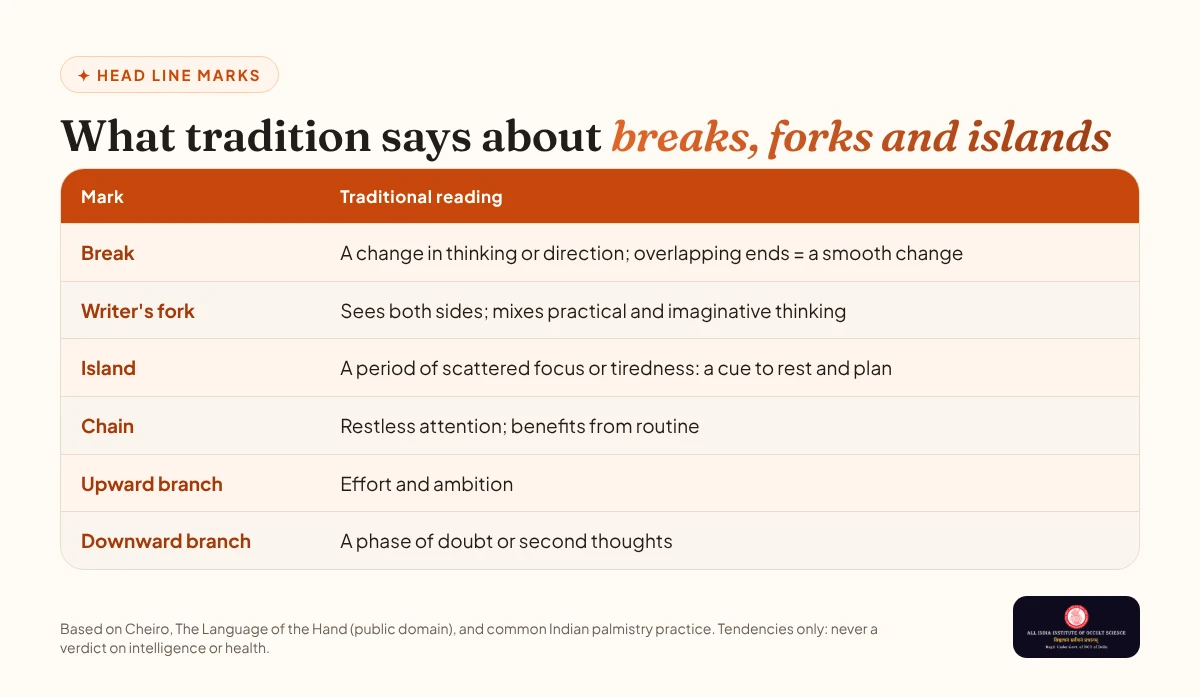
Broken head line
A break is traditionally read as a change in thinking or direction, such as a change of field, a move or a new way of looking at life. If the two ends overlap, palmists read the change as smooth and planned. A break is not a prediction of injury or illness.
Forked head line (writer's fork)
A fork at the end, with one branch straight and one sloping, is often called the writer's fork. It is linked with seeing both sides of a matter and combining practical and imaginative thinking.
Islands and chains
An island (a small oval in the line) or a chained section is read as a period of scattered focus or mental tiredness. Palmists read these as reminders to rest and plan, never as a diagnosis.
Branches
Small upward branches are read as effort and ambition; downward branches as periods of doubt. Crosses and stars on the head line are read individually by experienced palmists, often alongside the rare palm signs elsewhere on the hand.
Reading the Head Line With Hand Shape
Palmists never read a line on its own. The same head line can mean slightly different things on different hand types, which many traditions group by the four elements.
- Earth hand (square palm, short fingers): a straight head line is expected here and reads as down-to-earth common sense. A steep slope on an earth hand stands out as hidden imagination.
- Air hand (square palm, long fingers): a long, clear line fits this curious, communicative type.
- Fire hand (long palm, short fingers): a short or widely separated head line matches quick, energetic decisions.
- Water hand (long palm, long fingers): a sloping line is natural here and reads as sensitivity and imagination.
When the head line "agrees" with the hand shape, the trait is read as strong. When it contrasts, palmists describe a mix of tendencies.
Two Worked Examples (Sample Palms)
Sample palm A: a long, straight, deep head line that starts joined with the life line for about 1 cm, with no breaks. A palmist would describe a careful, logical thinker who plans ahead, values family advice early on, and stays focused once a decision is made.
Sample palm B: a medium-length head line with a small gap from the life line, sloping gently, with a writer's fork at the end and an overlapping break below the middle finger. The reading: an independent, creative thinker who changed direction at some point, smoothly, and enjoys combining ideas with practical work.
Notice that neither reading says anything about intelligence, success or health. That is the right way to read a head line.
What the Head Line Can and Cannot Tell You
| It can suggest | It cannot tell you |
|---|---|
| Thinking style: logical, creative or a mix | Your intelligence or IQ |
| How quickly or carefully you decide | Whether you have, or will have, a mental health condition |
| Periods of change or scattered focus, as tradition reads them | Exam results, career success or accidents |
Lines can also change. Palmists often notice that head lines deepen or lengthen as people learn new skills, which is why the dominant hand is re-read every few years.
How to Learn Palmistry Properly
Reading one line from a chart is easy. Reading a whole hand well means comparing both palms, hand shape, finger length, mounts and all the major lines together, then practising on many hands. The All India Institute of Occult Science teaches this in its palmistry course through live online classes in small batches, with recordings and doubt-solving in the app.
Conclusion
The head line is the palm's map of how you think: its start, length, slope, depth and marks describe tendencies, not limits. Read all five features together, compare both hands, and never treat a single mark as a verdict. If you would like to read whole hands with confidence, explore the Institute's palmistry course and learn the method step by step with a teacher.
This article shares traditional palmistry knowledge for educational purposes. It is not a substitute for professional medical or psychological advice. Please read our disclaimer.