Written by Jyoti Chauhan, Content Writer · Reviewed by Gurudev Shrie Kashyap, Chairman & Founder, All India Institute of Occult Science · Published 16 Nov 2026
Key Takeaways
- To find your lucky number by date of birth, add the digits of your birth day and reduce to a single digit (1-9); this is your mulank, the number most Indian numerologists treat as your main lucky number.
- Your bhagyank (destiny number), from the full date of birth, is often used as a second lucky number.
- Each number 1-9 is ruled by a graha, and its "friendly numbers" follow the traditional friendships between planets.
- Example: sample DOB 14-08-1992 gives mulank 5 and bhagyank 7.
- Lucky numbers are a traditional tool for choosing dates and preferences, not a guarantee of luck, and should never guide gambling or investments.
Someone in every family has a "lucky number". Your uncle insists on 7 for his car number, your cousin picked a wedding date that added up to 1, and your friend will only sit in seat 9 at the cinema. Where do these numbers come from?
In Indian numerology (ank jyotish), your lucky number is worked out from your date of birth. The calculation takes less than a minute.
This guide shows you how to calculate your lucky number in two steps, how it differs from your destiny number, which numbers are traditionally friendly to yours, and how lucky numbers are actually used. You can also check the result instantly in the free numerology calculator.
What Is a Lucky Number in Numerology?
A lucky number is the number that a numerology tradition considers most in harmony with you, based on your date of birth. In Indian practice this is usually the mulank (also called the psychic or birth number), worked out from the day of the month you were born. Numbers that are "friendly" to it are treated as supportive too.
Numerology links each number from 1 to 9 with a planet, an idea found in both Indian practice and Western writers such as Cheiro, whose Book of Numbers (1926) popularised the system worldwide. For an overview of the field, see our complete guide to numerology and Britannica's entry on numerology.
How to Find Your Lucky Number by Date of Birth
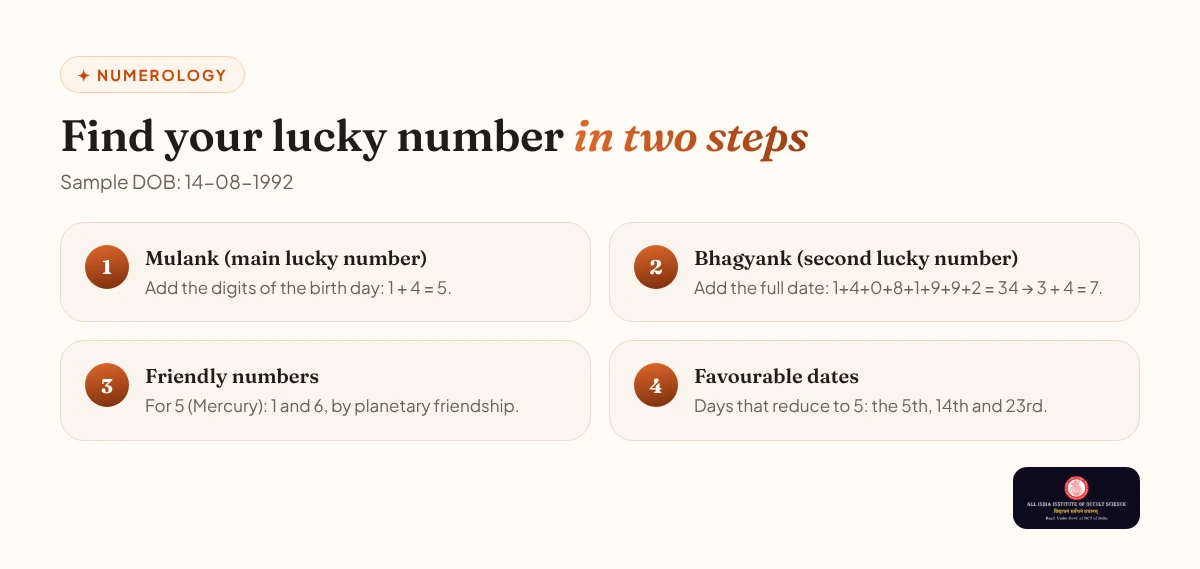
Step 1: Calculate your mulank (main lucky number)
Take only the day of your birth and add its digits until you get a single digit.
- Born on the 7th: mulank 7.
- Born on the 14th: 1 + 4 = 5.
- Born on the 29th: 2 + 9 = 11, then 1 + 1 = 2.
Step 2: Calculate your bhagyank (second lucky number)
Add every digit of your full date of birth and reduce to a single digit. Some numerologists keep 11 and 22 as master numbers; our guide to master numbers explains when.
Worked example (sample DOB: 14-08-1992)
- Mulank: 1 + 4 = 5
- Bhagyank: 1 + 4 + 0 + 8 + 1 + 9 + 9 + 2 = 34, then 3 + 4 = 7
- Friendly numbers for 5: 1 and 6 (see the table below)
So for this sample date, 5 is the main lucky number, 7 a strong second, and 1 and 6 are supportive. Dates such as the 5th, 14th and 23rd of a month (all reducing to 5) would be considered favourable in this tradition.
Lucky Number vs Mulank vs Bhagyank
| Term | Calculated from | Traditionally describes | Used as lucky number? |
|---|---|---|---|
| Mulank (birth / psychic number) | Day of birth only | Personality, how you see yourself | Yes, usually the main one |
| Bhagyank (destiny / life path) | Full date of birth | Life direction and opportunities | Often as a second lucky number |
| Name number | Letters of your name | How others see you | Checked for harmony with the two above |
Different schools weigh these differently. Most agree that a number shared by your mulank and bhagyank, or friendly to both, is especially supportive for you.
Numbers 1 to 9: Planets, Traits and Friendly Numbers
Friendly numbers follow the natural friendships between the grahas described in Vedic astrology. Rahu (4) and Ketu (7) are not covered by the classical friendship lists, so numerologists differ on them; Cheiro, for example, pairs 4 with 1 and 7 with 2.
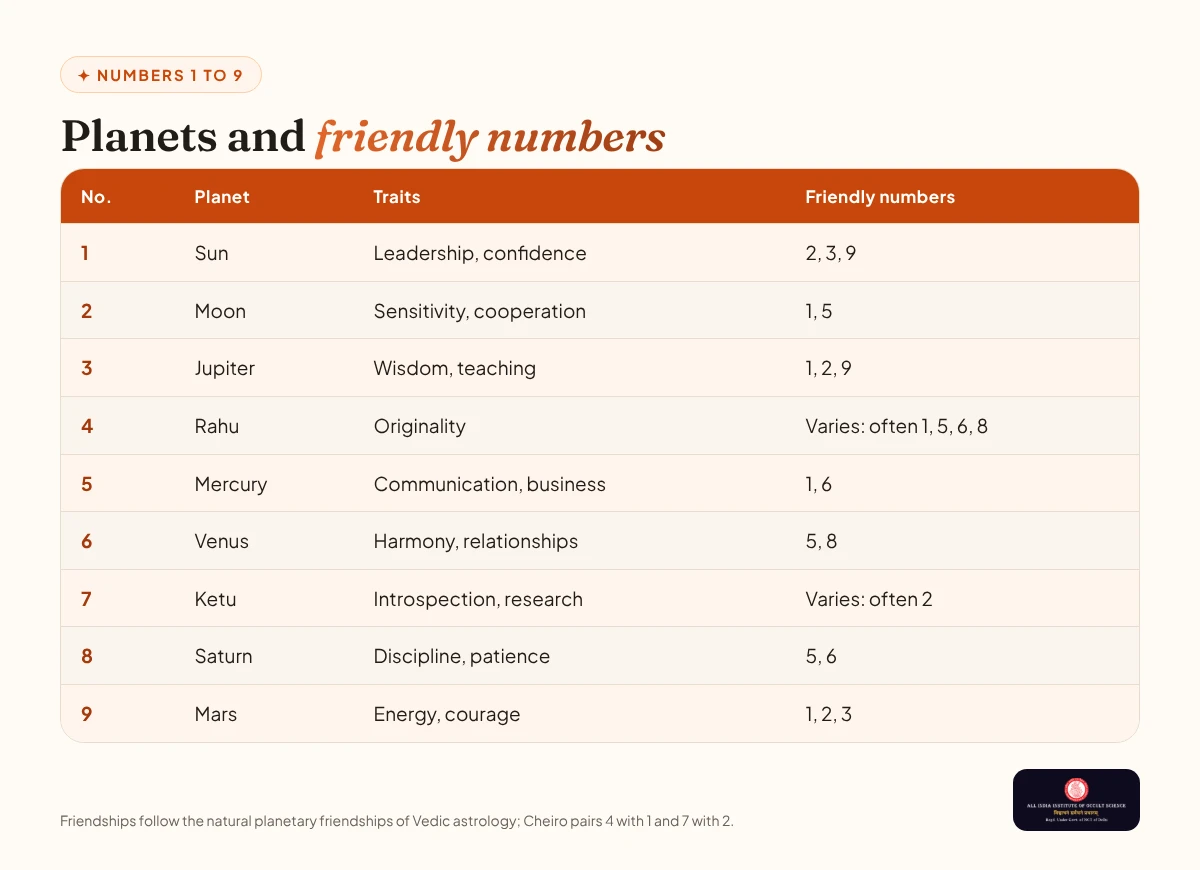
| Number | Planet | Traditional traits | Friendly numbers |
|---|---|---|---|
| 1 | Sun (Surya) | Leadership, confidence, independence | 2, 3, 9 (and 4 in Cheiro's system) |
| 2 | Moon (Chandra) | Sensitivity, cooperation, imagination | 1, 5 (and 7 in Cheiro's system) |
| 3 | Jupiter (Guru) | Wisdom, teaching, optimism | 1, 2, 9 |
| 4 | Rahu | Originality, unconventional thinking | Traditions differ: often 1, 5, 6, 8 |
| 5 | Mercury (Budh) | Communication, quick thinking, business | 1, 6 |
| 6 | Venus (Shukra) | Beauty, harmony, relationships | 5, 8 |
| 7 | Ketu | Introspection, research, spirituality | Traditions differ: often 2 |
| 8 | Saturn (Shani) | Discipline, patience, hard work | 5, 6 |
| 9 | Mars (Mangal) | Energy, courage, drive | 1, 2, 3 |
For a fuller description of each number, read our guide on the meaning of numbers 1 to 9.
Lucky Days and Colours Linked With Each Number
Because each number is tied to a planet, numerologists also link it with that planet's weekday and colours. These links come from the planetary rulers of the days of the week, so they are fairly consistent across schools, except for 4 and 7, where practice varies.
| Number | Day commonly linked | Colours commonly linked |
|---|---|---|
| 1 | Sunday | Gold, orange, yellow |
| 2 | Monday | White, cream, silver |
| 3 | Thursday | Yellow, saffron |
| 4 | Varies (often Saturday or Sunday) | Grey, smoky blue |
| 5 | Wednesday | Green |
| 6 | Friday | White, pink, light blue |
| 7 | Varies (often Monday) | Light green, mixed shades |
| 8 | Saturday | Dark blue, black |
| 9 | Tuesday | Red, coral |
For our sample DOB (mulank 5), Wednesday and green would be the traditional pairing. Many people enjoy using these as gentle personal touches, such as starting a new course on a Wednesday. They are preferences, not rules.
How People Use Lucky Numbers
In everyday practice, lucky numbers are used for small choices where any option would do, so people prefer the one that feels harmonious:
- Choosing dates: picking a day of the month that reduces to your lucky number for a celebration, a move or starting a new habit.
- Homes and vehicles: preferring a house, flat or vehicle number that matches or is friendly to yours. Our guide to house number numerology covers homes in detail.
- Phone numbers: some people choose a mobile number whose total matches their lucky number; the mobile number numerology calculator checks this for you.
- Personal symbols: a favourite number for a jersey, a password hint or a signature style.
Can You Have More Than One Lucky Number?
Yes. Most people have a main lucky number (the mulank), a second one (the bhagyank) and one or more friendly numbers. When the mulank and bhagyank are the same, or friendly, numerologists see that number as particularly strong. When they conflict, for example 1 and 8, which are not traditional friends, numerologists usually favour numbers friendly to both, such as 5 or 6 if they fit.
Common Mistakes When Calculating Your Lucky Number
- Using the wrong date: use your actual date of birth in the Gregorian calendar, not a later registration date.
- Stopping at two digits: always reduce to 1-9 (unless you are deliberately working with master numbers).
- Mixing up mulank and bhagyank: the first uses the day only; the second uses the full date.
- Treating one source as final: friendship tables for 4 and 7 vary by school, so expect small differences between books and calculators.
What a Lucky Number Can and Cannot Do
| It can | It cannot |
|---|---|
| Give a traditional, personal way to choose between equal options | Guarantee luck, success or protection |
| Prompt reflection on your traits and strengths | Predict lottery, betting or market results |
| Add meaning to dates and personal choices | Replace careful decisions about money, health or relationships |
Please do not use lucky numbers for gambling, lotteries or investments. No numerology tradition can predict those outcomes.
How to Learn Numerology Properly
Calculating a lucky number is the first step. Reading the full picture means combining the mulank, bhagyank, name number, Lo Shu grid and personal year. The Institute's numerology course runs as a Diploma in Numerology (about 2 months) and a Master in Numerology (about 4 months), taught live online in small batches.
Conclusion
Your lucky number by date of birth is simply your mulank: the digits of your birth day added down to one number, with your bhagyank and friendly numbers as support. Use it for small, happy choices, and remember it is a tradition to enjoy, not a promise. Want to see your mulank, bhagyank and name number together? Enter your details in the free numerology calculator.
This article shares traditional numerology knowledge for educational purposes. It is not a substitute for professional financial, legal or medical advice. Please read our disclaimer.