Written by Gurudev Shrie Kashyap, Chairman & Founder, All India Institute of Occult Science · Published 14 Nov 2026
Key Takeaways
- Nadi dosha is said to occur in kundli matching when the bride and groom share the same nadi; that koota then scores 0 out of 8 points.
- There are 3 nadis (Adi, Madhya and Antya), and each of the 27 nakshatras belongs to one of them, so roughly 1 couple in 3 shares a nadi by chance.
- Classical matching texts list exceptions: the same rashi with different nakshatras, the same nakshatra with different rashis, or the same nakshatra with different padas.
- Nadi is 1 of 8 kootas (36 points in total). A full reading looks at both charts, not one score.
- No classical rule says a marriage "will fail" because of Nadi dosha, and fear-driven remedies are not needed.
The wedding date is almost fixed, the families get along, and then someone reads out the matching report: "Nadi dosha hai." Suddenly the mood in the room changes. Aunties start whispering, and someone suggests an expensive puja before anyone has even understood the term.
I have seen this scene many times in more than 30 years of practice. In most cases, the worry comes from half-information. Nadi dosha is a real part of traditional kundli matching, but it is also one of the most misunderstood.
This guide explains what the Nadi koota measures, how to check it step by step, the cancellation rules that classical texts describe, and the myths that cause needless fear.
What Is Nadi Dosha?
Nadi dosha is a mismatch flagged in Ashtakoot (eight-fold) kundli matching when both partners' Moon nakshatras belong to the same nadi. The Nadi koota carries 8 points, the highest of all eight kootas. Different nadis score 8; the same nadi scores 0, and that zero is called Nadi dosha.
The word nadi literally means a channel or pulse. In Ayurveda, the three nadis are linked with the three doshas (constitutions): Vata, Pitta and Kapha. Matching texts use this idea to describe temperament and physical constitution. So, at its heart, Nadi koota is a traditional way of asking whether two people's natures balance each other.
If you are new to the building blocks here, our guide on what astrology is explains rashis, nakshatras and the Moon's role in a chart.
The Three Nadis and Their Nakshatras
Every one of the 27 nakshatras is assigned to one nadi in a repeating pattern. Here is the standard list used in North and South Indian matching.
| Nadi | Linked dosha | Nakshatras |
|---|---|---|
| Adi (first) | Vata | Ashwini, Ardra, Punarvasu, Uttara Phalguni, Hasta, Jyeshtha, Mula, Shatabhisha, Purva Bhadrapada |
| Madhya (middle) | Pitta | Bharani, Mrigashira, Pushya, Purva Phalguni, Chitra, Anuradha, Purva Ashadha, Dhanishta, Uttara Bhadrapada |
| Antya (last) | Kapha | Krittika, Rohini, Ashlesha, Magha, Swati, Vishakha, Uttara Ashadha, Shravana, Revati |
Because each nadi holds 9 of the 27 nakshatras, about one in three random pairs will share a nadi. That alone tells you Nadi dosha is common, not a rare curse.
How to Check Nadi Dosha Step by Step
You can check the Nadi koota yourself in a few minutes. You need both partners' birth date, exact time and place.
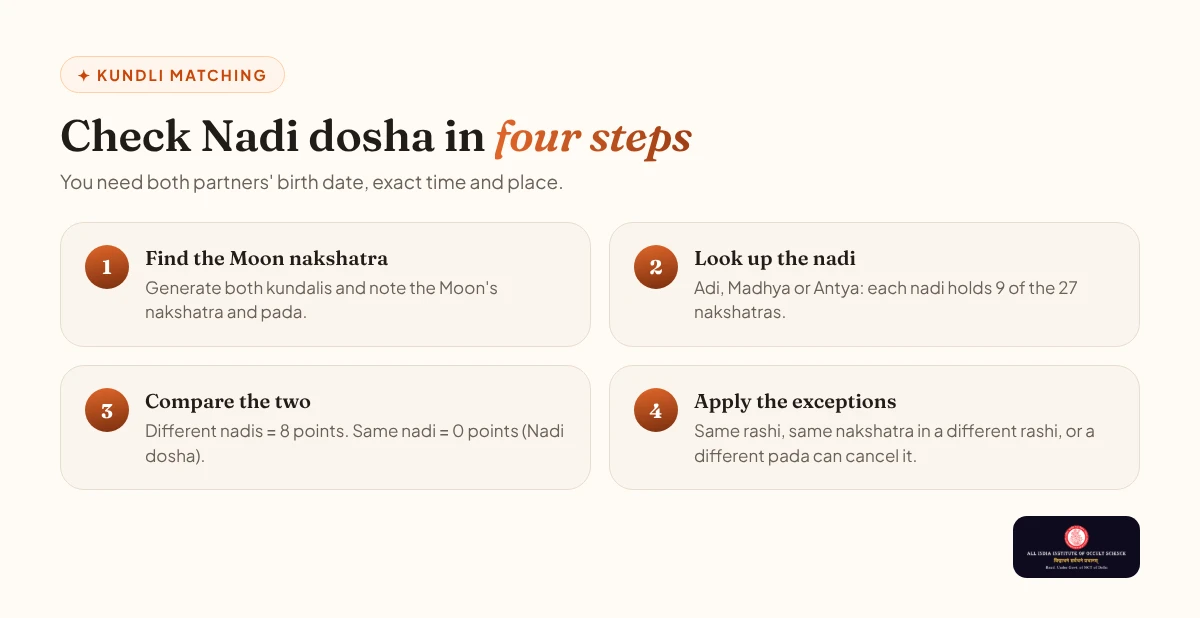
Step 1: Find each person's Moon nakshatra
Generate both birth charts with a free kundali tool and note the nakshatra and pada (quarter) of the Moon. Our guide on how to read your kundali shows where this appears.
Step 2: Look up the nadi of each nakshatra
Use the table above. Write down Adi, Madhya or Antya for each partner.
Step 3: Compare
Different nadis: 8 points, no Nadi dosha. Same nadi: 0 points, and Nadi dosha is flagged.
Step 4: Check the exceptions before concluding anything
If the nadi is the same, go through the cancellation rules in the next section. Many "doshas" disappear here.
A worked example (sample data)
Sample partner A: Moon in Rohini, pada 2, in Taurus (Vrishabha). Sample partner B: Moon in Krittika, pada 3, in Taurus. Rohini and Krittika are both Antya nadi, so the Nadi koota scores 0. But both Moons are in the same rashi (Taurus) with different nakshatras, which is one of the classical exceptions. A careful astrologer would note the dosha as cancelled and move on to the rest of the matching.
Nadi Dosha Cancellation Rules (Exceptions)
Texts on muhurta and matching, especially the Muhurta Chintamani and the commentaries that follow it, list conditions under which Nadi dosha is not considered harmful. Different schools weigh them a little differently, but these are the ones most practitioners apply.
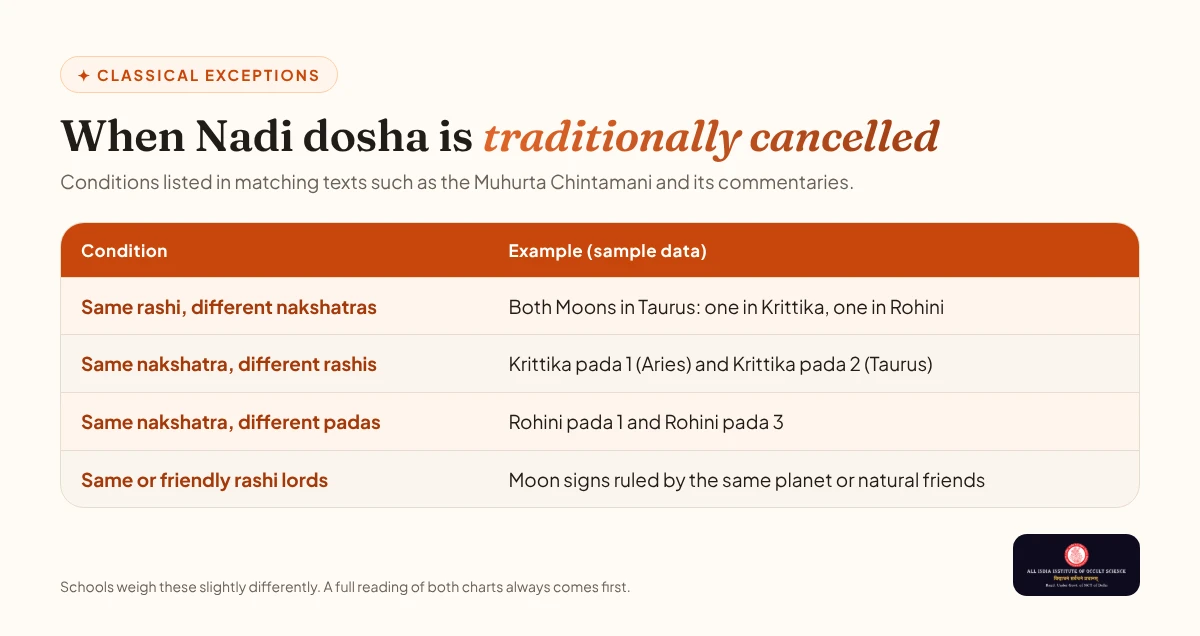
- Same rashi, different nakshatras: both Moons in one sign but in different nakshatras.
- Same nakshatra, different rashis: possible for nakshatras that span two signs, such as Krittika, Mrigashira, Punarvasu, Uttara Phalguni, Chitra, Vishakha, Uttara Ashadha, Dhanishta and Purva Bhadrapada.
- Same nakshatra, different padas: both Moons in one nakshatra but in different quarters.
- Same or friendly rashi lords: many practitioners also relax the dosha when the Moon-sign lords are the same planet or natural friends, especially when the total score is good.
Some regional traditions add further points, such as the strength of Jupiter or the seventh house in each chart. The principle is the same everywhere: one koota is never read in isolation.
How Much Does Nadi Koota Really Weigh?
Ashtakoot matching has eight kootas: Varna (1 point), Vashya (2), Tara (3), Yoni (4), Graha Maitri (5), Bhakoot (7), Gana (6) and Nadi (8), for a total of 36. The kundli matching tool explains each one and what a "good score" means.
Nadi carries the most points, which is why it attracts the most attention. But Guna Milan only compares the two Moons. It does not look at the seventh house, Venus, the dasha periods running for each partner, or Mangal dosha (which you can check with the free Mangal dosha calculator). A complete compatibility reading weighs all of these together, along with the couple's own values and choices.
Nadi, Bhakoot and Gana: The Three Kootas Families Worry About
Three kootas cause most of the anxiety in matching reports. Seeing them side by side helps you keep each one in proportion.
| Koota | Points | What it traditionally compares | Flagged when |
|---|---|---|---|
| Nadi | 8 | Constitution and temperament (Vata, Pitta, Kapha) | Both Moons in the same nadi |
| Bhakoot | 7 | Relative position of the two Moon signs | Signs placed 2-12, 5-9 or 6-8 from each other |
| Gana | 6 | Nature: Deva, Manushya or Rakshasa gana | Certain gana pairs, especially Deva-Rakshasa |
Each of these has its own exceptions, and each looks only at the Moon. When a family asks me about a low score, I first check which koota caused it, then whether an exception applies, and only then read both charts as a whole.
Common Myths About Nadi Dosha
Myth 1: "Same nadi means the marriage will fail."
No classical text makes such a blanket statement, and the texts themselves list exceptions. Countless couples with the same nadi live happy married lives.
Myth 2: "Nadi dosha harms children's health."
Some popular writing links the Nadi koota with progeny. This is a traditional association about temperament and constitution, not a medical finding. Questions about fertility or a baby's health belong with a qualified doctor.
Myth 3: "Only a costly puja can fix it."
Traditional remedies mentioned for Nadi dosha are simple: prayer, charity and mantra recitation such as the Mahamrityunjaya mantra. No one needs to spend large sums out of fear.
Myth 4: "If the online score shows 0 for Nadi, the match is rejected."
Software shows the raw koota score. It often does not apply the cancellation rules or the wider chart reading. Treat the number as the start of a conversation, not the verdict.
What Nadi Matching Can and Cannot Tell You
| It can | It cannot |
|---|---|
| Show how two Moon nakshatras relate in a traditional framework | Predict divorce, illness or a child's health |
| Prompt a fuller look at both charts | Replace mutual respect, communication and shared values |
| Highlight temperament differences worth discussing | Decide a marriage on its own |
As I often tell students, planets show the terrain; people still choose the path. A remedy without understanding is superstition. With understanding, it becomes a tool for reflection.
How to Learn Kundli Matching Properly
Matching looks simple on a calculator, but reading it well needs practice: knowing the nakshatras by heart, applying exceptions, and seeing how the seventh house, Venus and dashas change the picture. At the All India Institute of Occult Science, kundli matching is part of the astrology course, taught in live online classes in small batches, with class recordings and doubt-solving in the app.
Conclusion
Nadi dosha is a common result in kundli matching, not a sentence. It means both Moons fall in the same nadi, and classical texts themselves describe several situations where it is cancelled. Before anyone panics, check the nakshatras, padas and rashis, then look at the whole chart. Want to see how your two charts compare? Enter both birth details in the free kundli matching tool and read the full koota breakdown.
This article shares traditional astrology knowledge for educational purposes. It is not a substitute for professional medical, legal or financial advice. Please read our disclaimer.