Written by Jyoti Chauhan, Content Writer · Reviewed by Gurudev Shrie Kashyap, Chairman & Founder, All India Institute of Occult Science · Published 12 Nov 2026
Key Takeaways
- A north-facing house in Vastu is one whose main entrance faces north as you step out; it is traditionally one of the most favoured orientations.
- North is the direction of Kubera, linked in Vastu with opportunities and prosperity, so the north side is ideally kept open, light and uncluttered.
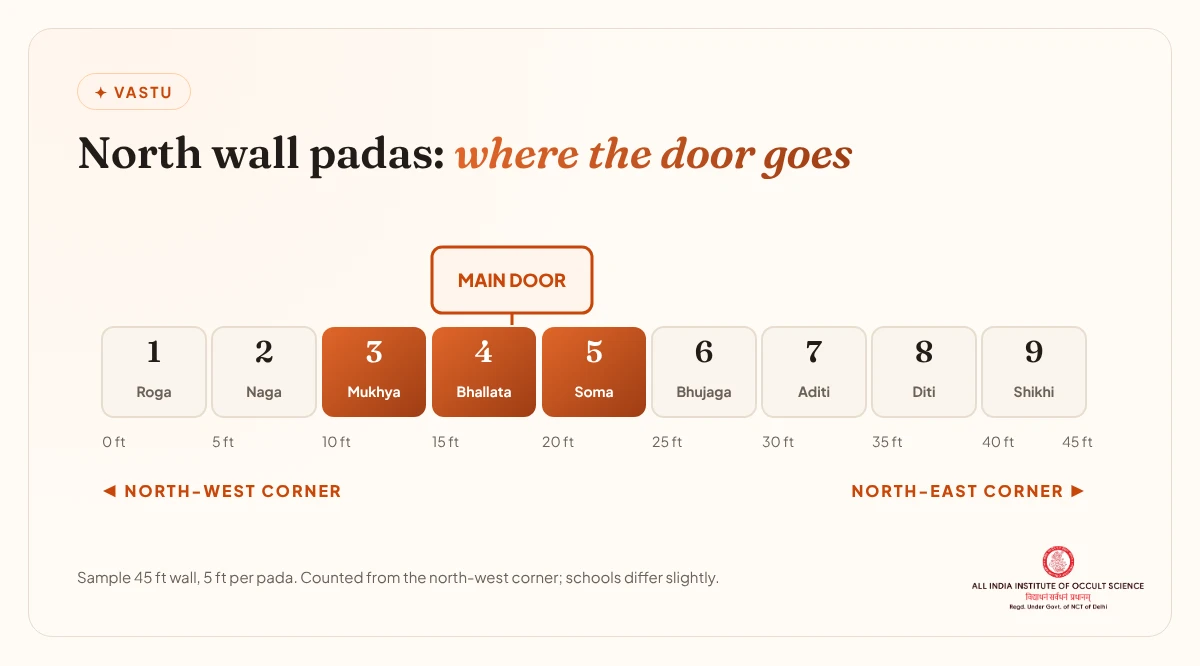
- On the north wall, the 3rd, 4th and 5th padas counted from the north-west corner (Mukhya, Bhallata, Soma) are commonly recommended for the main door.
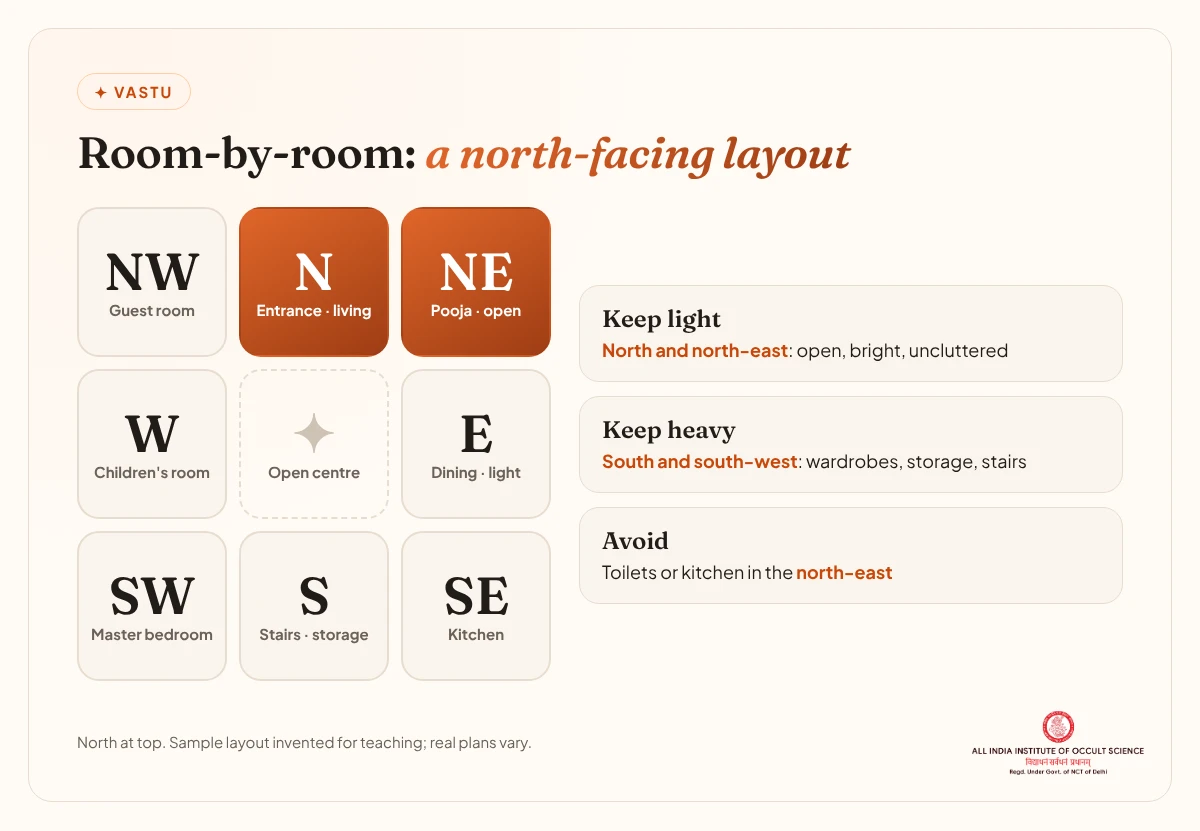
- Typical layout: kitchen in the south-east, master bedroom in the south-west, pooja space in the north-east, living room towards the north or north-east.
- Most corrections are simple and non-structural; no demolition or expensive product is needed.
You have found a flat you love. The light is good, the price is fair, and then someone in the family asks the inevitable question: "Is it north-facing?" When the answer is yes, the mood usually lifts. North-facing homes have an excellent reputation in Vastu, but a good facing is only the starting point. Where the door sits on the wall and how the rooms are arranged matter just as much.
This guide explains why north-facing homes are favoured, how to confirm your home really faces north, the best entrance zones, a room-by-room layout with a sample plan, tips for flats, common myths and simple fixes.
What Is a North-Facing House in Vastu?
A house is north-facing when you look towards the north as you step out of its main door. The facing is decided by the main entrance, not by the road, the balcony or the direction your windows face. In an apartment, it is your flat's own entrance door that counts.
To check, stand inside at the main door facing out and read a calibrated compass held flat, away from metal grills and electrical boards. A reading between about 337° and 22° is usually treated as north-facing; readings near 45° are closer to north-east.
Why North-Facing Houses Are Considered Good
In Vastu Shastra, each direction has a presiding deity and an element. North is ruled by Kubera, the guardian of wealth, and is associated with the water element, opportunities and steady growth. Classical architectural texts such as the Mayamata and the Manasara, in its chapters on ground plans (chapter 7), dwelling houses (chapter 36) and doorways (chapter 38), give detailed rules for laying out buildings around the Vastu Purusha Mandala, with lighter, open zones in the north and east and heavier zones in the south and west.
Practically, in India a north-facing entrance receives soft, indirect light through the day and avoids the harsh afternoon sun on the front of the house. That is one reason the tradition and everyday comfort often agree. For the wider principles, see our guide to Vastu Shastra: meaning, history and principles.
Best Main Entrance Position on the North Wall
Vastu divides each side of a plot into nine equal parts (padas), counted from the corner. On the north side, counting from the north-west corner towards the north-east, the padas are commonly named:
| Pada (from NW) | Name | Common view for a main door |
|---|---|---|
| 1 | Roga | Usually avoided |
| 2 | Naga | Usually avoided |
| 3 | Mukhya | Recommended |
| 4 | Bhallata | Recommended |
| 5 | Soma (Kubera) | Recommended |
| 6 | Bhujaga | Mixed views |
| 7 | Aditi | Mixed views |
| 8 | Diti | Mixed views |
| 9 | Shikhi (north-east corner) | Corner usually kept clear |
Worked example (sample house, invented for teaching): the north wall is 45 feet wide. 45 ÷ 9 = 5 feet per pada. Counting from the north-west corner, Mukhya is 10–15 ft, Bhallata 15–20 ft and Soma 20–25 ft. A 4-foot door starting about 15 feet from the north-west corner sits comfortably in the recommended zone. Different schools count and weigh padas slightly differently, so confirm with a trained consultant before construction.
Room-by-Room Layout for a North-Facing House
Here is the layout most commonly recommended by Vastu practitioners for a north-facing home. Use it as a guide, not a rigid rule.
| Room | Preferred zone | Alternative | Avoid if possible |
|---|---|---|---|
| Main entrance | North (Mukhya, Bhallata, Soma) | North-east part of north wall | North-west corner |
| Living room | North or north-east | East | South-west |
| Kitchen | South-east (agneya) | North-west | North-east |
| Master bedroom | South-west (nairitya) | South | North-east |
| Children's bedroom | West | North-west | South-east |
| Guest bedroom | North-west (vayavya) | West | South-west |
| Pooja space | North-east (ishaan) | East | Under a staircase, next to a toilet |
| Toilets and bathrooms | West or north-west | South (not corner) | North-east, centre |
| Staircase | South, west or south-west | — | North-east, centre |
| Centre (Brahmasthan) | Open and light | — | Pillars, toilets, heavy furniture |
Entrance and living room
With the door on the north wall, the living room naturally falls in the north or north-east, which suits its role as the open, welcoming part of the home. Keep this area bright and avoid heavy cupboards against the north wall.
Kitchen
The south-east is the zone of Agni (fire), so it is the traditional first choice for the kitchen; the north-west is the accepted alternative. Many consultants suggest the cook faces east while cooking. Avoid placing the kitchen in the north-east.
Bedrooms
The south-west is the zone of stability and is preferred for the master bedroom, with the bed's head towards the south or east. Children's rooms work well in the west or north-west; guest rooms in the north-west.
Pooja space
The north-east (ishaan) corner is the most sacred zone in Vastu and the traditional place for prayer or meditation. Keep it clean, light and free of heavy objects.
Water and utilities
Underground water tanks or borewells are traditionally placed in the north or north-east; overhead tanks in the south-west, the heaviest zone. Keep inverters and heavy machinery towards the south-east or south.
Plot, Garden and Exterior Tips
For an independent north-facing house, the outside of the home matters too. Vastu practitioners commonly suggest:
- More open space in the north and east: leave a larger setback, garden or courtyard on the north side than on the south.
- Slope and drainage: the plot ideally slopes gently towards the north or north-east, so rainwater flows that way.
- Boundary walls: walls on the south and west are traditionally higher and thicker than those on the north and east.
- Trees: tall, heavy trees are better in the south and west; small plants, lawns and flowering shrubs suit the north and east.
- Parking: a car porch works well in the north-west or south-east; avoid blocking the north-east corner.
- Gate: the compound gate is ideally in line with or near the main door's recommended zone on the north side.
Colours for a North-Facing Home
Colour is one of the easiest changes. Many Vastu consultants link the north with water and recommend light, cool colours there: light green, pale blue, cream or off-white. Earthy tones such as beige, light brown and peach suit the south-west bedroom, while warm shades like light orange or soft pink can be used in a south-east kitchen. Keep very dark colours away from the north and north-east, which should feel bright and open. These are suggestions, not rules: choose colours your family will enjoy living with.
A Sample Layout, Described Zone by Zone
The plan below is invented for teaching: a 30 × 45 ft north-facing independent house, divided into nine zones.
- North-east: pooja corner and a small sit-out with large windows.
- North (centre): main door in the Bhallata pada, opening into the living room.
- North-west: guest bedroom with an attached bathroom on its west side.
- East: dining area, bright with morning light.
- Centre: open passage connecting all rooms, kept free of furniture.
- West: children's bedroom and study.
- South-east: kitchen, with the stove on the east side of the platform.
- South: staircase and storage.
- South-west: master bedroom with heavy wardrobes on the south and west walls.
Real plans rarely fit perfectly; the aim is to get the most important zones (entrance, kitchen, master bedroom, north-east) right and keep the rest practical.
North-Facing Flats and Apartments
A north-facing flat follows the same principles, but you usually cannot move walls. Focus on what you can control:
- Judge facing by your flat's own door, not the building gate.
- Keep the entrance corridor clean, well lit and free of shoe piles.
- Use rooms according to the table above where you have a choice (for example, which bedroom the parents use).
- Keep the north side of the flat lighter: open shelves, light colours and fewer heavy items.
Builder layouts rarely match every rule. That is normal and is no reason to reject a good home.
Common Myths About North-Facing Houses
- "Every north-facing house is automatically lucky." The door position and room layout matter. A north-facing door in the north-west corner is not ideal.
- "Only north- and east-facing homes are good." Vastu gives good entrance zones on every side, including south and west.
- "A wrong room must be demolished." Most consultants first recommend changes in use, lighting, colour and arrangement.
- "You need a costly yantra or pyramid." No expensive product is required. Be cautious of fear-based selling.
Simple Fixes Without Demolition
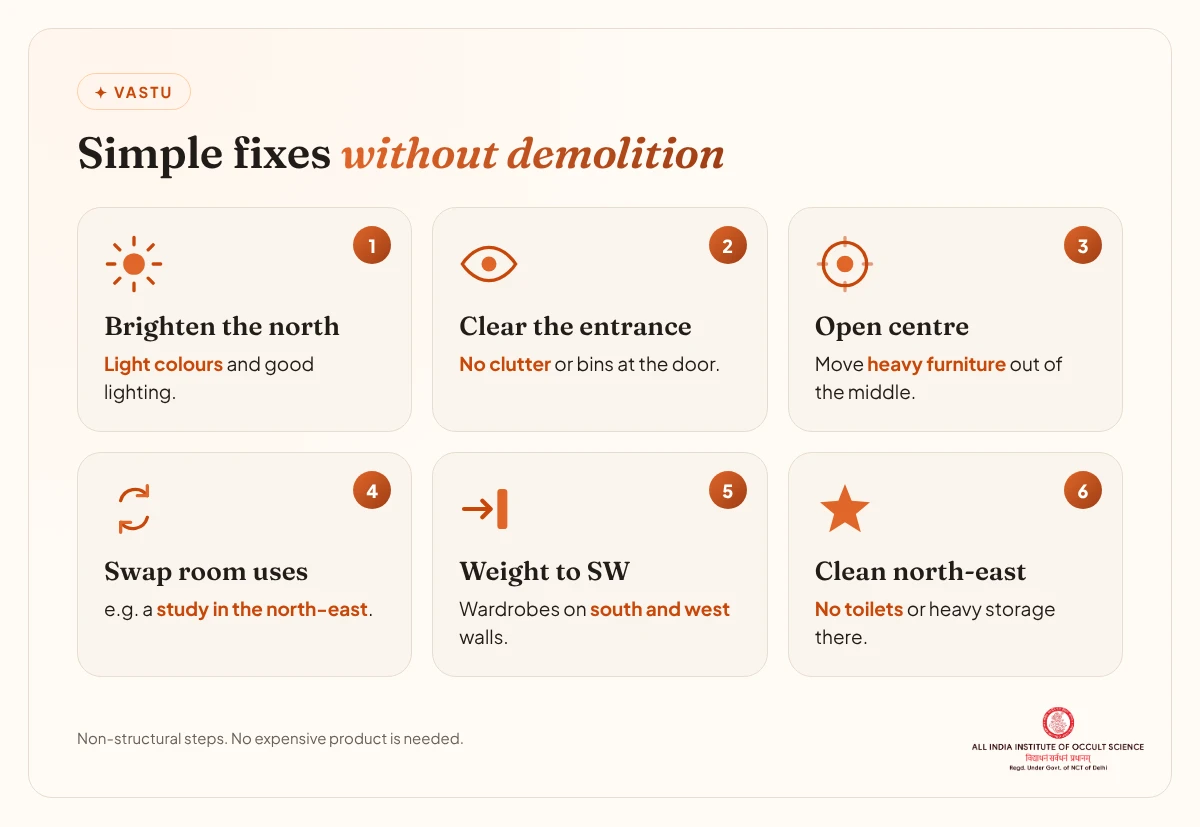
- Brighten the north: good lighting and light-coloured walls on the north side.
- Clear the entrance: no clutter, broken items or dustbins at the main door.
- Keep the centre open: move heavy furniture away from the middle of the home.
- Use rooms wisely: swap room uses where possible, such as moving a study to the north-east.
- Weight to the south-west: place heavy wardrobes and storage on south and west walls.
- Keep the north-east clean: no toilets, heavy storage or dustbins in that corner.
What Vastu Can and Cannot Do for Your Home
It can: help you plan a home that is bright, well ventilated and easy to live in, in line with a long Indian architectural tradition.
It cannot: guarantee wealth, health or success. Vastu's effects on luck have not been scientifically proven. For any structural change, always work with a qualified architect or structural engineer alongside Vastu advice.
How to Learn Vastu Properly
Reading a real floor plan means finding the true centre, marking the 16 zones, dividing walls into padas and balancing the five elements. The Institute's Vastu course teaches this on real plans across two levels: a Diploma in Vastu of about 2 months and a Master in Vastu of about 4 months, open to anyone who has passed 10th standard, with live online classes in batches of 10 to 15 students. The course draws on the practice of the Institute's founder, Gurudev Shrie Kashyap, who holds a Post Graduate Diploma in Vastu Shastra. You can explore more posts in our Vastu category.
Conclusion
A north-facing house starts with a favoured direction, but its real strength comes from a well-placed entrance (Mukhya, Bhallata or Soma), a sensible room layout and a light, open north side. Start with the simple fixes, and make structural changes only with professional advice. If you would like to learn to read floor plans yourself, book a free live demo class or explore the Vastu course.
This article shares traditional Vastu Shastra knowledge for educational purposes. It is not a substitute for professional architectural, engineering, medical, legal or financial advice. Please read our disclaimer.