Written by Gurudev Shrie Kashyap, Chairman & Founder, All India Institute of Occult Science · Published 16 Nov 2026
Key Takeaways
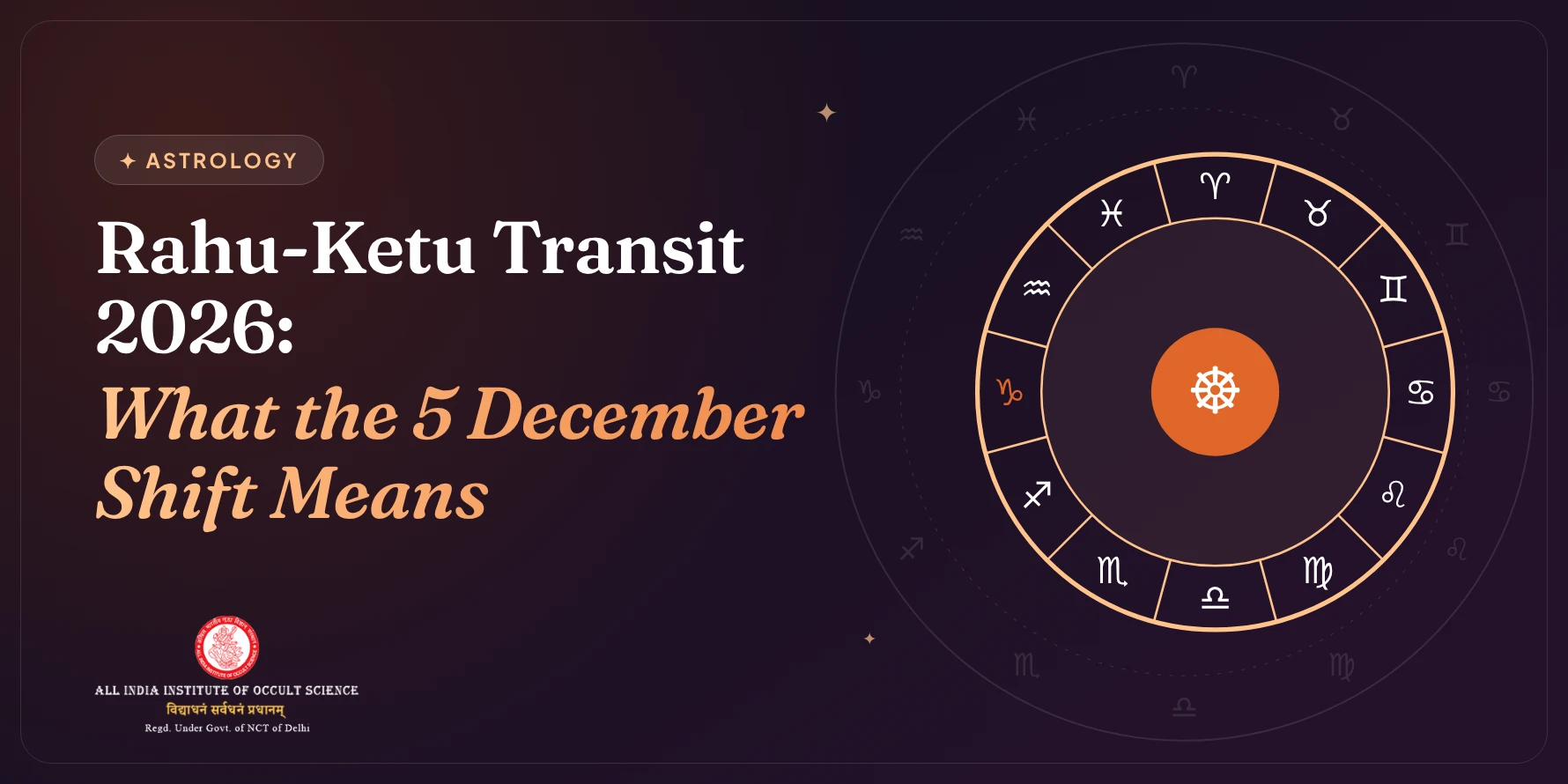
- In the Rahu-Ketu transit 2026, Rahu moves from Aquarius into Capricorn (Makar) and Ketu from Leo into Cancer (Karka) on 5 December 2026, in the evening (IST).
- Published times vary from about 7:30 PM to 10:30 PM IST because panchangs use different node models; check Drik Panchang for the New Delhi time.
- Rahu and Ketu are the two lunar nodes, points where the Moon's path crosses the Sun's path, not physical planets.
- The pair stays in these signs for about 18 months, until around mid-2028, and always moves backwards through the zodiac.
- A transit shows themes that the whole chart and running dasha will colour. It does not make any sign "bad".
Every eighteen months or so, the same messages start arriving on family WhatsApp groups: "Rahu is changing sign, be careful!" Usually there is a forwarded list of "unlucky" rashis, and a puja someone is selling.
On 5 December 2026, Rahu and Ketu change signs again. It is a significant event in Vedic astrology, but it deserves understanding, not fear.
In this guide I explain when the shift happens, why different panchangs show different times, what Rahu and Ketu actually are, how the transit is read for each Moon sign, and what it can and cannot tell you.
Rahu-Ketu Transit 2026: Date and Time
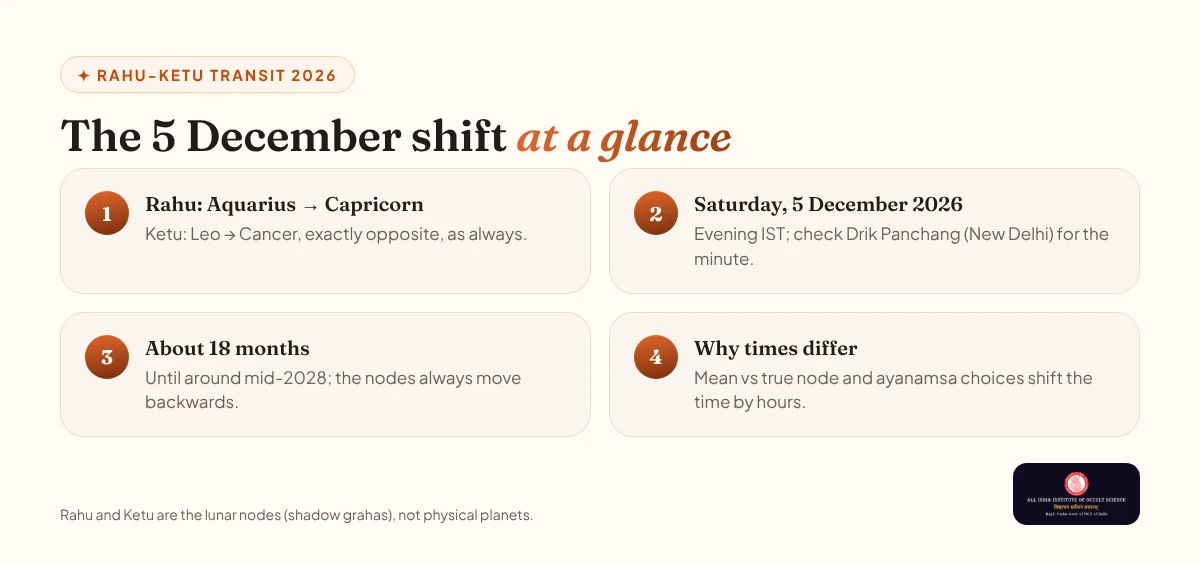
| Detail | Rahu | Ketu |
|---|---|---|
| Moves from | Aquarius (Kumbha) | Leo (Simha) |
| Moves into | Capricorn (Makar) | Cancer (Karka) |
| Date | Saturday, 5 December 2026, evening IST | |
| Stays until | About 18 months, around mid-2028 | |
| Direction | Backwards (retrograde) through the zodiac, as always | |
For the exact minute, use the Drik Panchang Rahu transit page with New Delhi selected. Sidereal (Lahiri) calculations place the shift in the evening of 5 December; the published times I have seen range from roughly 7:30 PM to 10:30 PM IST.
Why Do Transit Times Differ Between Panchangs?
If you compare three websites, you may find three different times. None of them is necessarily "wrong". The differences come from method:
- Mean node vs true node: the mean node is a smoothed average position; the true node wobbles around it. Most Indian panchangs use the mean node, but not all.
- Ayanamsa: the correction between the tropical and sidereal zodiacs. Lahiri is the Indian government standard, but some astrologers use others.
- Slow motion: the nodes move only about 3 minutes of arc a day, so a tiny difference in the model shifts the crossing time by hours.
For practical purposes, the date matters far more than the minute. The effects described in astrology unfold over months, not hours.
What Are Rahu and Ketu?
Rahu and Ketu are not physical planets. They are the two lunar nodes: the points where the Moon's orbit crosses the ecliptic, the apparent path of the Sun. Rahu is the north (ascending) node and Ketu the south (descending) node, always exactly opposite each other.
Eclipses happen only when the Sun and Moon are near these points, which is why Indian tradition connects Rahu and Ketu with grahan. The Brihat Parashara Hora Shastra counts them among the nine grahas and describes them as shadow planets (chhaya graha).
In chart reading, Rahu is traditionally linked with desire, ambition, the unfamiliar and the foreign; Ketu with detachment, introspection, past patterns and spiritual seeking. Together they describe an axis of growth: where life pushes you forward and what it asks you to let go.
What the Shift Means: Rahu in Capricorn, Ketu in Cancer
Capricorn is an earth sign ruled by Saturn, linked with work, structure, responsibility and long-term goals. Cancer is a water sign ruled by the Moon, linked with home, mother, emotional security and roots.
So the broad theme of this transit, as tradition reads it, is a pull between career and home: ambition and public duties on one side, family and inner security on the other. Collectively, astrologers often watch this axis for themes around institutions, governance, property and home life.
For an individual, though, the meaning depends on which houses Capricorn and Cancer occupy in your chart.
How to Read the Transit for Your Moon Sign
Count from your Moon sign (rashi) to see which houses Rahu and Ketu move into. If you do not know your rashi, our guide to the 12 zodiac signs explains it, and the free kundali tool will show it.
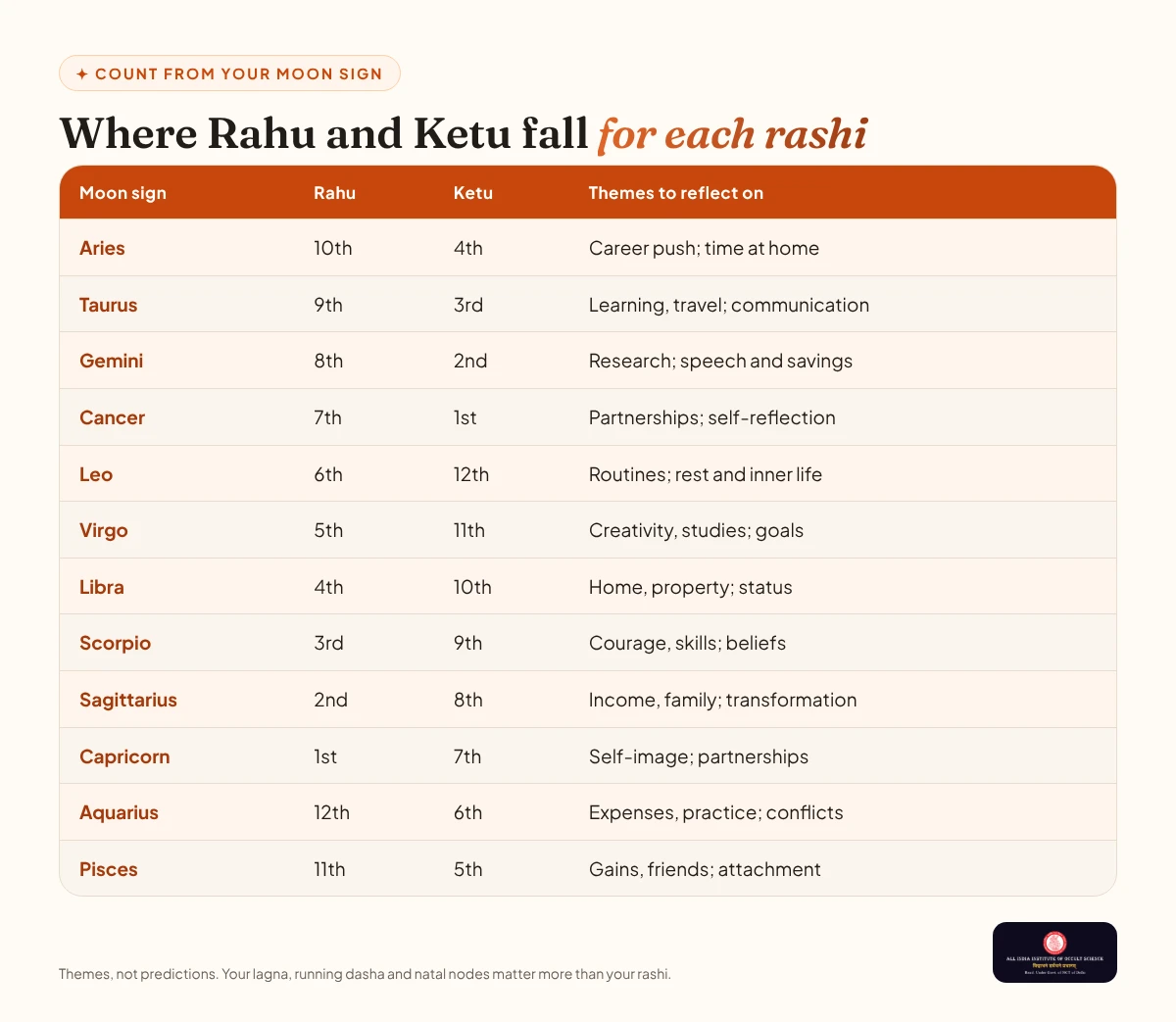
| Moon sign | Rahu in house | Ketu in house | Traditional themes to reflect on |
|---|---|---|---|
| Aries (Mesha) | 10th | 4th | Career push; balancing time at home |
| Taurus (Vrishabha) | 9th | 3rd | Higher learning, travel, beliefs; rethinking communication |
| Gemini (Mithuna) | 8th | 2nd | Research, shared resources; care with speech and savings |
| Cancer (Karka) | 7th | 1st | Partnerships in focus; self-reflection |
| Leo (Simha) | 6th | 12th | Work routines, competition; rest and inner life |
| Virgo (Kanya) | 5th | 11th | Creativity, studies, children; reviewing networks and goals |
| Libra (Tula) | 4th | 10th | Home, property, mother; detachment from status |
| Scorpio (Vrishchika) | 3rd | 9th | Courage, skills, short travel; questioning beliefs |
| Sagittarius (Dhanu) | 2nd | 8th | Income, family, speech; inner transformation |
| Capricorn (Makar) | 1st | 7th | Self-image and ambition; patience in partnerships |
| Aquarius (Kumbha) | 12th | 6th | Expenses, foreign links, spiritual practice; letting go of conflicts |
| Pisces (Meena) | 11th | 5th | Gains, friendships, goals; less attachment to results |
These are themes to reflect on, not predictions. The meaning of the 12 houses explains each area in more depth.
Why Your Whole Chart Matters More Than Your Rashi
A Moon-sign table treats millions of people as if they were one person. A real reading looks further:
- Your running dasha: if you are in a Rahu or Ketu mahadasha or antardasha, the transit is felt more strongly.
- The ascendant (lagna): houses counted from the lagna often describe events more precisely than houses from the Moon.
- Planets the nodes touch: Rahu or Ketu passing over your natal Moon, Sun or lagna degree is read as more significant.
- Natal placement: where Rahu and Ketu sit in your birth chart sets the tone for every node transit.
- Other transits: Saturn and Jupiter's positions at the same time change the overall picture.
Recent Rahu-Ketu Shifts (Sidereal, Approximate)
Looking back helps you see the rhythm of the nodes and check how earlier transits matched your own life.
| Period (approx.) | Rahu in | Ketu in |
|---|---|---|
| Apr 2022 – Oct 2023 | Aries | Libra |
| Oct 2023 – May 2025 | Pisces | Virgo |
| May 2025 – Dec 2026 | Aquarius | Leo |
| Dec 2026 – mid-2028 | Capricorn | Cancer |
A useful exercise: note what was active in your life during the last two node periods, and which houses they fell in from your Moon sign. Patterns you notice yourself teach more than any general forecast.
Simple Practices for the Next 18 Months
Traditional advice for node periods is about steadiness, not ritual spending. Practical habits that fit the Capricorn-Cancer theme:
- Plan career moves carefully: Rahu in Capricorn favours patient, structured effort over shortcuts.
- Protect family time: Ketu in Cancer can bring a feeling of distance at home; regular time with family keeps roots strong.
- Keep a daily routine: fixed hours for work, rest and prayer or meditation.
- Give where you can: charity and service are the remedies most often recommended in the texts.
Common Myths About the Rahu-Ketu Transit
"Some signs will suffer for 18 months."
No sign is singled out by the texts as doomed. Every house position has constructive and challenging sides.
"Rahu-Ketu transits cause Kaal Sarp dosh."
Kaal Sarp dosh is a pattern in the birth chart, where all planets fall on one side of the nodal axis. A transit does not give anyone a dosha.
"You must do an expensive remedy before 5 December."
Traditional guidance for difficult node periods is simple: steady routines, honesty, charity, prayer or meditation, and patience with decisions. Nothing needs to be bought out of fear.
What This Transit Can and Cannot Tell You
| It can | It cannot |
|---|---|
| Highlight life areas likely to feel active for 18 months | Predict specific events like job loss, illness or divorce |
| Offer a framework for reflection and planning | Override your choices, effort and circumstances |
| Add context to your running dasha | Be judged from the Moon sign alone |
Planets show the terrain; you still choose the path.
How to Learn Transit Reading Properly
Reading gochar (transits) well means combining them with dashas, divisional charts and the strength of each house. These are taught step by step in the Institute's astrology course, with live online classes, small batches and practice on real charts.
Conclusion
On 5 December 2026, Rahu enters Capricorn and Ketu enters Cancer for about eighteen months, bringing the career-and-home axis into focus. Check the exact New Delhi time on Drik Panchang, read the shift from your own chart rather than a forwarded list, and treat it as a season for reflection, not fear. To see where Capricorn and Cancer fall in your chart, generate it in the free kundali tool.
This article shares traditional astrology knowledge for educational purposes. It is not a substitute for professional medical, legal or financial advice. Please read our disclaimer.