Written by Jyoti Chauhan, Content Writer · Reviewed by Gurudev Shrie Kashyap, Chairman & Founder, All India Institute of Occult Science · Published 13 Nov 2026
Key Takeaways
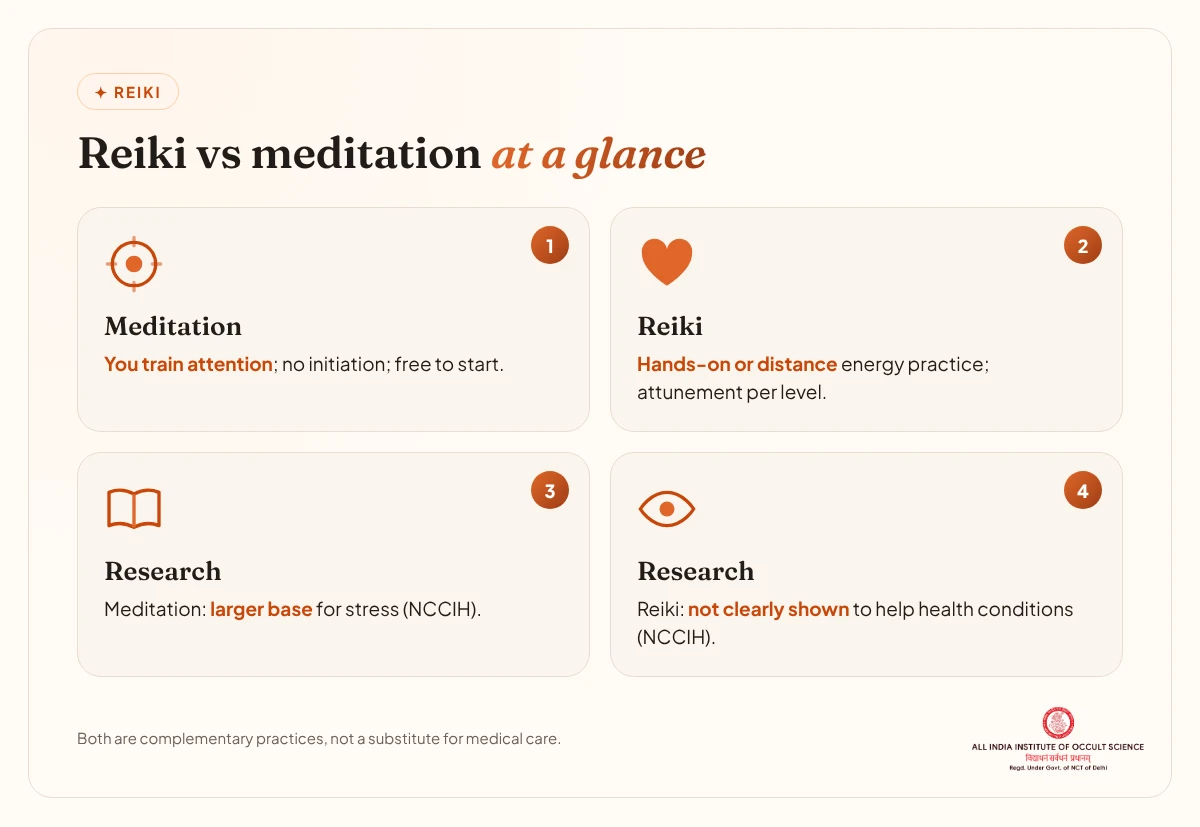
- Reiki vs meditation: meditation trains your own attention and awareness; Reiki is a hands-on or distance practice in which a practitioner aims to channel what the tradition calls universal life energy.
- Meditation needs no initiation; Reiki is traditionally learnt through an attunement from a teacher.
- They overlap: Usui Reiki includes Gassho meditation, and many people use self-Reiki as a meditative practice.
- Research support differs: meditation has a larger research base for stress, while NCCIH says Reiki has not been clearly shown to help any health condition.
- Both are complementary practices and are not a substitute for medical diagnosis or treatment.
You have had a stressful month and want something calming. One friend swears by her ten minutes of meditation every morning. Another says a Reiki session left her more relaxed than she had felt in years. Are they doing the same thing in different words, or two very different practices?
This guide compares Reiki and meditation clearly: how each works, what a session feels like, what research says, how they overlap, and how to decide where to start.
What Is Meditation?
Meditation is a family of practices that train attention and awareness. You might focus on the breath, a mantra, a sound or bodily sensations, or simply notice thoughts without following them. Indian traditions such as dhyana in yoga and Buddhist vipassana have taught meditation for thousands of years; modern mindfulness programmes adapt these ideas for everyday life.
The key point: in meditation, you do the work. No teacher or initiation is required, though guidance helps.
What Is Reiki?
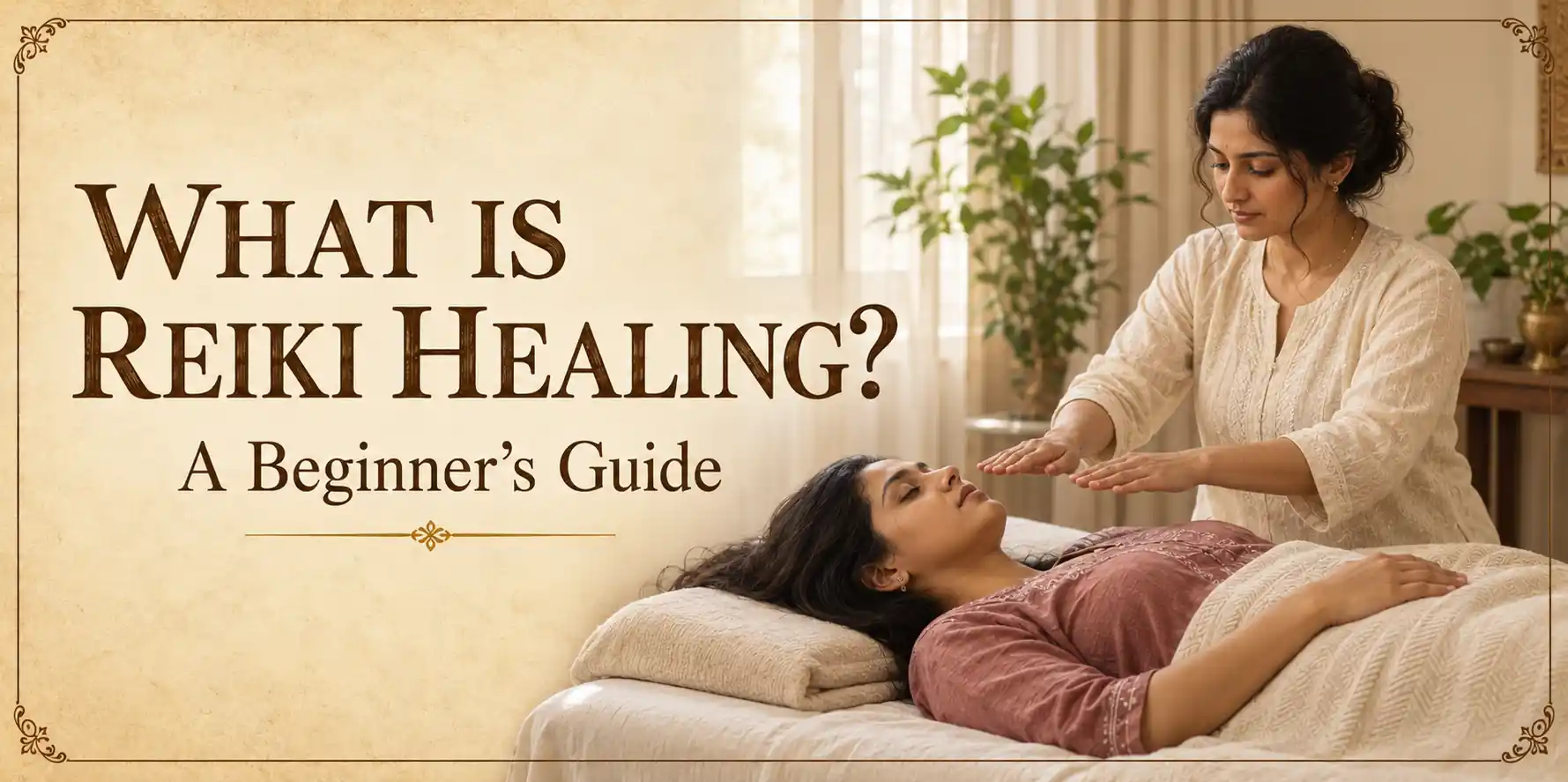
Reiki is a Japanese practice developed by Mikao Usui in the early 1920s. A practitioner places hands lightly on or just above the body (or sends Reiki at a distance, at Level 2) with the intention of channelling what the tradition calls universal life energy (rei-ki). Students learn it in levels, each starting with an attunement from a teacher. For the full picture, see our guide What Is Reiki?
In a Reiki session, you can receive passively while a practitioner works, or give Reiki to yourself after Level 1.
Reiki vs Meditation: Side-by-Side Comparison
| Meditation | Reiki | |
|---|---|---|
| Origin | Ancient Indian and Asian traditions | Japan, Mikao Usui, 1920s |
| Basic idea | Training attention and awareness | Channelling universal life energy (traditional view) |
| Who does it | You | A practitioner, or you after Level 1 |
| Initiation needed? | No | Yes, an attunement for each level |
| Typical session | 5–30 minutes, seated or lying | 45–60 minutes with a practitioner; 20–30 minutes self-Reiki |
| Touch | None | Light hands-on or hands-off |
| Cost to start | Free (apps and classes optional) | Sessions or a course |
| Research base | Larger, especially for stress | Small, mixed, inconclusive |
How the Two Practices Overlap
Reiki and meditation are closer than they look. Usui's original teaching included Gassho meditation: sitting with palms together in front of the chest and focusing on the point where the middle fingers meet. Many Reiki teachers start every class with Gassho or a breathing practice, and the five Reiki principles ("Just for today, do not anger; do not worry; be grateful; work diligently; be kind") are often recited as a daily contemplation.
Likewise, many people experience self-Reiki as a form of meditation: you sit quietly, place your hands in each position and keep your attention on the sensations. The difference is the intention: meditation trains awareness itself, while Reiki adds the intention to channel energy.
What a Session Feels Like
Meditation: beginners usually notice how busy the mind is. With practice, sessions become calmer and attention steadier. Some days are restless; that is part of the practice.
Reiki session: you lie fully clothed while the practitioner works through hand positions. People often describe warmth, tingling, heaviness or deep relaxation; some fall asleep. Others feel little. Both experiences are common.
What Research Says
According to the US National Center for Complementary and Integrative Health (NCCIH), meditation and mindfulness practices may help with stress, anxiety and some symptoms of depression, and are generally considered safe for healthy people, although research is still developing.
For Reiki, NCCIH states that it has not been clearly shown to be useful for any health-related purpose, and there is no scientific evidence for the energy field it describes. Reiki is generally considered safe because it is gentle and non-invasive, and many people simply find it relaxing.
Neither practice replaces medical care. If you have a health condition, talk to a doctor first, and never stop prescribed treatment.
Which Should You Start With?
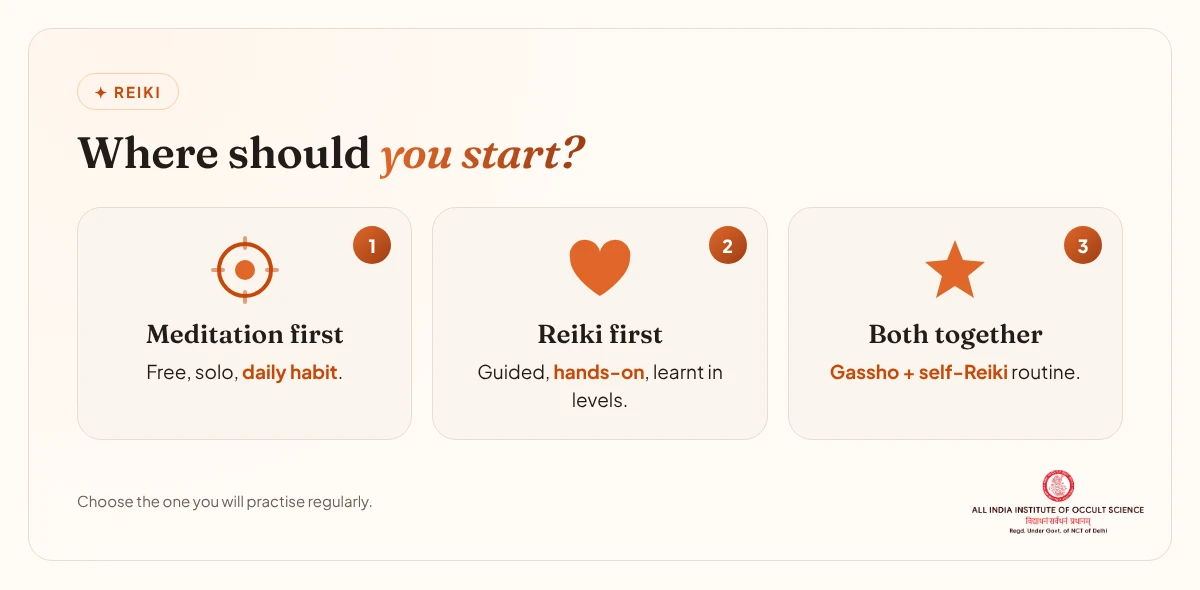
- Choose meditation first if: you want a free daily habit, prefer to work on your own, or want the practice with the larger research base for stress.
- Choose Reiki first if: you like the idea of a guided, hands-on relaxation practice, enjoy learning from a teacher in structured levels, or want a practice you can also offer to family.
- Do both if: you already meditate and want to explore energy work, or you practise Reiki and want a steadier mind for it.
People drawn to reflective practices often also explore the Akashic Records, which is taught through a meditative state.
A Simple Routine That Combines Both
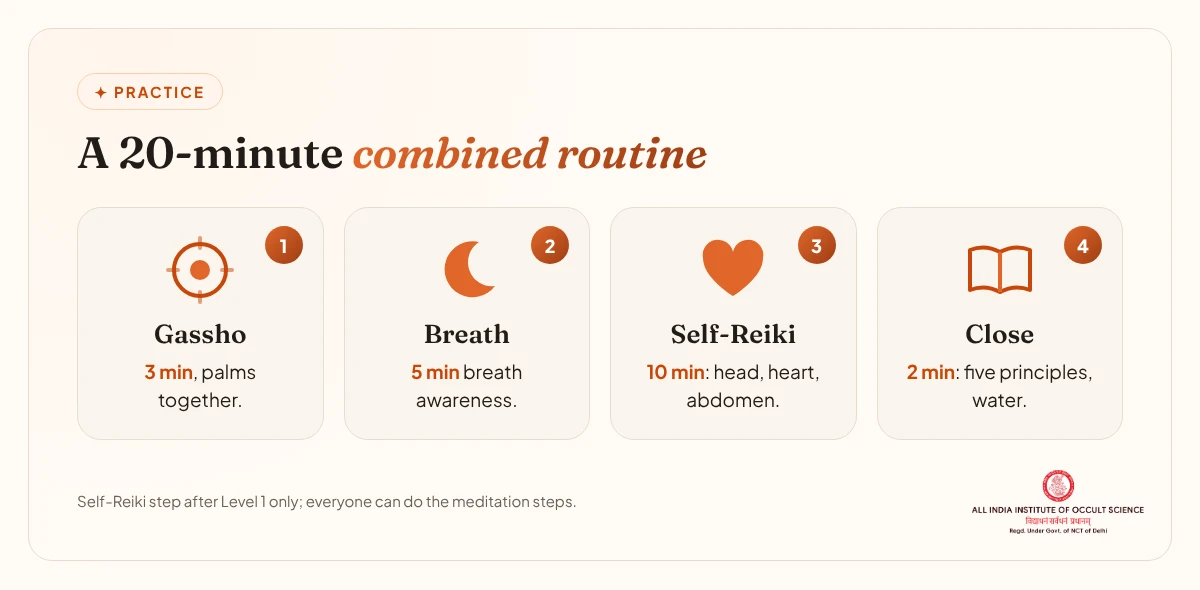
This 20-minute routine suits anyone who has completed Reiki Level 1. If you have not, do only the meditation parts.
- Gassho (3 minutes): palms together at the chest; attention on the fingertips.
- Breath awareness (5 minutes): notice each breath in and out; return gently when the mind wanders.
- Self-Reiki (10 minutes): hands on the head, heart and abdomen, about three minutes each.
- Close (2 minutes): recite the five principles silently, then drink a glass of water.
Practical Tips for Starting Either Practice
- Same time, same place: a fixed slot, such as after brushing your teeth in the morning, builds the habit faster than waiting for free time.
- Start small: five minutes a day for two weeks beats one long session a month.
- Keep a short journal: note sleep, mood and stress levels, so you can see honestly what is helping.
- Be patient with "nothing happening": both practices are subtle; benefits people report usually build over weeks.
- Choose teachers carefully: a good teacher never promises cures and always encourages you to keep up medical care.
Common Myths
- "Reiki is a religion." Reiki is not tied to any religion; people of all faiths learn it.
- "Meditation means emptying the mind." Most methods train attention; thoughts still come and go.
- "You need an attunement to meditate with Reiki principles." Anyone can meditate on the principles; the attunement is needed only for Reiki practice itself in the traditional system.
- "Either practice can cure illness." Neither is a cure. Both are complementary.
How to Learn Reiki Properly
If you decide to explore Reiki, learn it from a teacher who gives attunements, checks your hand positions and supports your first weeks of practice. The Institute's Reiki course is taught live online in stages: Level 1 (1 day, 3–4 hours), Level 2 (1 day), Level 3A (1 day), Level 3B (2 days) and Reiki Grand Master (2 days), open to anyone who has passed 10th standard. You can download the syllabus PDF to compare levels.
Conclusion
Meditation trains your own attention; Reiki adds a practitioner-led or self-applied energy practice learnt through attunements. They overlap more than most people expect, and many find they work well together. Start with whichever feels natural, practise regularly and keep medical care in its place. If you would like to learn Reiki with a teacher, explore the Institute's Reiki course or book a free live demo class.
This article shares traditional Reiki and meditation knowledge for educational purposes. Reiki is a complementary practice and is not a substitute for medical diagnosis or treatment. Please consult a qualified doctor for any health concern, and read our disclaimer.