Written by Jyoti Chauhan, Content Writer · Reviewed by Gurudev Shrie Kashyap, Chairman & Founder, All India Institute of Occult Science · Published 11 Nov 2026
Key Takeaways
- Reversed tarot cards are cards that appear upside down in a spread; most readers see them as the same energy turned inward, blocked, delayed or out of balance, not as a "bad" card.
- Reading reversals is optional. Many professional readers keep all 78 cards upright.
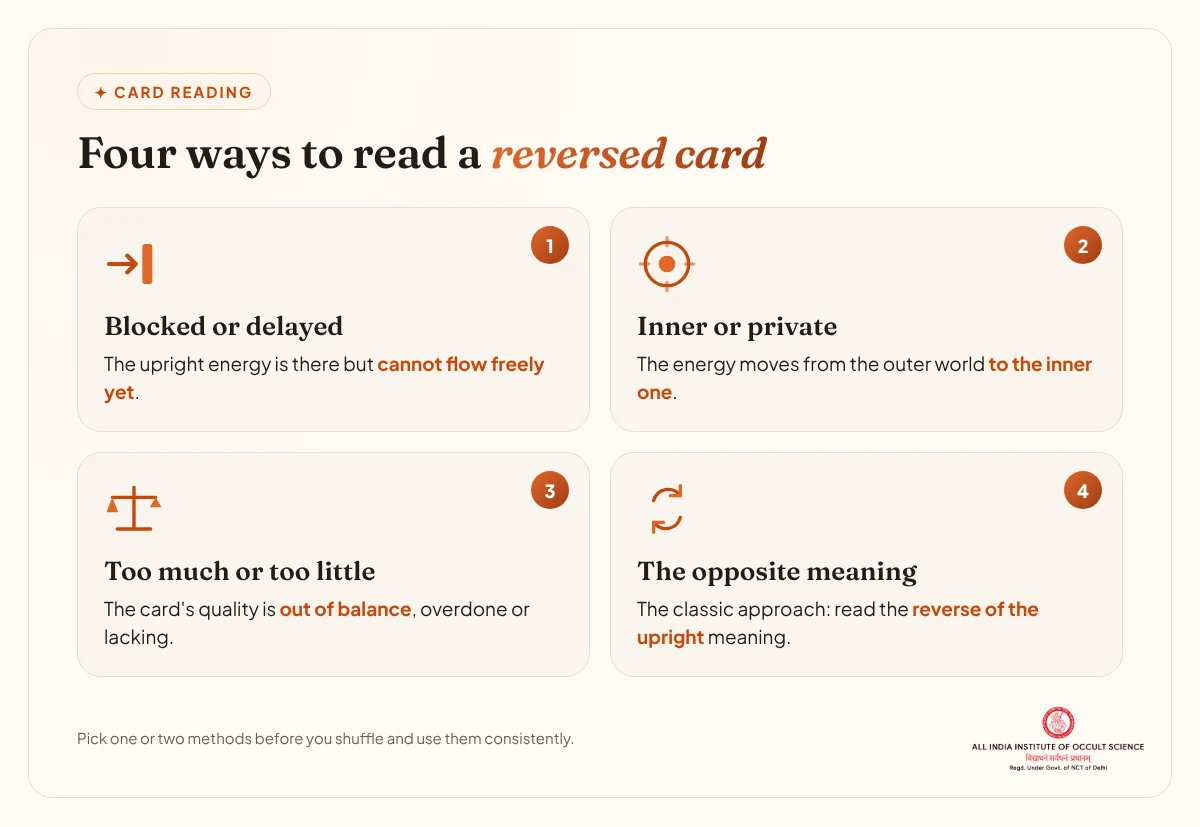
- There are 4 common methods to read a reversal: blocked energy, inner or private energy, too much or too little of the upright meaning, and the plain opposite.
- A. E. Waite's 1910 guidebook to the Rider-Waite-Smith deck already gave a separate reversed meaning for every card.
- Pick one method before you shuffle and stay with it for at least 30 readings so your interpretations stay consistent.
You shuffle, cut the deck, lay out three cards, and there it is: The Sun, sitting upside down. Your heart sinks a little. Isn't The Sun supposed to be the happiest card in the deck? Does upside down mean the good news is cancelled?
Almost every beginner has this moment. A reversed card is not a curse or a warning sign; it is another layer of meaning. This guide explains what reversed tarot cards mean, where the practice comes from, four ways to read them, a quick reference table and a worked example. If you are completely new to the cards, start with our overview of tarot cards and their types, then come back here.
What Are Reversed Tarot Cards?
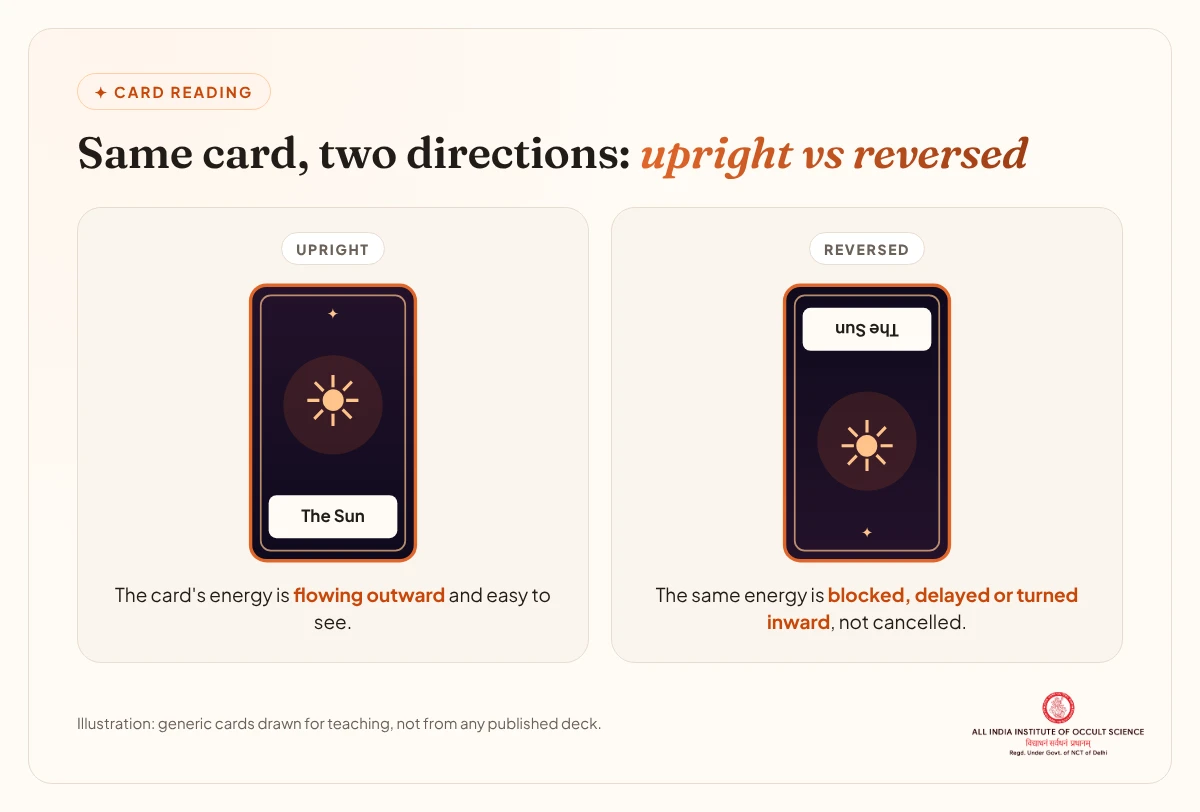
A reversed tarot card is any card that lands upside down when you draw it, with its image facing away from the reader. Instead of reading it with the usual upright meaning, many readers treat the reversal as a signal that the card's energy is weakened, delayed, hidden, overdone or turned inward in that situation.
The idea is older than most people think. Tarot began as a card game in 15th-century Italy, and it was only in late 18th-century France that writers started using the cards for divination, as Britannica's history of tarot explains. French cartomancers of that period, such as Etteilla, already gave many cards an upright and a reversed meaning. When A. E. Waite published The Pictorial Key to the Tarot with a reversed meaning listed for every card (1910, now in the public domain), the practice became standard for readers of the Rider-Waite-Smith deck, which is still one of the most widely used decks today.
Should You Read Reversed Tarot Cards at All?
There is no wrong answer. Here is how the two approaches compare.
| Question | Reading upright only | Reading with reversals |
|---|---|---|
| Meanings to learn | 78 | Up to 156 |
| Best for | Beginners, quick daily pulls, yes/no questions | Detailed readings, inner work, timing questions |
| Main risk | Readings can feel one-sided if you ignore a card's shadow side | Reading every reversal as "negative" and scaring the querent |
A practical path: learn the 78 upright meanings first, then add reversals once those come without the guidebook. Whatever you choose, decide before you shuffle. Deciding after you see the cards is how readers end up choosing the meaning they want to hear.
Four Ways to Read a Reversed Tarot Card
You do not need every method. Try each, then keep the one or two that feel natural.
1. Blocked or delayed energy
This is the most popular method. The upright energy is present but cannot flow freely yet. The Chariot reversed may describe a goal you are moving towards, but with stalled momentum or scattered focus. The Ace of Pentacles reversed may point to an opportunity that is still forming, not one that is lost.
2. Inner or private energy
Here the reversal moves the card's energy from the outer world to the inner one. The Empress upright is nurturing others; reversed, it can ask you to nurture yourself. The Hermit reversed may describe reflection that is happening privately rather than a visible withdrawal.
3. Too much or too little
Every card's energy can be out of balance. Reversed, the Four of Wands' celebration might turn into pressure to keep up appearances (too much), while the Knight of Swords' drive might become hesitation (too little).
4. The opposite meaning
The oldest method simply reads the opposite of the upright meaning, and many of Waite's reversed keywords follow this pattern. It is easy to learn, but it can feel harsh and absolute, so most modern readers use it only when the spread clearly supports it.
Reversed Major Arcana: Quick Reference Table
The 22 Major Arcana cards describe big life themes. This table shows a common blocked-or-inner reading for ten of them. Treat these as starting points, not verdicts.
| Card | Upright theme | Common reversed reading |
|---|---|---|
| 0 The Fool | New beginnings, trust, a leap | Hesitation before a leap, or a leap taken without a plan |
| I The Magician | Skill, focus, using your resources | Talent not yet used; scattered focus |
| II The High Priestess | Intuition, inner knowing | Ignoring your intuition; secrets kept from yourself |
| III The Empress | Care, abundance, creativity | Neglecting self-care; creative block |
| VI The Lovers | Connection, values, choices | Inner conflict over a choice; values out of alignment |
| VII The Chariot | Willpower, direction | Stalled momentum; pulled in two directions |
| X Wheel of Fortune | Cycles, change, turning points | Resisting a change that is already underway |
| XIII Death | Endings that make room for new growth | Holding on to something that has already ended |
| XVI The Tower | Sudden change, revelation | A change you sense coming but keep postponing |
| XIX The Sun | Joy, clarity, success | Joy that is present but muted, delayed or private |
Reversed Minor Arcana: How Each Suit Shifts
The 56 Minor Arcana cards deal with daily life. Know what each suit looks like when blocked or turned inward.
| Suit | Element and area | Typical reversed tone |
|---|---|---|
| Wands | Fire: drive, passion, projects | Low motivation, delays, burnout, or impatience |
| Cups | Water: emotions, relationships | Feelings held back, emotional fatigue, healing in private |
| Swords | Air: thoughts, decisions, communication | Overthinking, unspoken words, a decision being avoided |
| Pentacles | Earth: work, money, body, routine | Plans not grounded yet, poor routines, slow material progress |
The same fire, water, air and earth grouping is used for the 12 zodiac signs and their elements, which helps many students remember the suits.
A Worked Example: A Three-Card Spread With One Reversal
The querent and question below are invented for teaching.
Sample question: "How can I make progress on the online business I keep planning?" Spread: Past, Present, Advice. Method chosen before shuffling: blocked or delayed energy.
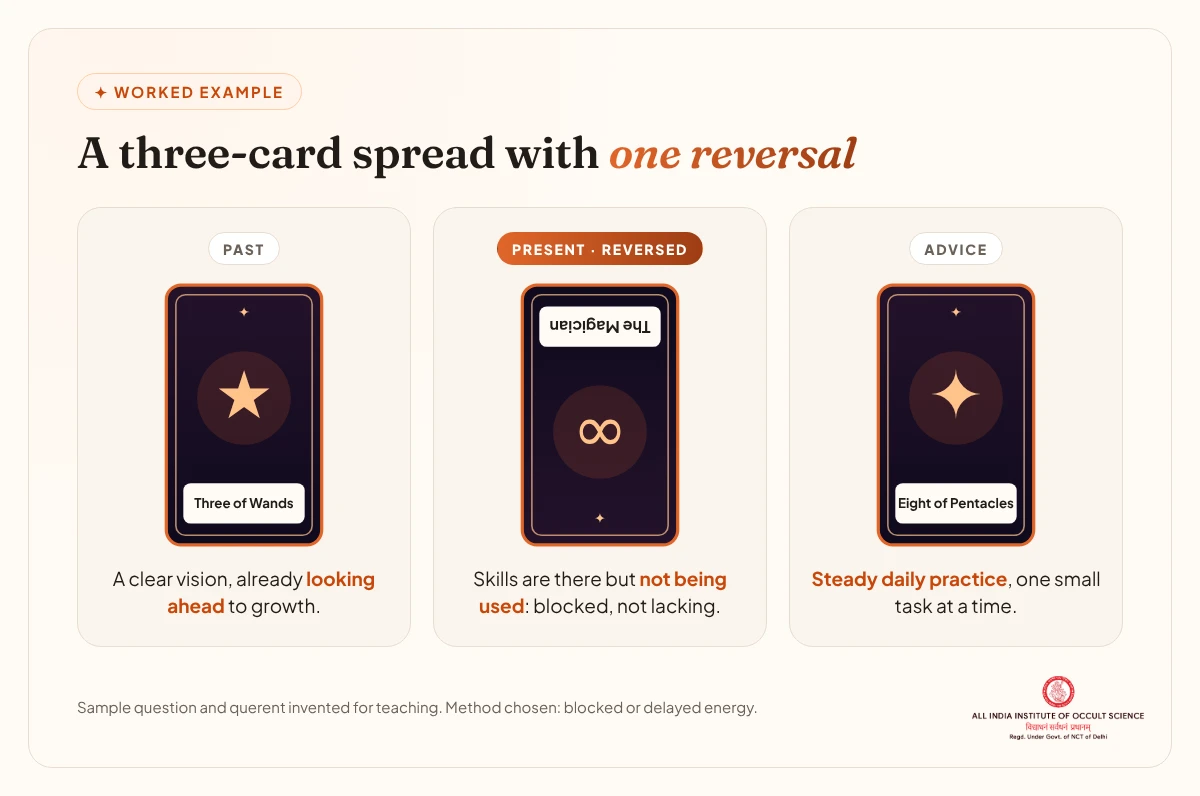
- Past: Three of Wands (upright). The querent once had a clear vision and was already looking ahead to growth.
- Present: The Magician (reversed). The skills and resources are there, but they are not being used. With our chosen method, this is blocked energy, not a lack of ability.
- Advice: Eight of Pentacles (upright). Steady practice, one small task at a time. The way to unblock The Magician is daily, practical work.
Reading it together: "You have had this vision for a while, and you already have what you need. The block right now is in starting, not in your talent. Pick one small task and do it every day for the next few weeks."
How to Get Reversed Cards When You Shuffle
A new deck has every card upright, so you must mix the orientation:
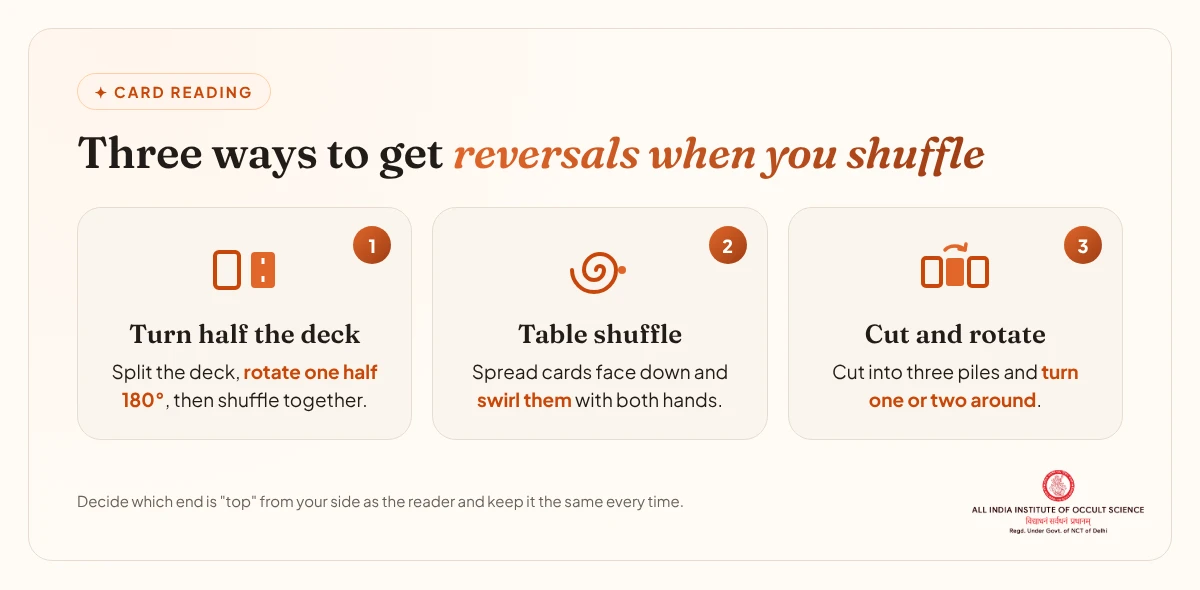
- Turn half the deck: Split the deck, rotate one half by 180 degrees, then shuffle the halves together.
- Table shuffle ("washing"): Spread the cards face down, swirl them with both hands, then gather them.
- Cut and rotate: Cut the deck into three piles and turn one or two piles around before restacking.
Decide which end of the card is "top" from your own point of view as the reader, and keep it that way for every reading.
Common Myths About Reversed Tarot Cards
- "A reversed card means something bad will happen." No. Most readers see reversals as blocked, delayed or inner energy. Many difficult cards actually soften when reversed.
- "Lots of reversals mean the reading is cursed." A spread full of reversals usually suggests a period of reflection, inner work or waiting. Some readers simply reshuffle if the deck was not mixed well.
- "You are not a real reader unless you use reversals." Many experienced readers never use them.
What Reversed Tarot Cards Can and Cannot Tell You
Tarot works best as a mirror for reflection. A reversed card can show where you feel stuck or which strength you are not using yet.
A reversed card cannot fix a date for an event, decide a medical, legal or financial matter, or tell you that someone will harm you or leave you. If you read for others, never use a reversal to frighten a person, and never suggest that a paid ritual or product is needed to "fix" a card.
How to Learn Tarot Reading Properly
A simple practice path:
- Weeks 1 to 4: Learn the 78 upright meanings with a daily one-card pull.
- Weeks 5 to 8: Add reversals with one chosen method. Practise three-card spreads.
- After that: Larger spreads, combinations and reading for others with a teacher's feedback.
At the All India Institute of Occult Science, the Card Reading course follows a similar path in two levels (as of November 2026): the Diploma in Card Reading (about 2 months) covers the 78 cards, the Major and Minor Arcana, spreads and basic reading techniques, and the Master in Card Reading (about 4 months) moves to complex spreads, card combinations, intuitive reading and consultation skills. Eligibility is 10th pass or equivalent. Classes are live and online, in small batches of 10 to 15 students, with recordings uploaded within 4 hours, and a certificate is given on completing the course, including the examination. You can download the course syllabus PDF to see the full topic list, or book a free live demo class to see how a session runs.
If you enjoy symbolic systems, our guides on what astrology is and how a birth chart works and palmistry for beginners are good next reads.
Conclusion
A reversed card is not a bad omen. It is the same card speaking in a quieter, slower or more private voice, and it often points straight to where energy is stuck. Choose one method before you shuffle, read each card with its neighbours, and keep a reading journal. Your next step: draw one card a day for 30 days with reversals on, and note what each one showed you. If you would like to build this skill with a teacher, explore the Institute's Tarot and Card Reading course.
This article shares traditional tarot knowledge for educational purposes. It is not a substitute for professional medical, legal or financial advice. Please read our disclaimer.