Written by Mahi Kashyap, CEO, All India Institute of Occult Science · Published 15 Nov 2026
Key Takeaways
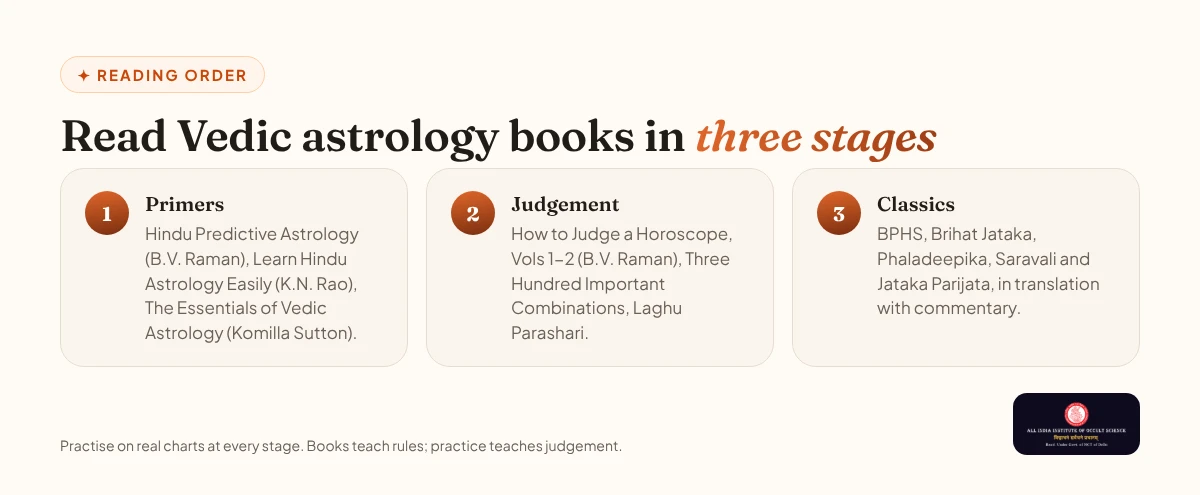
- The best books to learn Vedic astrology work in layers: 1 or 2 beginner primers, then 2-3 practical judgement books, then the classical texts.
- Good first books: B.V. Raman's Hindu Predictive Astrology, K.N. Rao's Learn Hindu Astrology Easily and Komilla Sutton's The Essentials of Vedic Astrology.
- The core classics are the Brihat Parashara Hora Shastra (BPHS), Brihat Jataka, Phaladeepika and Saravali; read them after the basics, not before.
- For Hindi readers, Nemichandra Shastri's Bharatiya Jyotish and Hindi commentaries on Phaladeepika and Laghu Parashari are widely used.
- Books teach rules; a teacher and real charts teach judgement. Most learners need both.
Walk into any bookshop near a temple and you will find a whole shelf of jyotish books: thick classics in Sanskrit with English or Hindi commentary, glossy paperbacks promising to make you an astrologer in 30 days, and everything in between. For a beginner, the hardest question is not "which book is good?" but "which book do I read first?"
Read the classics too early and you drown in unfamiliar terms. Read only quick guides and you never learn the reasoning behind a rule.
This list sorts the best books to learn Vedic astrology into a reading order, from your first primer to the classical texts, with notes on what each one teaches and who it suits. It builds on our step-by-step guide on how to learn Vedic astrology.
Why Reading Order Matters
Vedic astrology has a vocabulary of its own: graha, rashi, bhava, nakshatra, dasha, yoga and many more. Classical texts assume you already know these words. A primer gives you the vocabulary; a practical book shows you how astrologers combine the pieces; the classics then give you the original rules and their nuances.
Before you start, make sure you can read a chart. Our guide on how to read your kundali covers the layout of houses, signs and planets, which every book on this list assumes.
Stage 1: Best Vedic Astrology Books for Beginners
1. Hindu Predictive Astrology by B.V. Raman
Dr B.V. Raman was one of the most influential Indian astrologers of the twentieth century, and this book is a classic starting point. It explains signs, planets, houses, divisional charts and basic prediction in plain English, with examples. Its language is a little old-fashioned, but its structure is excellent for self-study.
2. Learn Hindu Astrology Easily by K.N. Rao
K.N. Rao is known for a practical, research-minded approach and for teaching generations of students. This short book introduces the building blocks quickly and is a good companion if Raman's style feels dense.
3. The Essentials of Vedic Astrology by Komilla Sutton
Written for an international audience, this book explains Indian concepts without assuming a Hindu cultural background. It suits NRI learners and anyone coming from Western astrology.
4. Light on Life by Hart de Fouw and Robert Svoboda
A thorough introduction that explains not only the rules but the philosophy and reasoning behind them. It is longer than a primer, so many learners read it alongside one of the shorter books above.
5. A Catechism of Astrology by B.V. Raman
Organised as questions and answers, this is useful for revision and for testing yourself after the first primer.
Stage 2: Practical Judgement Books
Once you know the vocabulary, these books teach you to judge a chart house by house and to read combinations.
6. How to Judge a Horoscope (Volumes 1 and 2) by B.V. Raman
Probably the most widely used judgement manual in English. Volume 1 covers houses one to six and Volume 2 houses seven to twelve, each with example charts. Work through them with your own chart open, and pair them with our guide to the 12 houses in astrology.
7. Three Hundred Important Combinations by B.V. Raman
A reference on yogas (planetary combinations) such as Raj yoga, Gaja Kesari yoga and Dhana yogas, with the classical conditions for each. Use it as a dictionary rather than reading it cover to cover.
8. Laghu Parashari (Jataka Chandrika)
A short classical text that condenses Parashara's principles on functional benefics and malefics, yogakarakas and dasha results. It is a perfect bridge to the classics and pairs well with our guide on how mahadasha works.
9. Crux of Vedic Astrology by Sanjay Rath
For learners ready to go deeper into timing techniques and Jaimini concepts. It is best read after you are comfortable with Parashari basics.
Stage 3: The Classical Texts
These are the foundation texts that every serious student eventually studies. All are in Sanskrit; you will read them in translation with commentary.
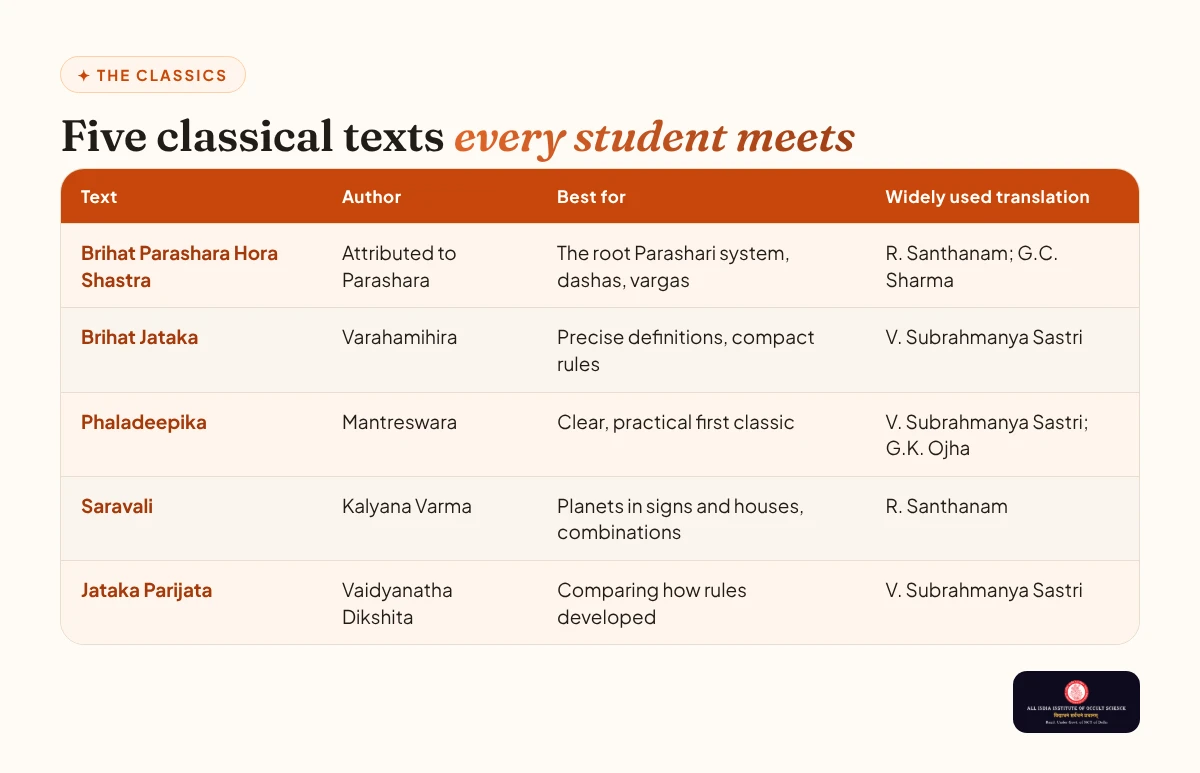
10. Brihat Parashara Hora Shastra (BPHS)
Attributed to the sage Parashara, the Brihat Parashara Hora Shastra is the root text of Parashari astrology. It covers planets, signs, the 16 divisional charts, house results, yogas, the Vimshottari dasha system and much more. Widely used English translations include those by R. Santhanam and by G.C. Sharma.
11. Brihat Jataka by Varahamihira
Brihat Jataka, by the sixth-century scholar Varahamihira, is compact and dense. It is valued for its precise definitions. V. Subrahmanya Sastri's English translation is a standard edition.
12. Phaladeepika by Mantreswara
Clear, well organised and practical, Phaladeepika is often the first classic students enjoy reading. Translations by V. Subrahmanya Sastri (English) and Gopesh Kumar Ojha (Hindi and English) are popular.
13. Saravali by Kalyana Varma
A large text especially rich on planetary combinations and the results of planets in signs and houses. R. Santhanam's translation is widely used.
14. Jataka Parijata by Vaidyanatha Dikshita
A comprehensive later classic that builds on the earlier texts, useful for comparing how rules developed over time.
Specialist Books for Later Study
Once you are comfortable with natal charts, you may want to explore specific branches of jyotish. These are standard references, each best read after the basics.
- Muhurta Chintamani by Daivajna Rama: the classic on muhurta (choosing auspicious times), including the Ashtakoot rules used in kundli matching.
- Prashna Marga: a Kerala text on prashna (horary astrology), answering questions from the chart of the moment the question is asked.
- KP Readers by K.S. Krishnamurti: the six-volume series that introduced the Krishnamurti Paddhati system with its stellar sub-lords. Read it as a separate system, not mixed with Parashari rules at first.
- Jaimini Sutras: the sutra text of the Jaimini system, with chara karakas and rashi dashas, usually studied with a commentary.
Books on Calculation and Astronomy
Software now calculates charts in seconds, but understanding the astronomy behind them makes you a more confident astrologer. You will know why the Indian zodiac is sidereal, what the ayanamsa is, and why panchangs sometimes give slightly different times.
- Surya Siddhanta: the classical Indian astronomical text. Ebenezer Burgess's 1860 English translation is in the public domain and widely available.
- Calculation sections of Bharatiya Jyotish: Nemichandra Shastri explains how to cast a chart by hand, step by step, in Hindi.
- A good panchang: learning to read the daily tithi, nakshatra, yoga and karana trains your eye for the sky as it actually moves.
Common Mistakes When Learning From Books
- Collecting instead of reading: ten unread books teach less than one book read twice with notes.
- Applying one rule in isolation: classics list hundreds of rules; real charts need them weighed together.
- Mixing systems too early: Parashari, Jaimini and KP each have their own logic. Learn one well first.
- Predicting for others too soon: practise on your own and family charts, with their permission, before reading for anyone else.
Best Jyotish Books in Hindi
Many learners in India find it easier to study in Hindi. Good options include:
- Bharatiya Jyotish by Nemichandra Shastri: a respected, systematic Hindi textbook covering both calculation and prediction.
- Phaladeepika with Hindi commentary by Gopesh Kumar Ojha: one of the most read classical editions in Hindi.
- Hindi commentaries on Laghu Parashari and BPHS: publishers such as Chaukhamba carry several; choose an edition with the Sanskrit verse, word meaning and a clear commentary.
How to Choose a Good Translation
Two translations of the same classic can read very differently. Before you buy, check these points:
- Sanskrit verse included: so you can compare and spot where the translator has added an opinion.
- Commentary kept separate: the translator's notes should be clearly marked apart from the text.
- Example charts: helpful for practice, as long as they are labelled as the translator's examples.
- Index and glossary: invaluable when you look up a rule later.
Avoid books that promise exact predictions or sell remedies on every page. Classical texts describe tendencies and principles; they are not shopping lists.
A 6-Month Reading Plan (Sample)
| Month | Read | Practise |
|---|---|---|
| 1 | One primer (Raman or K.N. Rao) | Learn the 12 signs, 9 grahas and 12 houses; read your own chart |
| 2 | Second primer or Light on Life | Study the 27 nakshatras; note the Moon nakshatra of 10 family charts |
| 3 | How to Judge a Horoscope, Vol. 1 | Judge houses 1-6 in 5 charts |
| 4 | How to Judge a Horoscope, Vol. 2 | Judge houses 7-12 in the same 5 charts |
| 5 | Laghu Parashari + a yoga reference | Find yogas and functional benefics in each chart |
| 6 | Begin BPHS or Phaladeepika | Compare classical rules with your earlier notes |
Keep a notebook. Write each rule in your own words with the chart where you saw it work or not work. This habit turns reading into learning.
Can You Learn Vedic Astrology Only From Books?
You can learn a great deal of theory from books, and many famous astrologers were largely self-taught. But books cannot answer your doubts, correct your calculations, or show you how an experienced astrologer weighs conflicting rules in a real chart. That judgement usually comes from practice with feedback.
Our article on what most beginners wish they had known earlier covers the common traps self-learners fall into.
What Books Can and Cannot Do for You
| Books can | Books cannot |
|---|---|
| Give you the vocabulary and the classical rules | Tell you which rule matters most in a given chart |
| Show worked example charts | Check your own readings and correct mistakes |
| Be re-read for years as references | Replace practice on many real charts |
How to Learn Vedic Astrology With a Teacher
If you want structure and feedback, a course can sit alongside your reading. The All India Institute of Occult Science's astrology course runs in three levels: Certificate in Astrology (about 2 months), Diploma in Astrology (about 5 months) and Master in Astrology (about 8 months), with 10th pass as the eligibility. Classes are live online in batches of 10-15 students, recordings are uploaded within 4 hours, and doubts are answered in class and in the app. You can download the syllabus PDF to see how the topics map to the books above.
Conclusion
The best books to learn Vedic astrology are the ones you read in the right order: a clear primer first, practical judgement books next, and the classics once the vocabulary feels natural. Read slowly, practise on real charts and keep notes. When you are ready to add a teacher and guided practice to your reading, explore the Institute's astrology course and see which level fits you.