About Astrology
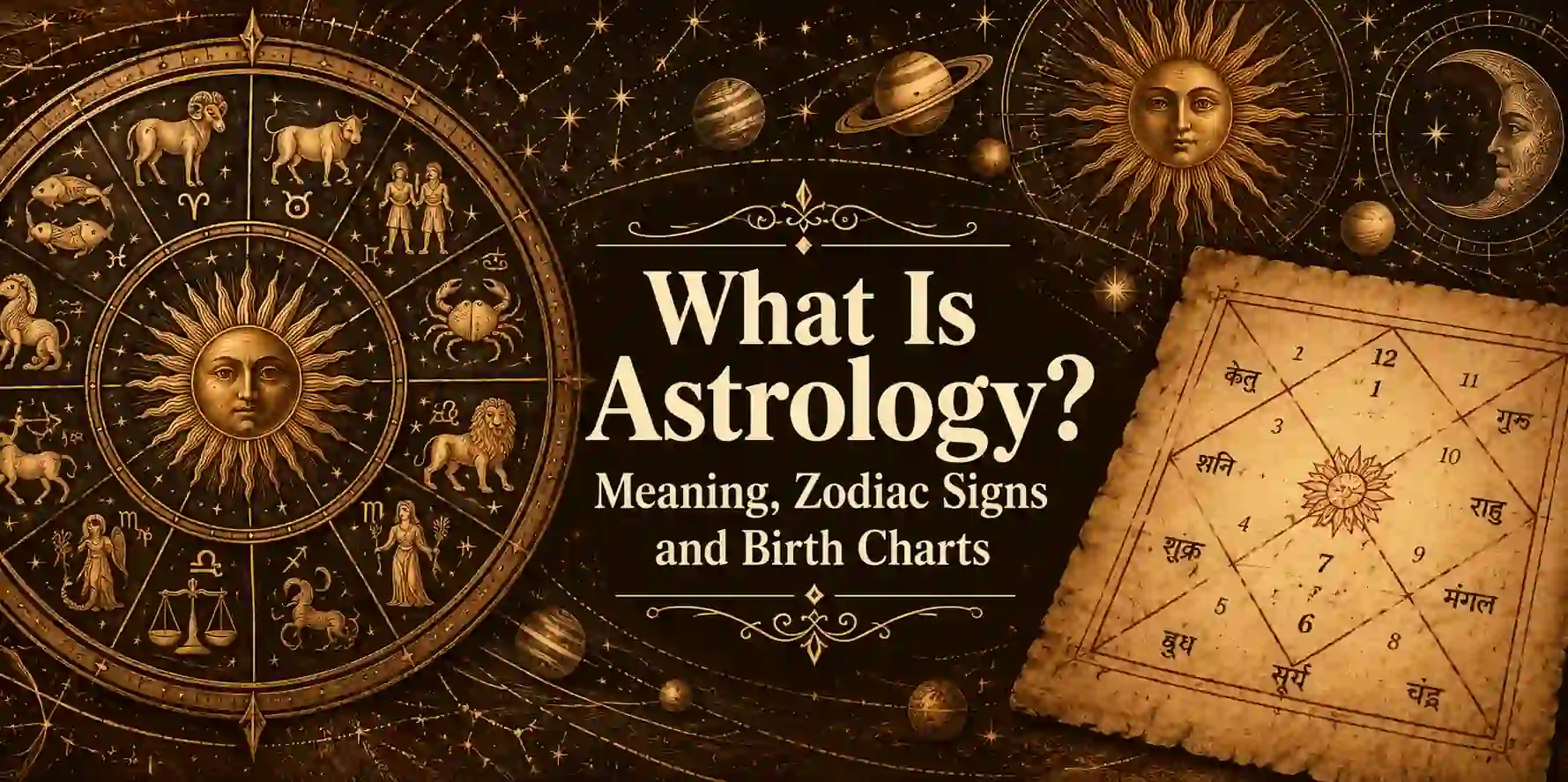
Astrology is a traditional practice in which the positions and movements of the sun, Moon and planets are interpreted to understand what they might mean in relation to a person’s personality and life event. And, to make it happen, one of the main tools astrologers use for this is a birth chart, also called ‘kundali’.
You may already know your zodiac sign or read your horoscope online now and then. But, when an astrologer reads a kundali ( birth chart ), astrology meaning becomes more broader than that, it involves - Moon sign, rising sign, houses and planetary placements together. That’s the reason your kundli ( birth chart ) can give a lot of pictures about you.
Here, this article explains the meaning of Astrology through the context of vedic astrology ( also called Jyotisha ) including how a kundall is read properly.
What Is a Birth Chart in Astrology?
A birth chart ( Kundli) shows the placement of the Sun, Moon and planets at the time of birth, along with the rising SIgn on the eastern horizon at the birth place. This sign is also known as the Lagna or Ascendant.
In order to prepare a birth chart ( janam Kundli) , the following information is needed:
-
Date of birth.
-
Recorded time of birth.
-
Place of birth.
An astrologer uses this information to calculate your chart and reads its placements according to astrological methods. You can also generate your birth chart through our free Kundali calculator by entering your details to see how your kundli is arranged with grah and dosh.
What Is Astrology Based On?
At the first sight of an Astrology chart, the numbers and symbols can seem confusing. All those different signs refer to grahas ( planets) , Zodiac signs ( rashis ) and houses and they are useful aspects of astrology, so it is important to understand what each of them means.
Planets and Grahas
There are nine grahas in Vedic astrology; the Sun, Moon, Mars, Mercury, Jupiter, Venus, Saturn, Rahu and Ketu.
Graha is often translated as planet, although the term includes more than just astronomical planets. These include - the Sun ( a star ), the Earth’s ( natural satellite) and Rahu and Ketu ( calculated points called lunar nodes ), and the Moon ( whose orbital path crosses the sun’s apparent yearly path.
In astrology, certain characteristics are associated with each graha – for example, Mercury is connected with communication and learning – meaning an astrologer will consider the meanings while looking at where mercury is placed in a chart.
Zodiac Signs and Rashis
A rashi is one of the 12 zodiac signs including Aries, Taurus and Gemini, that comprise the zodiac circle. Each sign is associated with specific characteristics within astrology.
When a graha is placed in a particular sign, astrologers consider the qualities of that sign while interpreting the placement.
Houses and Bhavas
The 12 houses, or bhavas, represent different areas in your life including family, studies, relationships and work experiences.
While a house and a rashi (zodiac sign) have different applications in a chart, it is important to understand that a house relates to an area of life, while the sign occupying it adds information used in the interpretation. We will look at simple examples to understand this deeper meaning later in this blog.
You can read more about these areas in our guide to the 12 houses in astrology.
The 12 Astrology Signs and Their Core Elements
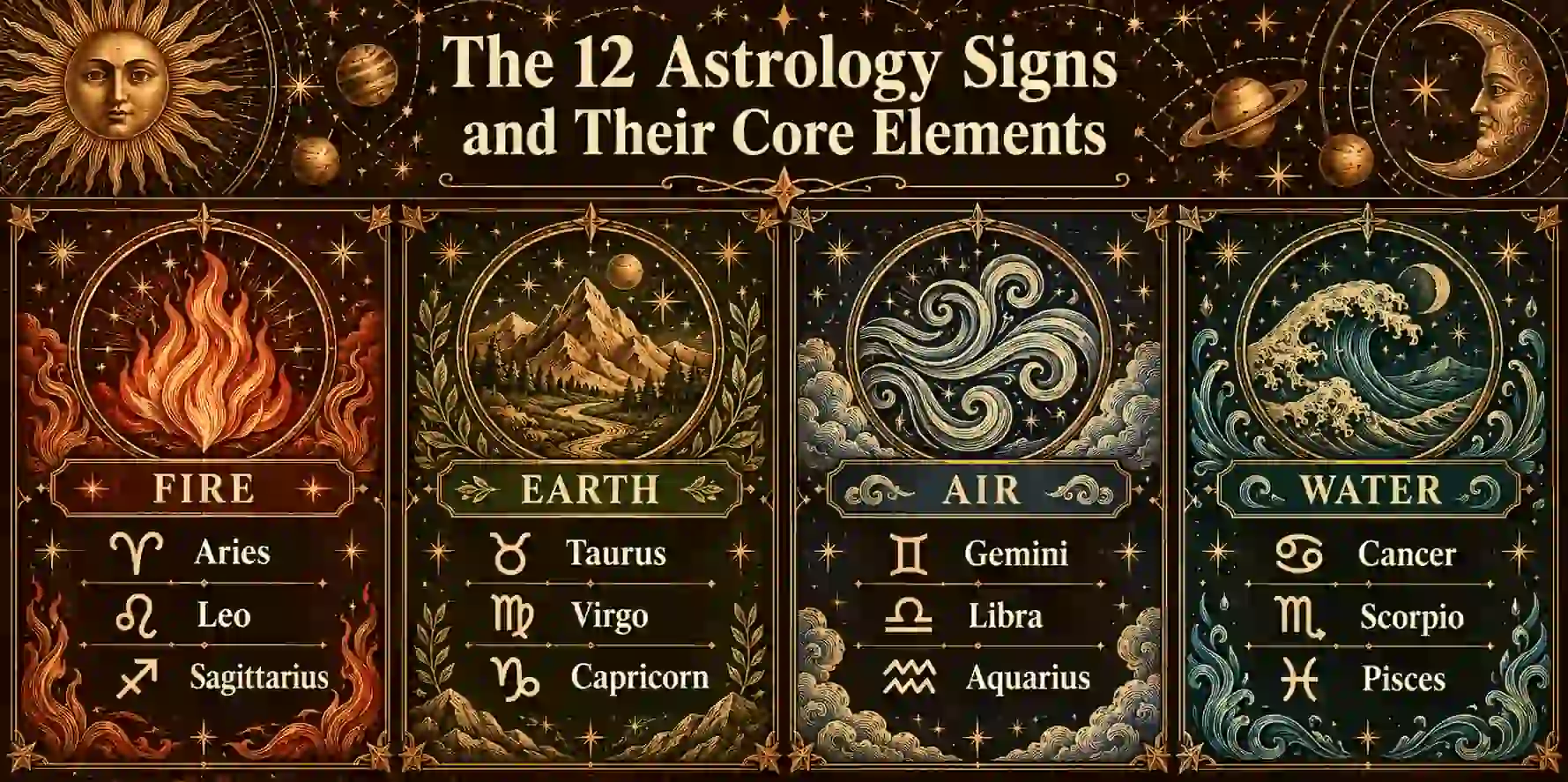
The phrase ‘astrology zodiac signs’ generally refers to the 12 signs of the zodiac, which appear on a birth chart. They are listed in a specific order, beginning with Aries and ending with Pisces. Each sign has a number that you can use to identify it in a Vedic chart.
|
Number |
Zodiac sign |
Common Sanskrit name |
Element |
|
1 |
Aries |
Mesha |
Fire |
|
2 |
Taurus |
Vrishabha |
Earth |
|
3 |
Gemini |
Mithuna |
Air |
|
4 |
Cancer |
Karka |
Water |
|
5 |
Leo |
Simha |
Fire |
|
6 |
Virgo |
Kanya |
Earth |
|
7 |
Libra |
Tula |
Air |
|
8 |
Scorpio |
Vrishchika |
Water |
|
9 |
Sagittarius |
Dhanu |
Fire |
|
10 |
Capricorn |
Makara |
Earth |
|
11 |
Aquarius |
Kumbha |
Air |
|
12 |
Pisces |
Meena |
Water |
You may have noticed that a sign has been described as a fire sign or a water sign. This refers to the elements that the signs are classified under in astrology.
Fire signs are energetic, earth signs are practical, air signs are communicative and thoughtful and water signs are expressive, as explained by the properties of the elements. Signs are equal divisions of the zodiac, and should not be confused with constellations, which occupy an unequal area of the sky. Our guide to the 12 zodiac signs explains the individual signs further.
Sun Sign, Moon Sign and Lagna Explained
When someone asks “what is your sign?”, it helps to know which sign they mean as your sun sign, Moon sign and Lagna describes different features of your birth chart.
|
Term |
What it means |
|
Sun sign |
The zodiac sign occupied by the Sun at birth |
|
Moon sign |
The zodiac sign occupied by the Moon at birth |
|
Lagna or rising sign |
The zodiac sign rising on the eastern horizon at the time and place of birth |
For example, your Sun could be in one sign and your Moon in another, with a third sign on the eastern horizon at the time of your birth. They can all belong to the same kundali chart.
In Indian usage, janma rashi usually refers to the Moon sign, as the word rashi means a zodiac sign. In this case, it is important to clarify the context if you are referring to a chart or an astrologer.
Why Can Vedic and Western Astrology Show Different Signs?
The general rule is that Vedic astrology uses the sidereal zodiac whereas Western astrology usually uses the tropical zodiac. Sidereal astrology uses a reference point to the stars. Tropical astrology uses the reference point of the equinoxes and seasons.
While both systems divide the zodiac into 12 equal parts, the reference point changes meaning the planets can fall into a different sign.
If you have two astrology apps that provide different information about your chart, consider if they are using the same zodiac system. Also consider if they are providing the same information about the same component of your sign (Sun, Moon etc).
How to Read an Astrology Chart or Birth Chart
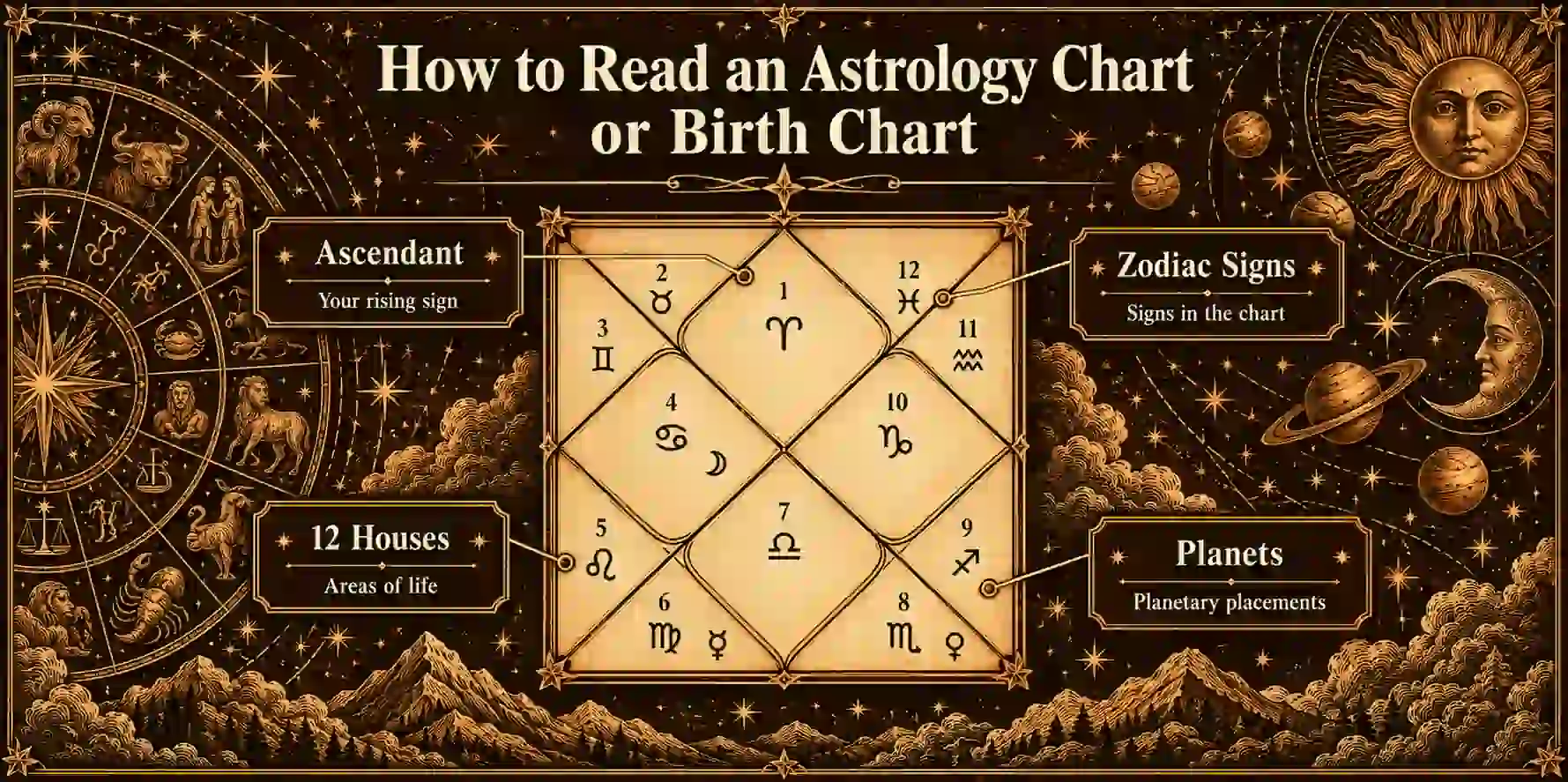
Learning to identify the features of an Astrology chart gives you a practical understanding of the meaning of Astrology. First, start with finding the lagna, finding which signs occupy the houses and notice the grahas placed there.
1. Check the Chart Layout
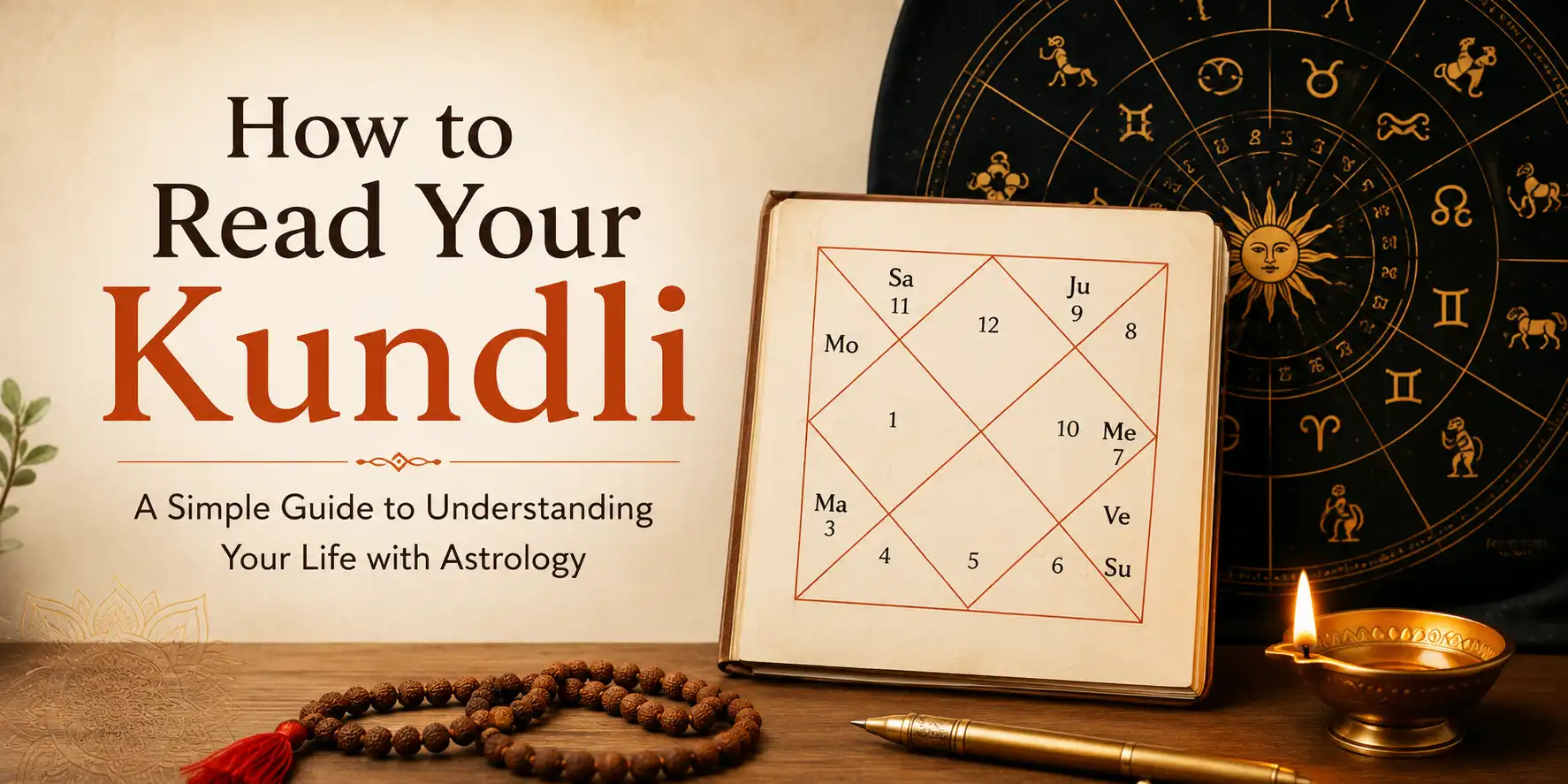
Vedic astrology charts can be presented using a variety of layouts, such as North Indian or South Indian formats, in which the signs and houses are in different positions. For example, the chart above uses a simple house system in which whole signs are allocated to houses, but a South Indian chart would not follow this pattern. Therefore, it is important to read the labels on the chart before following instructions that relate to a house’s location.
2. Find the Lagna and Follow the Houses
Locate the Lagna, Ascendant or Asc – for the purposes of this example, we will assume Taurus is the Lagna sign and whole-sign houses apply to this chart. In this case, Taurus would occupy the first house, followed by Gemini in the second house and Cancer in the third house.
|
House in this example |
Sign and its number |
Placement |
|
First house |
Taurus, sign 2 |
Lagna |
|
Second house |
Gemini, sign 3 |
– |
|
Third house |
Cancer, sign 4 |
Moon |
This is a hypothetical example to illustrate a point. It explains why the sign number and house number can be different for the same sign – Taurus is sign number 2, but it occupies the first house in this chart. Other house systems apply different principles.
3. Note Where the Grahas Are Placed
In this example, let us assume the Moon falls in Cancer. You can record that the Moon occupies both Cancer and the third house, as both pieces of information are used when interpreting a placement.
Before you progress to detailed interpretation, practise by locating the grahas, signs and houses in a chart. Our step-by-step guide to reading a kundali explains how to continue.
History of Astrology and Its Development in India
The history of astrology covers a range of traditions that have observed the sky and connected celestial patterns with events on Earth. Ancient Mesopotamian records show early links between sky observation, calendar and omens. describe the relationship between observations of the heavens, the calendar and omens.
The Indian tradition of Jyotish covers a broad scope of activities, including calendar calculations, the timing of rituals and astrological readings. Its history brings together mathematical astronomy and practices such as choosing a muhrat or reading a birth chart, which developed over time.
These different uses explain why astrology includes questions about personal charts as well as the timing of ceremonies and events.
Where Can You Begin Learning Astrology?
Start with the signs, grahas, houses and lagana, then practice finding them in a chart. Once you are able to identify these, you can move to how an astrologer read the birth chart ( kundali ) relationships between placements and study timing methods.
If you want to pursue a professional level course to understand the meaning of Astrology and become a market ready consultation with correct guidance, you can explore the astrology course at All India Institute of Occult Science.
They offer certificate, Diploma and Master levels for structured learning with practical application training with expert faculty guidance.
You can explore the astrology syllabus to see how the subject is organised.
Common Questions About Astrology
Is Astrology the Same as Astronomy?
Astrology and astronomy have similarities in their history and calculations, but they are fundamentally different disciplines. Astronomy is a science that studies the properties and behaviours of celestial bodies, while astrology interprets the influence of celestial bodies and events on individuals’ lives through traditional means.
Is Astrology Scientifically Proven?
Astrology makes claims about a person’s character and future that cannot be scientifically proven. Even though accurately calculating a planet’s position in the sky is a scientific achievement, it does not mean that this has a direct influence on a person’s character or future. For more information,
Can You Read a Birth Chart Without an Exact Birth Time?
You can use an approximate time for generating a chart, but the Lagna and houses may not be accurate. In addition, if the Moon changes sign between the assumed times, the Moon sign will also be approximate. An astrologer should give a disclaimer about the limitations of a birth chart in cases such as this one.
Do You Need Sanskrit to Learn Astrology?
You can begin learning astrology basics using terminology that you understand, connecting it to terms such as rashi, graha and bhava as you become more familiar with them. With time, you will intuitively grasp their meanings as part of the language of astrology.
What Is Astrology Used For?
Astrology can be used for personal chart readings, relationship chart comparisons and choosing a muhurat for a ceremony. The process will vary depending on the type of question you have. A general horoscope, personal kundali reading or timing reading will all be different.