Have you ever looked at someone's notebook and know who it belongs to before seeing their name? Perhaps one of your friends always writes in small letters. Maybe someone else leaves massive gaps between their words. And then there is the person whose pen presses so hard against the paper that you can see the impressions from the back.
We are all taught the same alphabet, but our handwriting seems to transform as we grow.
The sizes of our letters, the slants and pressure of our pen, the spacing between our words and even the way we sign our name can change from person to person.
This is what graphology studies.
Also known as Handwriting Analysis, Graphology studies patterns in handwriting and what they may suggest about the writer.
But one handwriting sign does not tell you everything about a person.
An analysis looks at several features together.
What Is Graphology?
In its simplest form, Graphology is the study and interpretation of characteristics that appear in handwriting. A graphologist does not simply observe what a person has written, but how they have written it, including the size, slant and pressure of the script, the spacing between words and letters, the line and baseline of the writing, the use of margins, the formations of the letters, the speed of writing and the signature.
Wikipedia describes Graphology as handwriting analysis performed in an attempt to understand personality traits, whilst also pointing out that scientific evidence does not support regarding its conclusions as established psychological facts.
Imagine two people who both write in large letters. One person could have heavy pressure with narrow spacing and another could have lighter pressure with wider spacing. Similarities could be observed in the size of the writing, but patterns would be different overall. This is why Graphology examines combinations, and not just one characteristic.
History and Origin of Graphology
The idea of studying handwriting in relation to the writer has existed for centuries. One early work often mentioned in the history of handwriting analysis is Camillo Baldi's book from 1622.
Modern Graphology is strongly connected with Jean-Hippolyte Michon, who developed a more organised system of handwriting signs in the nineteenth century and used the term Graphology for handwriting analysis. Later, Jules Crépieux-Jamin expanded Michon's work and developed a broader approach in which handwriting features were considered together rather than as isolated signs.
This development is one reason Graphology today is generally studied through combinations of characteristics.
Source reference: Wikipedia – Graphology, Jean-Hippolyte Michon and Jules Crépieux-Jamin.
What Can Handwriting Reveal in Graphology?
In the traditional approach to Graphology, handwriting can be examined to discuss:
- Emotional expression
- Communication style
- Confidence and self-expression
- Behavioural tendencies
- Organisation and consistency
- The way in which a signature presents itself
This is where the phrase 'may suggest' is important. Handwriting can change according to tiredness, the speed of writing, the type of pen used, the posture and the surface on which the writing appears.
Handwriting and Personality
Now we come to the question most people ask when they begin studying Graphology:
What does my handwriting say about me?
There is no single answer, but we can look at the connection between handwriting and personality.
Also Read: What Does Handwriting Say About Your Personality?
Handwriting and Confidence
When it comes to confidence, Graphology practitioners could examine size, pressure, movement, capital letters and the relationship between ordinary handwriting and the signature.
The idea is not to look for one feature that reflects confidence, but to see if several characteristics support the same interpretation.
Handwriting and Emotional Expression
Slant is often studied in relation to emotional expression, but pressure, spacing and consistency can modify or contradict the initial interpretation.
Handwriting and Communication
Connections between letters, spacing and movement can be observed, but communication involves many factors and should not be reduced to a single characteristic.
Handwriting and Behavioural Patterns
This is where repetition becomes important.
Does the writing keep the same size? Does the pressure change frequently? Does a single unusual formation appear several times?
Repetition is worth more than an isolated feature.
Is Graphology Scientifically Proven?
Graphology is practiced and taught as a system of interpreting handwriting, but research has not proven it as a consistently reliable psychological personality test.
A 2009 study that involved two separate samples and compared graphologists' assessments with Big Five personality measures found no evidence of validity as a personality measure, and low agreement between graphologists in the first study.
What this means is that the meanings discussed below should be regarded as traditional interpretations of Graphology, and not psychological evaluations.
Now that this has been established, let us turn our attention to handwriting itself.
How Does Graphology Work?
Suppose you get a page of handwriting.
Your instinct is to look for something that stands out: a letter or sign.
But a graphologist looks at a complete page.
Does the writing appear in large or small letters? Does it seem cramped or spaced out? Do the letters lean in a particular direction? Are the lines straight or do they slant upwards?
After observing general patterns, a graphologist will turn to smaller details. A basic analysis usually follows this pattern:
Overall page → Main characteristics → Individual formations → Signature → Combined interpretation
What Are the Main Elements of Handwriting Analysis?
Place two pages of handwritten text side by side. You may have never studied Graphology before, but you are likely to see some differences.
One page may have larger letter writing, another may have slanted writing and a third may have unusually wide spacing between words.
These noticeable differences are where Handwriting Analysis begins.
Handwriting Size
Start with the most apparent characteristic. How large are the letters?
Traditional Graphology could associate larger handwriting with increased outward expression, whilst smaller handwriting is often linked with concentration and attention to detail.
Size, however, should not be examined alone. Large letters with wide spacing give a different impression to large letters with no spacing between words.
Read more: Handwriting Size Meaning in Graphology
Handwriting Slant
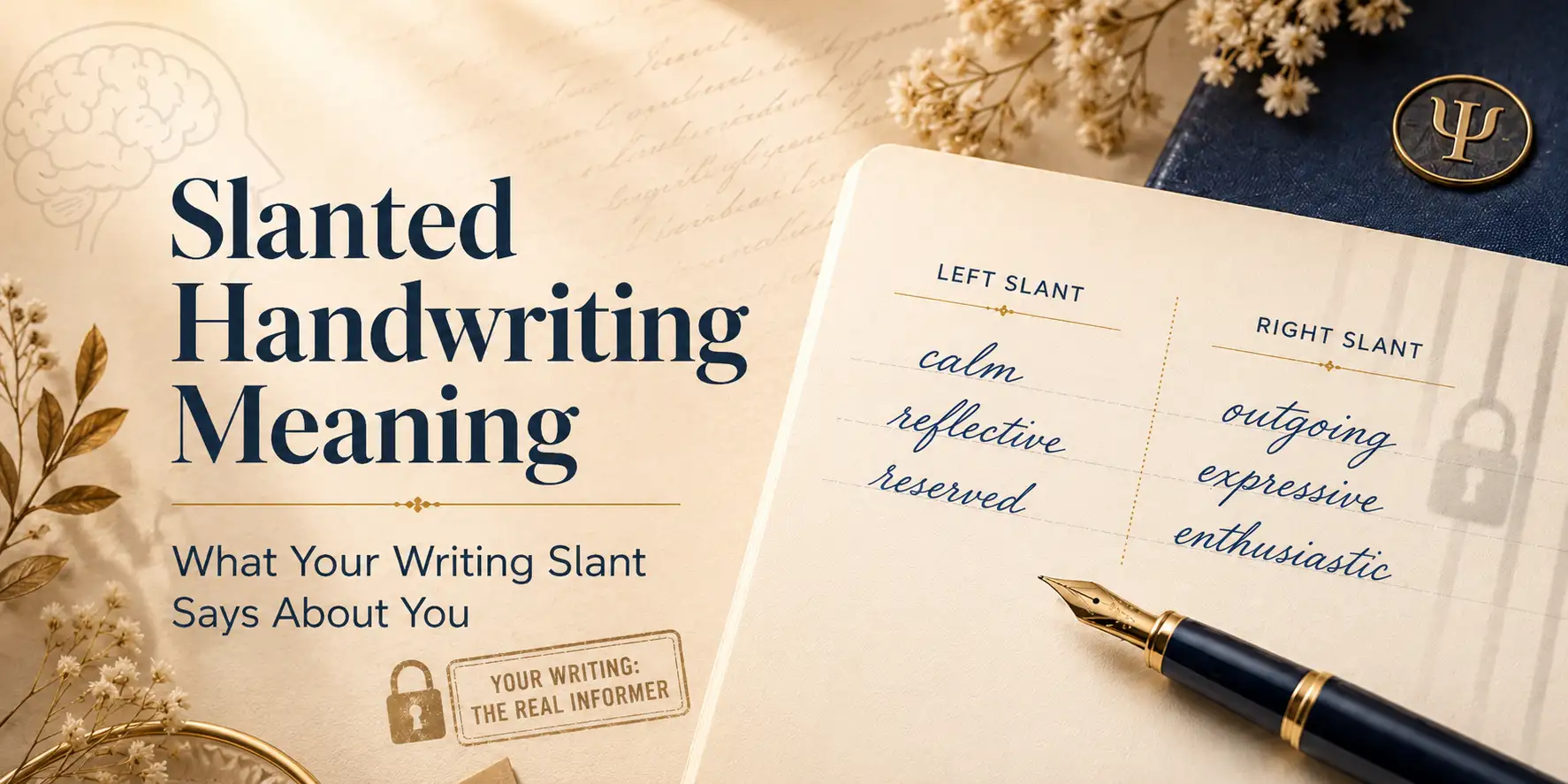
Take a look at the direction of the letters.
|
Slant |
What You See |
|
Right |
Letters lean towards the right |
|
Left |
Letters lean towards the left |
|
Vertical |
Letters remain mostly straight |
|
Mixed |
Direction keeps changing |
Traditional Graphology often observes slant in relation to emotional response and expression. The amount and consistency of the slant are also taken into account, since a slight tilt should not be regarded in the same way as a strong slant.
Read more: Handwriting Slant Meaning in Graphology
Handwriting Pressure
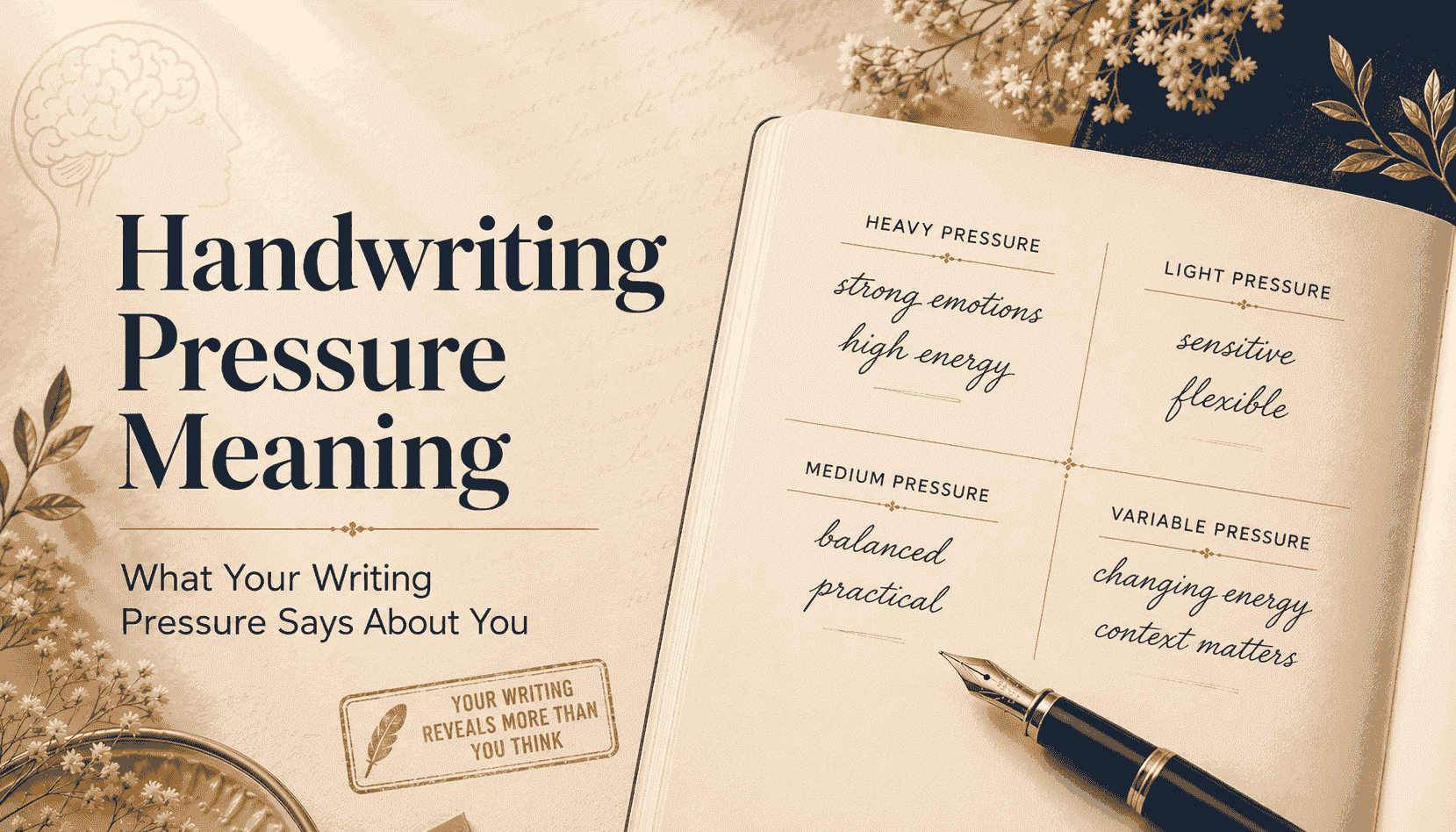
Now take a look at how hard the pen is pressed against the page. Some people write with such light pressure that the strokes are barely visible. Others press down so hard that the page beneath the writing is marked.
A graphologist usually observes:
-
Light pressure
-
Medium pressure
-
Heavy pressure
-
Changing pressure
Stronger pressure often appears in traditional interpretations, but the pen, paper and writing surface can affect pressure, so it is worth remembering.
Letter Spacing
Look inside the words.
How much space can be seen between one letter and the next?
Some letters almost touch while others remain clearly separated.
Rather than judging an unusual gap, a graphologist looks for if the same spacing appears repeatedly.
One strange-looking word may simply be the result of writing quickly.
Word Spacing
Between words, the spacing can indicate details about the writer's communication style.
Traditional Graphology often links wider spacing with personal space or independence and narrower spacing with closeness.
Line Spacing
Now move away from the words. How much space is there between lines?
Graphologists may study the use of line spacing, but lined paper can automatically influence the distance between lines.
Because of this, a natural sample of handwriting on unmarked paper will usually give a better impression of line spacing.
Baseline
Imagine a ruler placed underneath a sentence. Does the writing stay level or does it rise, fall or repeatedly move up and down?
This is the baseline.
|
Baseline |
What It Looks Like |
|
Rising |
Writing gradually moves upward |
|
Falling |
Writing gradually moves downward |
|
Straight |
Writing remains mostly level |
|
Wavy |
Writing repeatedly rises and falls |
Traditional Graphology has different interpretations for each of these patterns, but posture, tiredness and the slope of the paper can also affect the baseline.
Margins
Most people do not consciously think about the amount of space they leave on either side of a page, but margins appear automatically.
A graphologist can observe the left, right, top and bottom margins and see how they change as the writer moves around the page.
Does the left margin get wider? Does the writing slowly drift towards one edge?
Now simply observe what is happening and do not attach meaning to it yet.
Letter Formation
Now take a closer look at the letters.
Take the lowercase 't', for example. One person could cross it high, another might use a small bar and a third could create a long cross stroke.
Similar variations appear in loops, dots, curves and strokes at the end of letters.
The important thing to remember is that it is not just one unusual letter that is significant, but if the same formation appears more than once.
Writing Speed
You probably write differently when you are in a hurry.
Faster writing often has simpler letter formations and longer joining strokes, whilst slower writing has careful letter formations.
Neither is better or worse, but speed, rhythm and the rest of the sample should be taken into account.
Upper, Middle and Lower Zones
Look at the letters 'l', 'a' and 'g'.
The tall part of 'l' moves upwards, the body of 'a' stays in the middle and the lower part of 'g' moves below the writing line.
This creates three zones in handwriting:
|
Zone |
Examples |
Traditionally Studied in Relation To |
|
Upper |
l, h, t |
Ideas, goals and thinking |
|
Middle |
a, e, m |
Everyday behaviour and interaction |
|
Lower |
g, y, p |
Practical and physical drives |
Capital Letters
Capital letters are naturally larger than the rest of the writing.
A graphologist observes their size, formation, decoration, pressure and relation to the lowercase letters.
Learned handwriting style is also relevant, since a decorated capital letter could simply be the result of a person's natural style of writing.
Understanding the 12 Main Handwriting Characteristics
Now that you know why it is not sufficient to look at a single characteristic, let us examine the main ones that are commonly studied.
|
Characteristic |
What You Observe |
|
Size |
Large, medium or small letters |
|
Slant |
Right, left, vertical or mixed |
|
Pressure |
Light, medium, heavy or changing |
|
Spacing |
Distance between letters and words |
|
Baseline |
Rising, falling, straight or irregular |
|
Letter formation |
Shapes, loops and strokes |
|
Writing speed |
Flow and movement |
|
Connections |
Joined or separate letters |
|
Margins |
Space around the writing |
|
Signature |
Size, movement, pressure and style |
|
Consistency |
Patterns that remain or change |
|
Overall layout |
How the page is arranged |
Now, there is something else we have not looked at properly yet - your signature.
How Does Signature Analysis Work in Graphology?
Write one normal sentence. Now write your name underneath it.
Are they similar?
Sometimes they are, but sometimes it is as if two completely different people have written the sample.
This is why Signature Analysis is studied separately.
What Is Signature Analysis?
Signature Analysis examines the size, slant, pressure, underline, loops and movement of a signature.
This is then compared with normal handwriting.
If they appear to be similar, that is one pattern. If the signature suddenly becomes much larger or darker, that is something else entirely.
This should not be confused with forensic signature verification, which deals with questions, such as whether a signature is genuine or forged.
Signature Size
The size of the signature can be larger, smaller or similar to the rest of the writing.
Traditional Signature Analysis often associates larger signatures with self-presentation and smaller signatures with a more reserved presentation.
The comparison with the writing above or below is more important than the size on its own.
Signature Slant
A signature can lean right, left or remain upright.
Compare it with the writing above or below.
If someone writes vertically but signs with a strong right slant, this change itself is relevant.
Signature Pressure
A signature can also be darker or lighter than the writing above or below it.
For an accurate comparison, both should ideally be produced with the same pen and under similar conditions.
Signature Underline
Some people underline their signature, some use a short line and others use none at all.
A graphologist observes the length, direction and pressure of the underline, rather than giving the same meaning to every line.
Signature Loops
Loops can occur at the beginning, middle or end of a signature.
Instead of simply counting them, examine their size, shape and frequency.
Most importantly, compare them with ordinary handwriting.
A feature that appears only in the signature will create a different pattern to one that appears throughout the writing.
Read more: Signature Analysis in Graphology
How to Analyze Handwriting Step by Step
Now it is time to put everything together.
Get a sample of natural handwriting and observe it step by step:
-
Get a natural sample: Ask the writer to produce a short paragraph of natural handwriting, preferably on plain paper.
-
Look at the whole page: Observe the overall pattern, size and white space.
-
Check size and slant: Look at how large the letters are and the direction in which they lean.
-
Study pressure: Observe if it is light, medium, heavy or changing.
-
Check spacing: Examine the spacing between letters, words and lines.
-
Follow the baseline: See if the writing rises, falls or stays level.
-
Observe letter formations: Look for repeated loops, dots, strokes and formations.
-
Study the signature: Analyse it on its own, then compare it with the writing above or below it.
-
Look for repetition: A single anomalous letter is not as important as a repeated feature.
-
Combine the observations: Interpretation should come at the very end, after observation and comparison.
How to Read a Handwriting Sample
Now that you know what to look for, let us apply it in practice.
When you have a full page of writing in front of you, begin with the larger features and move onto the smaller ones.
What to Look at First
Begin by observing size, slant, spacing, margins, baseline and the overall layout of the page.
Then move onto the individual letters.
Overall Impression
Look at the page for a few seconds.
What stands out first?
The letters could be extremely small, every line could rise upwards or there could be a lot of white space.
This is not your interpretation yet - simply make a mental note of what you see.
Individual Characteristics
Write down exactly what you see.
For example:
-
Size: Small
-
Slant: Slight right
-
Pressure: Medium
-
Word spacing: Wide
-
Baseline: Straight
Notice that we are still not labelling the person with any particular quality.
We are only observing.
Combining Multiple Characteristics
Now combine the observations.
Instead of looking at what each characteristic individually suggests, examine if they support each other and if they continue throughout the sample.
This is when a collection of meanings stops being a list and becomes an actual analysis.
Common Mistakes Beginners Make
Avoid judging people based on single characteristics, use very short samples, ignore conditions under which writing took place, study the signature exclusively or treat one anomalous letter as significant.
Remember: Observe → Compare → Interpret
Graphology and Graphotherapy
We have spent all this time looking at existing handwriting, so what happens when someone deliberately changes it?
What Is Graphotherapy?
Graphotherapy involves practicing changes to handwriting.
In other words:
Graphology studies the handwriting you already have. Graphotherapy involves developing new patterns of handwriting.
How Graphotherapy Relates to Handwriting
A practitioner could first observe existing patterns, then introduce exercises that involve specific strokes or formations.
Graphotherapy should be regarded as a self-development practice, rather than a substitute for medical or psychological treatment.
Graphology vs Graphotherapy
|
Graphology |
Graphotherapy |
|
Studies existing handwriting |
Works with intentional changes |
|
Focuses on observation |
Focuses on repeated practice |
|
Interprets current patterns |
Practises selected new patterns |
Applications of Graphology
Personality Analysis
Traditional Graphology uses combinations of characteristics to discuss personality and self-expression.
Signature Analysis
Signatures can be studied separately and compared with ordinary handwriting.
Education and Learning
Students of Graphology develop observation, pattern recognition and comparison skills.
Self-Understanding
This is probably the point where most people begin.
You study your own handwriting, then your signature, then you notice how differently someone else writes.
What began as casual observation could become something you want to learn about properly.
Graphology vs Forensic Handwriting Examination
Graphology and forensic handwriting examination both study handwriting, but their purpose is different.
|
Graphology |
Forensic Handwriting Examination |
|
Focuses on traditional handwriting interpretation |
Focuses on questioned handwriting and documents |
|
May discuss personality and behavioural tendencies |
May examine whether handwriting or a signature is genuine and assess likely writership |
|
Uses handwriting characteristics for interpretation |
Uses systematic handwriting comparison for forensic examination |
The National Institute of Standards and Technology (NIST) explains that trained forensic document examiners may study handwriting or signatures to help determine genuineness and likely writership. This is different from personality-based Graphology.
Source reference: NIST – Forensic Handwriting Examination and Human Factors.
Related Graphology Guides
-
Handwriting Size Meaning
-
Baseline Analysis
-
Signature Analysis
-
Graphotherapy
-
Graphology Course
Want to Learn Graphology Properly?
Reading about handwriting size, slant or pressure can help you understand the basics, but learning Graphology properly requires more than memorizing what individual signs mean.
You need to know what to observe, how different characteristics connect and when a single sign is not enough to form an interpretation.
This understanding develops with structured learning and regular practice with complete handwriting samples.
At the All India Institute of Occult Science, the Graphology Course covers Handwriting Analysis, Signature Analysis, Graphotherapy and practical study to help you understand the subject step by step.
If Graphology has made you curious about what handwriting can tell you and you want to learn how to analyse it properly, enroll in the Graphology Course at All India Institute of Occult Science and begin your professional learning journey.