Astrology sounds simple when someone says, “Your Rashi is Gemini,” and then mention your Lagna, the house where Shani is situated and your current Dasha, but how did your Rashi lead to all of these? What do all these words even mean and how are they connected?
Well, A Kundli combines signs, planets and houses and brings them all together in a single horoscope. Getting familiar with the basic terminology eases the process of learning about Nakshatras, Dashas and the various approaches to reading a horoscope.
In this guide, we will explore how you can learn Vedic astrology step by step with the help of a few examples and practice sessions. So, let us begin your Vedic astrology journey.
What Should You Learn First in Vedic Astrology?
First, learn about the Zodiac Signs, Grahas, Houses and Lagna. After you can identify them in a birth chart study House Lords, Planetary aspects, Nakshatras and Dashas.
Vedic astrology, also known as Jyotish, is an Indian tradition of planet position interpretation through charts, and other methods. A birth chart is calculated using the date, time and place of a person’s birth.
So let us first get familiar with the terms.
Step 1:Understand the Basic Terms
|
Term |
A brief explanation |
|
Kundli or Janam Patrika |
A chart calculated using a person's date, time and place of birth. |
|
Rashi |
A zodiac sign. When one says Janma Rashi, they are usually referring to the Moon sign of birth. |
|
Graha |
A factor used in astrology, often called a planet. Sun, Moon, Rahu and Ketu are included among the nine Grahas. |
|
Bhava |
A house in the chart, associated with an area of life. |
|
Lagna |
The sign on the eastern horizon at the time and location of birth. It marks the beginning of the first house in the chart. |
|
Nakshatra |
One of the 27 divisions used in the common lunar-zodiac system. |
|
Dasha |
A planetary period used in a timing system. |
|
Gochar |
The current transit of a planet. |
The only difference that we should be aware of at this point is Rashi vs Bhava. A Rashi is a sign (like Taurus) whereas a Bhava refers to a house (the second house). They overlap in a Kundli but are otherwise different.
Step 2: Learn the 12 Zodiac Signs and Their Rulers
Now that we’ve covered the basics, let us learn the signs. The 12 Rashis (Zodiac Signs) come in a set order from Aries to Pisces, each traditionally ruled by a Graha. We’ll need these rulers later on, when we study who ‘owns’ a house in a chart.
|
Rashi |
Sanskrit name |
Traditional ruler |
|
Aries |
Mesha |
Mars |
|
Taurus |
Vrishabha |
Venus |
|
Gemini |
Mithuna |
Mercury |
|
Cancer |
Karka |
Moon |
|
Leo |
Simha |
Sun |
|
Virgo |
Kanya |
Mercury |
|
Libra |
Tula |
Venus |
|
Scorpio |
Vrishchika |
Mars |
|
Sagittarius |
Dhanu |
Jupiter |
|
Capricorn |
Makara |
Saturn |
|
Aquarius |
Kumbha |
Saturn |
|
Pisces |
Meena |
Jupiter |
For now, memorise the order of these Rashis and their traditional rulers. You’ll need to remember that Mercury rules over Gemini and Virgo.
Step 3: Get to Know the Nine Grahas
We now know the signs and their traditional rulers. Who are these rulers? The Navagraha are the nine factors you will keep encountering in a Kundli.
-
Surya (Sun): Traditionally associated with identity, authority and leadership.
-
Chandra (Moon): Associated with the mind, emotions and nurturing.
-
Mangal (Mars): Associated with action, bravery and conflict.
-
Budha (Mercury): Associated with speech, thoughts and communication.
-
Guru (Jupiter): Associated with learning, teaching and discernment.
-
Shukra (Venus): Associated with relationships, art and comfort.
-
Shani (Saturn): Associated with responsibility, discipline and delays.
-
Rahu: Associated with desires and unfamiliar experiences.
-
Ketu: Associated with detachment and spiritual interests.
Rahu and Ketu may be called planets in an astrology lesson but they are actually lunar nodes which don’t represent physical planets. The Sun and Moon are also part of the Navagraha, which is why the list does not seem familiar to you from science class.
Don’t let a single word define a whole reading. If a lesson says Saturn represents delays, it does not mean that every chart that includes Saturn will share this meaning. Look at its sign, house and connections to other Grahas as well before deciding. For now, choose one Graha, identify two of its traditional meanings and look for its abbreviation somewhere in a sample Kundli.
Step 4: Understand What the 12 Houses Represent
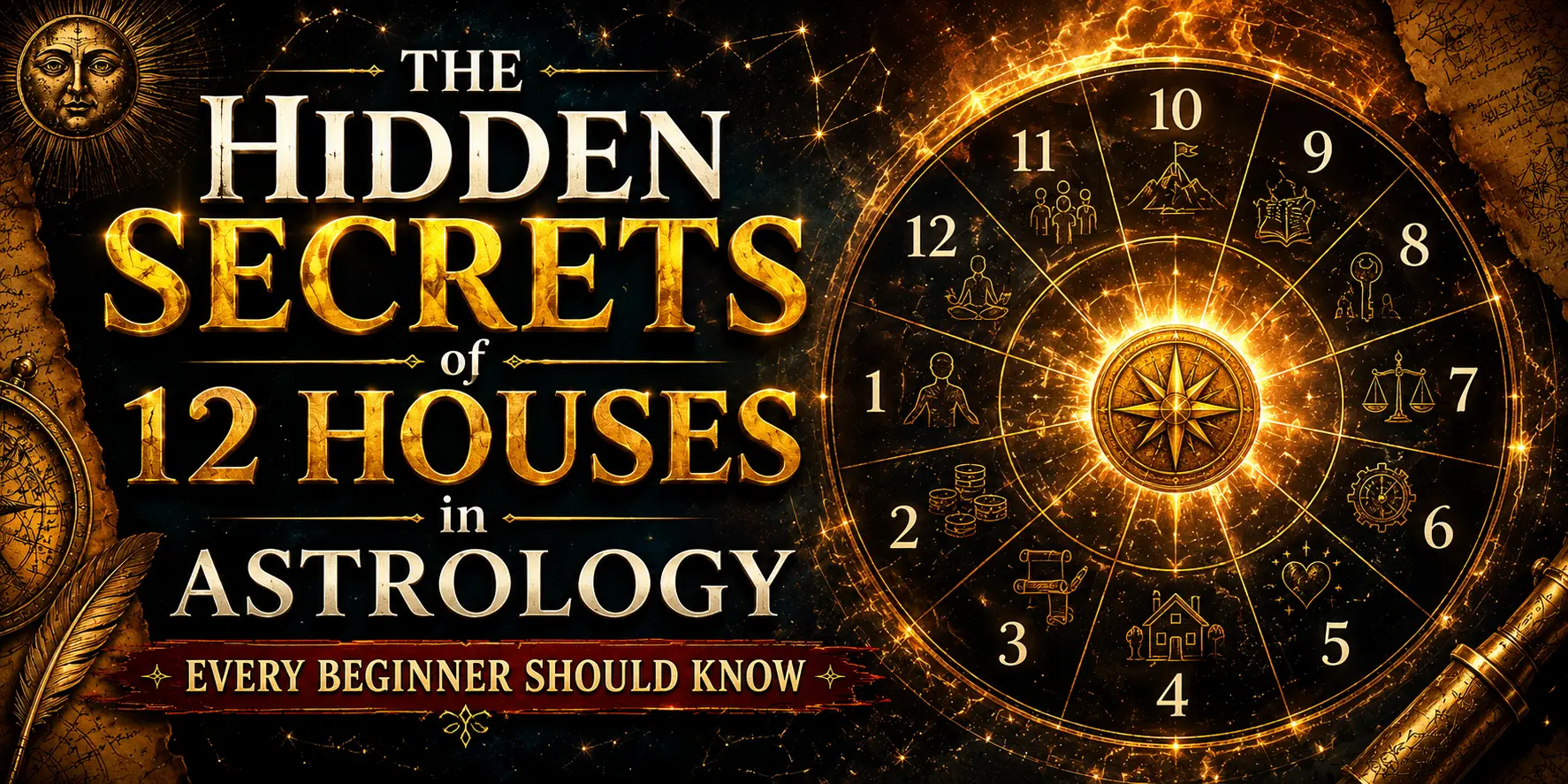
Now that we’ve identified the signs and Grahas, it is time to learn about the houses. If the signs and Grahas are the names used in a chart, houses describe which areas of life are being discussed. Note that they have more than one meaning, but let us begin with the popular associations.
|
House |
Some areas traditionally associated with it |
|
1st |
Self and appearance. |
|
2nd |
Family, speech and saved resources. |
|
3rd |
Effort, skills and siblings. |
|
4th |
Home, mother and comfort. |
|
5th |
Creativity, learning and children. |
|
6th |
Service, competition and debts. |
|
7th |
Marriage and partnerships. |
|
8th |
Shared resources, major changes and research. |
|
9th |
Beliefs, teachers and higher learning. |
|
10th |
Work, duties and public role. |
|
11th |
Gains, networks and aspirations. |
|
12th |
Expenses, withdrawal and release. |
Did you notice the difference between Rashi and Bhava from step one? It comes into use here. Taurus is always Taurus, but Taurus does not always fall into the second house. The position of a sign in a house depends on the Lagna and the method of chart calculation.
Step 5: Open a Kundli and Find the Lagna
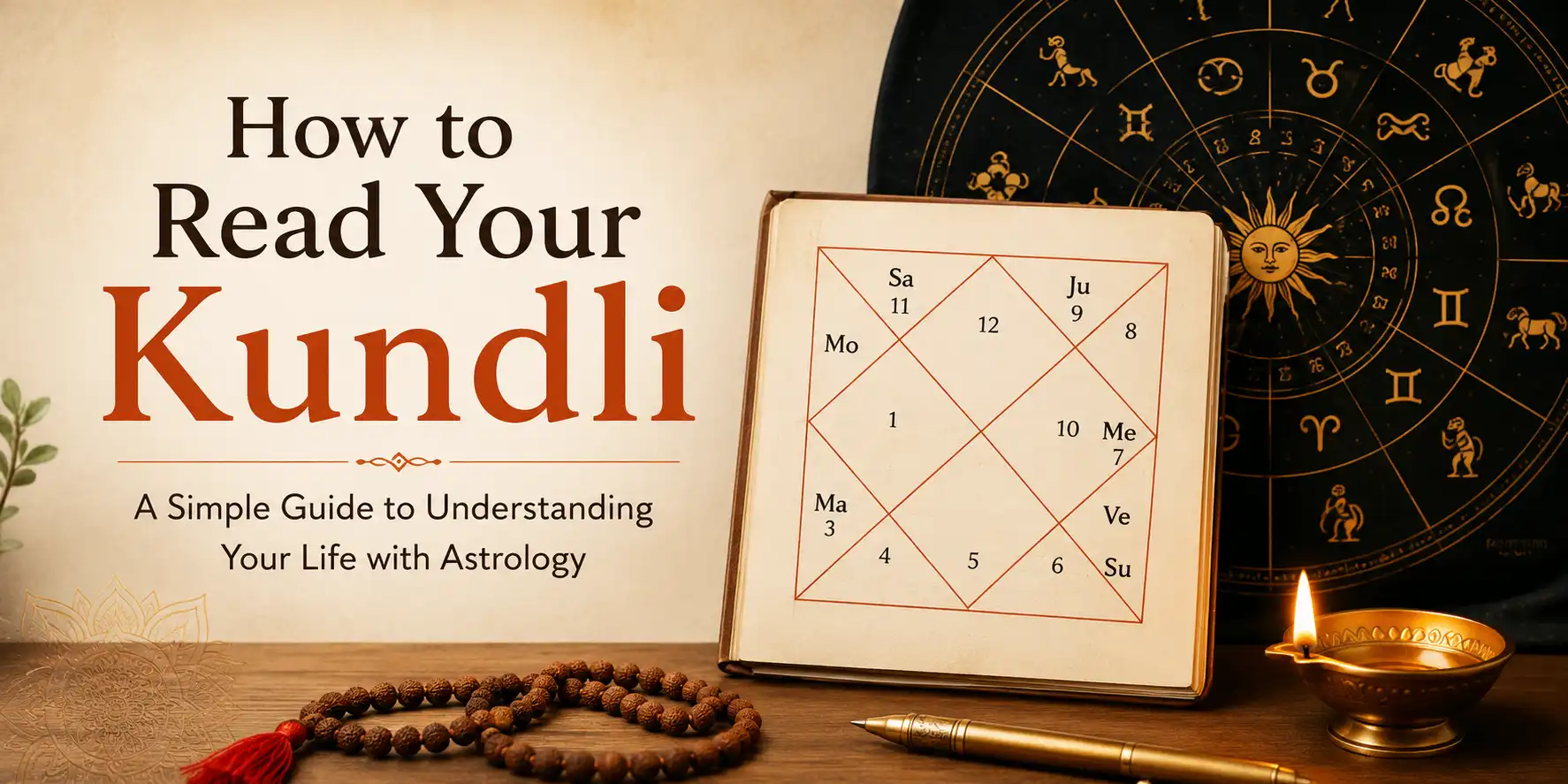
This is as far as the words go, before we move on to the actual chart. Open a birth chart, sometimes called the Rashi or D1 chart, and locate the Lagna first. It tells us which sign falls into the first house of the given chart we are examining.
North Indian and South Indian charts use the same information but in slightly different layouts. Usually, the positions of houses remain fixed in a North Indian chart while the signs remain fixed in a South Indian chart. Choose one for now so that the visual format does not add to what you have to learn at this point.
Once you have chosen the format, proceed to examine the chart in this order:
-
Look at the date, time and place used to create it.
-
Identify the Lagna and its sign.
-
Identify the Moon and its sign.
-
Locate the other Grahas.
-
See if any number indicates a sign or a house.
You can use our free Kundli calculator to make a chart and practice finding this information too. If the precise birth time is not known, make a note of that. The Lagna and house positions depend on time, and an approximation can alter the outcome.
Let Us Try a Taurus Lagna Example
Suppose we look at a teaching chart with Taurus Lagna. We are using whole-sign houses so Taurus is the first house, Gemini is the second and Aquarius is the tenth.
|
What are we looking for? |
What do we find? |
|
The Lagna |
Taurus. |
|
Its traditional ruler |
Venus. |
|
The sign in the tenth house |
Aquarius. |
|
The ruler of that sign |
Saturn. |
Did you notice what we did? We identified a sign, counted to a house and identified the ruler of that sign. We have yet to discuss what kind of career this person has, because this is only a practice example and not a full horoscope. The next step shows why the ruler is important.
Step 6: Follow the House Lord
In the example, the tenth house includes Aquarius. Saturn traditionally rules over Aquarius, so Saturn becomes the tenth-house lord in this chart. The next question is: where is Saturn placed?
This is where we begin to piece the Kundli together. We can now look at the condition of this planet and its relations to others, rather than simply following the number that indicates a house.
The main things to learn at this point are:
-
House lordship: Which Graha rules the sign in a house?
-
Placement: In which sign and house is that Graha placed?
-
Dignity: is it in its own sign or in one considered exalted or debilitated?
-
Conjunction: Which Grahas are together, and how close are they under the method taught?
-
Drishti or aspect: Which other houses or Grahas does it aspect under that method?
Different schools sometimes explain the rules differently. Identify the method that your source is using before applying a mix of rules. To practice, choose one house and write only the sign, its lord and the placement of the latter. You can later double-check the interpretation if those three pieces of information are correct.
Step 7: Move to Nakshatras and Dashas
We now know what is in a birth chart and how some of its parts relate. The next question many people wonder about is time: why do astrologers talk about one period of life differently to another?
That is where Nakshatras and Dashas come in. Begin by learning how to find the Moon’s birth Nakshatra. In the Vimshottari Dasha system, the position of the Moon in that Nakshatra determines which planetary period is in effect at birth and how much of it remains.
You will often encounter three terms:
-
Mahadasha: A major planetary period.
-
Antardasha: A lesser period within a Mahadasha.
-
Gochar: A current planetary transit, considered alongside the birth chart.
Find the names and dates of these periods in a sample report, and go back to the birth chart to see which planet is associated with a period. A Dasha’s name alone does not indicate the full story or guarantee that everything that happens under it will be good or bad.
Step 8: Leave Yogas and Divisional Charts for Later
You may be familiar with the terms Raj Yoga or Navamsa already. It is tempting to jump straight to the popular combinations, because they sound the most interesting. But Yoga has conditions, and a divisional chart needs to be examined alongside the main chart.
Recall the example with Taurus. Before identifying the tenth-house lord, you had to be familiar with the Lagna, count the houses and recall the traditional ruler of Aquarius. Yogas require even more connecting of details before interpretation. This is why they make more sense once the earlier steps feel familiar.
Begin with one Yoga and a worked example. Later, study one divisional chart, such as Navamsa or D9, asking your teacher or source to identify the rule and whether the birth details are accurate enough for the exercise.
Step 9: Write Down What You Notice
It is easy to think a lesson makes sense while you are watching it. Close the video and try explaining it on paper. This is when you discover what you remember and what you need to clarify.
Keep a notebook for the charts you practice with. You only need a few bits of information on each page:
-
The lesson or source you followed.
-
The birth details and chart settings used.
-
The sign, planet, house or rule you checked.
-
Your explanation in your own words.
-
Any correction you made afterwards.
You can use your own chart to learn the labels and practice the method, or use teaching examples to practise the method. If someone shares their birth details with you, ask permission to do so and keep their information private.
And take notes on what goes wrong. Discovering that you miscounted the houses is useful; now you know what to double-check before the next chart.
Step 10: Let Your Questions Guide the Next Lesson
When should you move on? Test yourself by explaining the current topic without referring to your notes. Can you identify a Rashi and a house? Can you find a house lord and explain your process? Can you identify the rule behind an aspect?
If one thing is still unclear, go back to it and practise again. A good teacher can assess your work, explain why an answer was incorrect and identify what readings cannot say with certainty. This kind of feedback is more useful than gathering one more list of planet meanings.
A Four-Week Starting Plan
If you want a schedule, try this one. Set aside around 20 to 30 minutes at a time when you can dedicate this to learning astrology. The four weeks give your first lessons some structure; they are not a deadline to master astrology.
|
Week |
What to study |
What to do with it |
|
1 |
Basic terms, Rashis and their rulers. |
Make a brief reference sheet and explain the difference between a sign and a house. |
|
2 |
The nine Grahas and 12 houses. |
Find each Graha in a labelled teaching chart and write one meaning for each house. |
|
3 |
Lagna and chart layout. |
Work through the Taurus Lagna example, then try another chart from your lesson. |
|
4 |
House lords and revision. |
Find the sign and ruler of three houses. Check your answers and note what confused you. |
After that, move on to planetary condition, aspects, Nakshatras and timing methods. If week three takes you two weeks, that is okay. Understanding the chart is more important than completing a timetable.
Do You Need Books, Videos or a Course?
You can begin at home with one beginner book or a clear lesson series. Choose something that explains the terms, shows a labelled chart, and works through an example. If you jump from five different teachers on the same day, you may end up mixing their methods without realising it.
And a course beats the scattered information online, as a course can help if you want regular lessons and someone to check your chart work. Ask to see the syllabus, how much chart practice is included, and how your questions will be answered. These details tell you more about the learning experience than a promise to make you an expert quickly.
Learn with All India Institute of Occult Science
If you would like to learn with a teacher, take a look at the online Vedic astrology course at All India Institute of Occult Science, founded by Gurudev Shrie Kashyap.
Our published course information describes live online classes, recordings for revision, theory with practical learning, and support for questions with 100 percent placement support. The institute lists three programme levels:
|
Programme |
Published duration |
|
Certificate in Astrology |
2 months. |
|
Diploma in Astrology |
5 months. |
|
Master in Astrology |
8 months. |
The course page notes that teaching can run longer than these stated durations. Have a look at the current astrology syllabus and batch details to see which level fits what you want to learn.