contact@occultscience.in
 +91 96724 36436
 Send Your Query
 Get Syllabus


 +91 96724 36436
 contact@occultscience.in


Written by Jyoti Chauhan, Content Writer · Reviewed by Gurudev Shrie Kashyap, Chairman & Founder, All India Institute of Occult Science · Published 25 Nov 2026
Key Takeaways
- How to become a Reiki healer: train level by level, practise daily on yourself, give many supervised or consented practice sessions, then set up an ethical practice.
- Training levels are short (often 1 to 2 days each), but confidence comes from months of regular practice.
- India has no specific licence for Reiki; a certificate shows training, while ethics and honesty build trust.
- Reiki is a complementary practice: never diagnose, never claim cures, never advise stopping medical treatment.
- The Institute teaches Reiki in five stages, from Level 1 to Grand Master, live online (as of Nov 2026).
Many Reiki healers describe the same beginning. They tried a session during a stressful time, felt unusually calm, and wanted to understand what had happened. A Level 1 class followed, then a daily self-practice, and slowly the question changed from "What is this?" to "Could I offer this to others?"
If you are at that point, this guide is for you. It explains how to become a Reiki healer step by step: the training path, how much practice you really need, what a professional session looks like, the ethics you must follow, and how practitioners build a practice over time. If you are new to Reiki itself, start with our guide on what Reiki is.
What Does a Reiki Healer Do?
A Reiki healer, or practitioner, offers sessions in which they place their hands lightly on or just above the client's body in a series of positions, or send Reiki at a distance. Practitioners describe Reiki as channelling universal life energy to support relaxation and a sense of balance. Clients usually lie or sit fully clothed, and a session often lasts 45 to 60 minutes.
Clients often say they feel warmth, calm or deep relaxation. A responsible healer presents Reiki for what it is: a complementary, relaxing practice that some people find supportive, used alongside medical care, never instead of it.
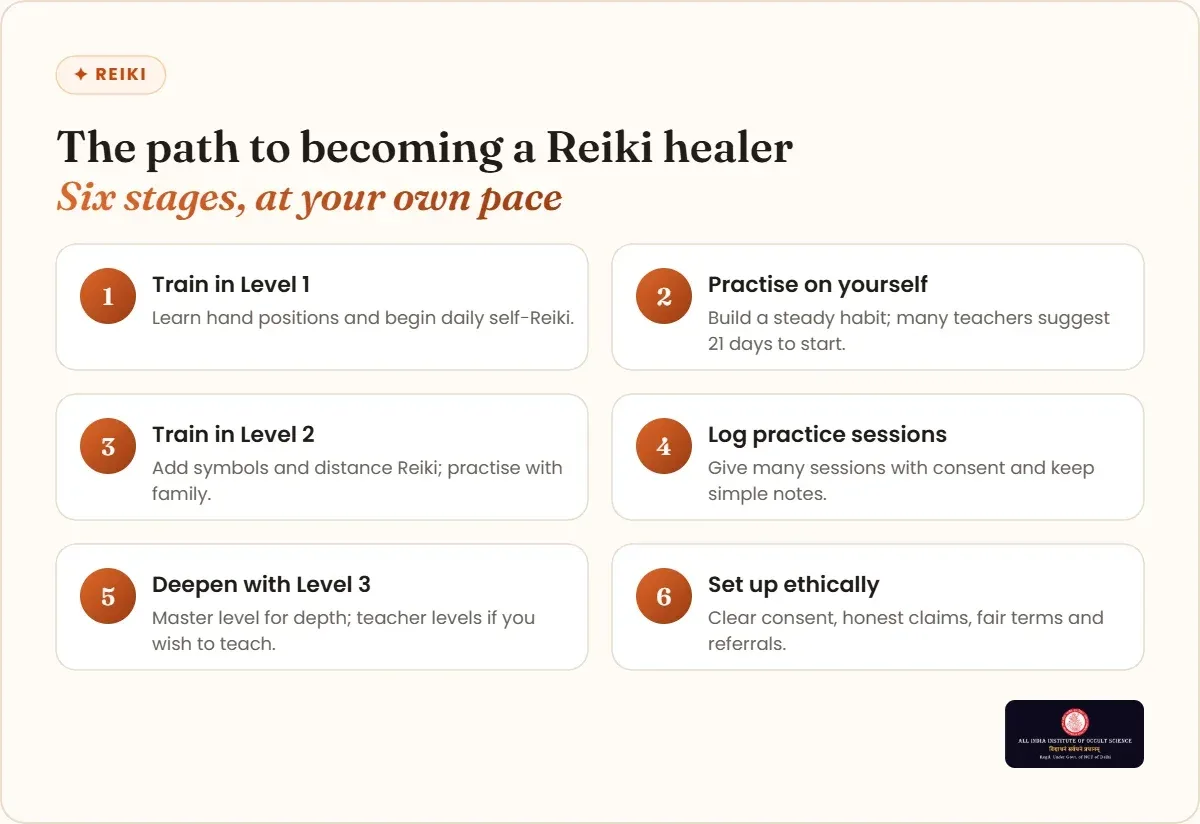
Step 1: Complete Level 1 and Build Self-Practice
Every Reiki healer begins with Level 1, which teaches the hand positions for self-treatment and for treating others, the Reiki principles, and includes the first attunement. The most important part comes after the class: daily self-Reiki. Many teachers suggest 21 consecutive days as a starting routine.
Self-practice matters because you cannot offer calm and steadiness to others without first building it in yourself. It also teaches you, through your own experience, how sessions feel from the inside.
Step 2: Add Level 2 and Practise With Others
Level 2 introduces the traditional symbols and distance Reiki. This is usually the level at which people begin offering sessions to family and friends. Our guide to Reiki levels explains what each level adds and how long to practise between them.
Practice sessions with consenting family and friends are where you learn the practical side: preparing the room, explaining the session, managing time, and asking for honest feedback afterwards.
Step 3: Build Real Practice Hours
There is no fixed number, but experienced practitioners generally recommend giving many practice sessions before offering paid ones. A simple log helps you see your progress:
- Date and length of the session.
- Client's consent and any concerns they mentioned.
- Hand positions used and any adjustments.
- Client feedback, in their own words.
- Your own reflections: what went well, what to improve.
Keep these notes private and anonymised. Over a few months, they become the foundation of your confidence.
Step 4: Deepen With the Master Levels
Level 3 (Master) deepens your practice with the Master symbol and advanced techniques. Some healers stop here; others continue to the teacher level to train students, and to a Grand Master course that covers all levels. Teaching is optional. Many excellent healers never teach and focus entirely on sessions.
What a Professional Reiki Session Looks Like
A well-run session usually follows a clear structure:
- Welcome and intake: a short conversation about why the client has come, any health conditions, and whether they are under medical care.
- Explanation and consent: what will happen, where your hands will be, and that they can stop at any time.
- The session: a calm room, soft light and quiet; hand positions held for a few minutes each.
- Closing: a moment of grounding, water, and time for the client to share how they feel.
- Aftercare: simple advice such as resting and drinking water, plus a reminder to continue any medical treatment.
The Ethics Every Reiki Healer Must Follow
Ethics are not an extra; they are the foundation of a trustworthy practice. The US National Center for Complementary and Integrative Health notes that Reiki has not been clearly shown to help any health condition and that there is no scientific evidence for the energy field it describes, while also reporting no known harmful effects. That is exactly why honest framing matters.
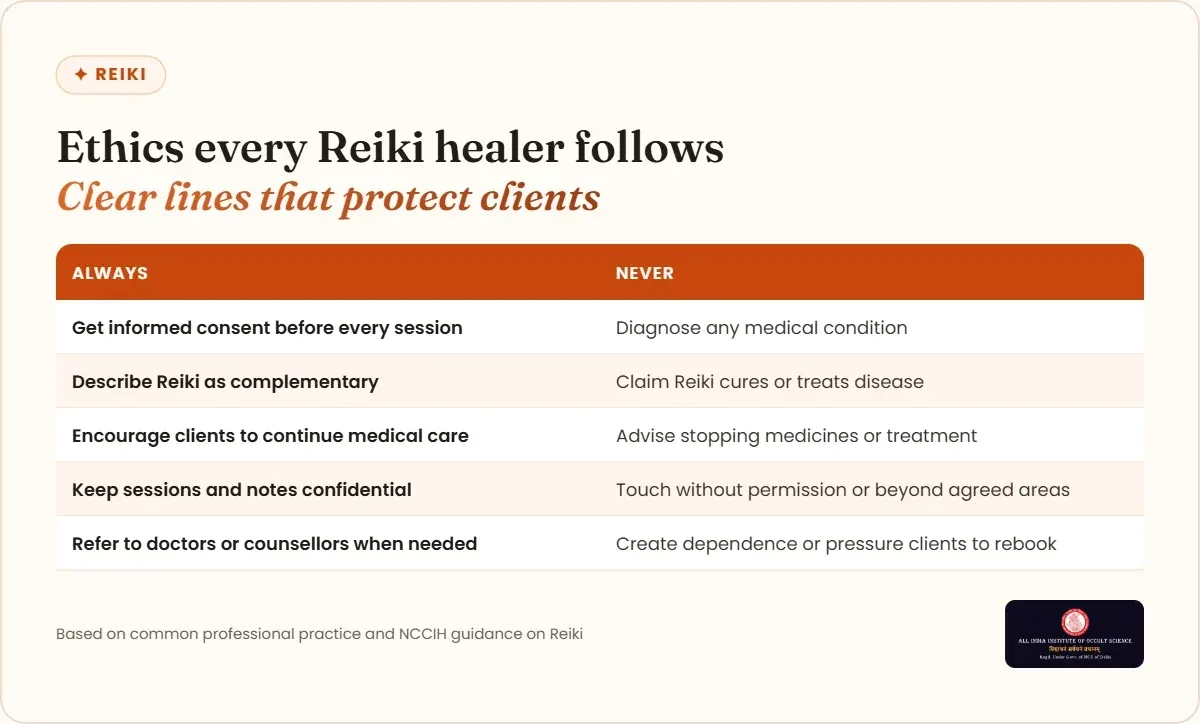
In India, advertising remedies with "magic" healing claims for diseases is also restricted by law, which is another reason to avoid any language about curing or treating illness. Describe what clients may experience, such as relaxation and calm, and nothing more.
A Sample Practice Week for New Healers
Structure makes progress visible. Here is an example week many students find manageable after Level 2:
- Daily: 15 to 20 minutes of self-Reiki, morning or before sleep.
- Twice a week: a full practice session with a consenting family member or friend, logged in your notebook.
- Once a week: a distance session for someone who has asked for it, at an agreed time.
- Weekend: 20 minutes reading back your notes and choosing one thing to improve.
Follow this for three months and you will have dozens of sessions behind you, along with a clear sense of your own style.
Self-Care for Reiki Healers
Practitioners stress that a healer's own state matters. Sessions given while exhausted, rushed or upset are rarely calm. Simple habits help: enough sleep, regular self-Reiki, breaks between sessions, light meals before long days, and time away from client work. Many healers also keep a short grounding ritual, such as washing hands and taking a few slow breaths, between sessions.
Questions Clients Often Ask
- "Will I feel something?" Many people feel warmth or deep relaxation; some feel little. Both are normal.
- "How many sessions do I need?" Avoid fixed promises. Suggest one session, then let the client decide.
- "Can Reiki replace my medicine?" No. Say so clearly and encourage them to follow their doctor's advice.
- "Do I need to believe in it?" No belief is required to receive a relaxing session.
Setting Up Your Reiki Practice
Space
A quiet, clean room with a massage table or comfortable chair, soft lighting, a blanket and water is enough. Many healers also offer distance sessions by video or at agreed times.
Clear information
Write a short description of what a session is, how long it lasts, what clients may experience, and what Reiki does not do. Include your training and levels honestly.
Fair terms
Set session length, price, cancellation policy and how you handle follow-ups. Avoid packages that pressure clients into many sessions upfront.
Records and privacy
Keep intake forms and notes secure. Never share client details without permission.
Where Reiki Healers Work
Reiki practitioners work in many settings. Some run a small practice from home or a rented room; others offer sessions at yoga studios, spas, wellness retreats or meditation centres. Many combine Reiki with an existing role, such as a yoga teacher, counsellor or wellness coach, where it fits naturally as an added relaxation service. Distance sessions also let practitioners work with clients in other cities and countries.
Whatever the setting, the same standards apply: consent, honest claims, clean and calm space, and respect for the client's medical care.
How Reiki Healers Find Clients
- Word of mouth: by far the most common source, built on calm, professional sessions.
- Wellness partnerships: yoga studios, meditation groups and wellness centres.
- A simple online presence: a social media page or profile with honest information.
- Workshops: short introductory talks on relaxation and self-Reiki.
Income varies widely and depends on location, experience and how the practice is run. No course can promise a particular income, and responsible teachers do not.
Distance Reiki Sessions: How Practitioners Run Them
Many healers today offer distance sessions alongside in-person work. Practitioners describe distance Reiki as sending Reiki with intention to a person who is not physically present, a technique taught at Level 2. A clear structure keeps these sessions professional:
- Book a time: agree a time when the client can lie down or sit quietly.
- Confirm consent and context: a short call or message about how they are feeling and any medical care they are receiving.
- Hold the session: usually 20 to 45 minutes, with the client resting at their end.
- Follow up: a brief message afterwards asking how they felt, without suggesting outcomes.
The same ethical rules apply as in person: describe the experience honestly, avoid health claims, and never send sessions to anyone without their permission.
Keeping Session Notes
Simple, private notes help you serve clients better and track your own growth. A useful note includes the date, length and format of the session, what the client asked for, any relevant health context they chose to share, what they reported feeling afterwards, and anything you would do differently. Store notes securely, keep only what you need, and delete them if a client asks you to.
Continuing Your Own Growth
Experienced healers rarely stop learning. Many attend refresher classes, join practice circles with other practitioners, or receive sessions themselves from more experienced healers. Regular self-practice remains the core: practitioners often say that the quality of a session reflects the steadiness of the person giving it.
Common Mistakes New Healers Make
- Rushing through levels without building self-practice.
- Overstating results to attract clients.
- Skipping the intake conversation and missing important health context.
- Neglecting self-care, which leads to fatigue and poor sessions.
- Unclear boundaries around touch, time and fees.
Reiki Alongside Other Practices
Many healers combine Reiki with meditation, breathwork or yoga, and some add another subject such as tarot or astrology later. Our article on Reiki vs meditation explains how the two relate. If you are still deciding which subject to study first, our comparison of astrology, numerology and Vastu also covers where Reiki fits.
How to Train as a Reiki Healer Properly
The Institute's Reiki Grand Master course is taught in five stages: Level 1, Level 2 and Level 3 (A) as one-day trainings of about 3 to 4 hours, followed by Level 3 (B) and Grand Master as two-day trainings. Classes are live online with theory and practice, and the course is ISO Certified and Govt. Registered (as of Nov 2026). You can download the syllabus to see each level.
Conclusion
Becoming a Reiki healer is less about collecting levels and more about steady practice, honest communication and firm ethics. Train level by level, practise daily on yourself, give many consented practice sessions, and set up your practice with clear information and boundaries. When you are ready to begin, explore the Reiki course at the All India Institute of Occult Science.
Reiki is a complementary practice and is not a substitute for medical diagnosis or treatment. Please consult a qualified doctor for any health concern. This article is for educational purposes only; please read our disclaimer.