contact@occultscience.in
 +91 96724 36436
 Send Your Query
 Get Syllabus


 +91 96724 36436
 contact@occultscience.in


Written by Jyoti Chauhan, Content Writer · Reviewed by Gurudev Shrie Kashyap, Chairman & Founder, All India Institute of Occult Science · Published 22 Nov 2026
Key Takeaways
- How to access Akashic Records, in this tradition: a calm meditation, a clear intention, a sacred opening, one open question, honest note-taking and a formal close.
- Beginners usually need only 20 to 30 minutes per session; short, regular practice works better than long sessions.
- Practitioners favour open, self-focused questions over predictions about events, money or other people.
- Opening prayers are traditionally learned from a teacher; many lineages treat them as protected texts.
- Akashic work is a spiritual practice, not a substitute for therapy, medical care or professional advice.
You have read about the Akashic Records, perhaps heard a friend describe a reading, and now you are wondering: can I do this myself? Is there a method, or does it depend on special gifts?
Practitioners describe accessing the Records as a skill built through meditation, intention and practice. This beginner's guide walks you through the idea, how to prepare, a seven-step meditation, what to ask, what to expect and how to stay grounded and safe. For background on what the Records are believed to be, read our guide on the Akashic Records.
What Does "Accessing" the Akashic Records Mean?
The word akasha comes from Sanskrit and refers to space or ether, the subtlest element. The modern idea of the Akashic Records was shaped in the late nineteenth century by Theosophical writers; Britannica's entry on Theosophy describes the movement that popularised it.
Practitioners describe the Records as a non-physical record of each soul's journey. "Accessing" them means entering a calm, focused state in which you believe you can receive impressions, words, images or feelings in response to a sincere question. It is a practice of belief and inner listening, not something that has been measured scientifically.
Before You Begin: Preparing Yourself
Teachers place a lot of emphasis on preparation, because the quality of the session depends on your state of mind.
- Choose a calm time: early morning or evening, when you are not rushed.
- Avoid alcohol or recreational substances beforehand; most lineages ask for a clear mind.
- Write your question before you start, so you are not searching for it during meditation.
- Keep a notebook ready. Writing helps you stay present and gives you a record to review.
- Check in with yourself: if you are very upset or exhausted, rest first. Sessions are best approached from a steady place.
The Role of Meditation
Every approach to the Records rests on meditation. Settling the breath and quietening the mind are what allow subtle impressions to be noticed at all. Research on meditation itself is encouraging: the NCCIH summary on meditation and mindfulness notes possible benefits for stress, anxiety and sleep, while adding that much of the evidence is still developing.
If you already practise meditation or Reiki, you will likely find the transition easier. Our article on Reiki describes a practice many Akashic students also use for grounding.
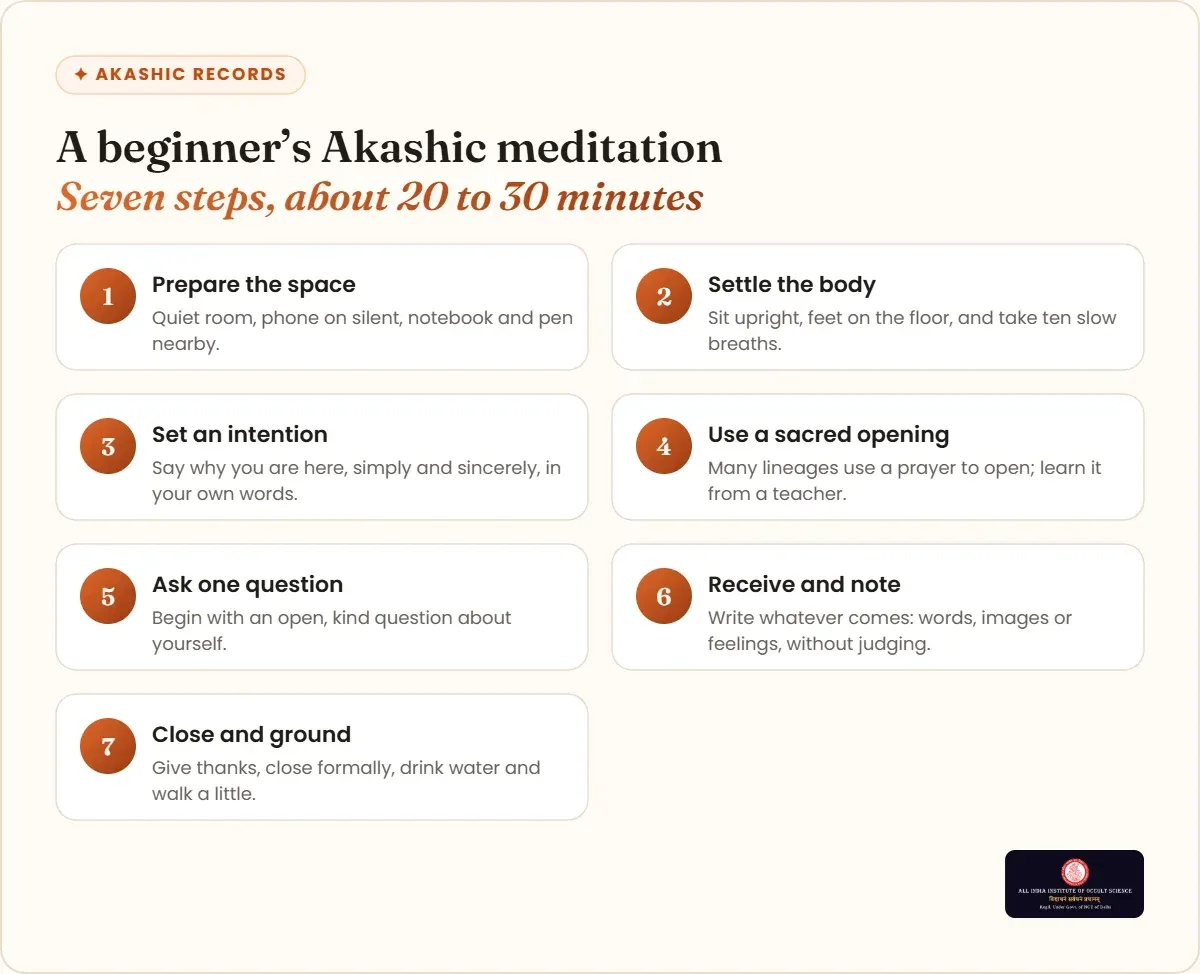
A Seven-Step Beginner's Meditation
About the opening prayer
Many Akashic lineages use a specific prayer or invocation to open and close a session. These prayers are usually passed on by teachers, and some are protected texts, so we do not reproduce them here. If you are learning on your own, a simple, sincere statement of intention, in your own words, is a respectful starting point until you train with a teacher.
Receiving impressions
Beginners often expect a voice or a vision. More often, impressions are subtle: a word that pops into the mind, a memory, a colour, a feeling of warmth or a sudden sense of understanding. Write everything down without judging it. Meaning usually becomes clear later, when you read your notes again.
Closing and grounding
Closing is as important as opening. Give thanks, close the session formally, and then ground yourself: drink water, eat something light, walk, or simply feel your feet on the floor for a minute.
What to Ask in Your First Session
The kind of question you ask shapes the whole session. Practitioners recommend open, self-focused questions that invite understanding rather than predictions:
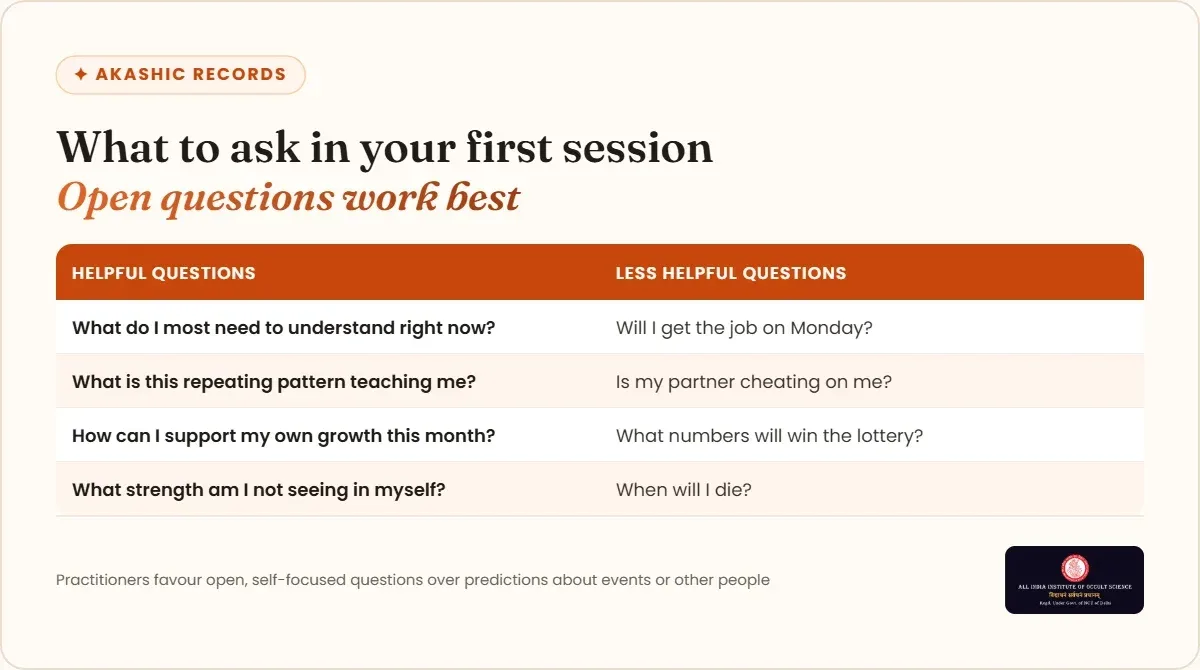
Questions about other people's private lives, exact dates, health diagnoses or money outcomes are discouraged. They tend to produce anxiety rather than insight, and they cross ethical lines. Many beginners find it helpful to explore a repeating pattern; our guide to Akashic Records and karma shows how practitioners approach such patterns.
What to Expect: A Realistic Picture
Experiences vary a great deal. Some people describe vivid impressions in their first session; many feel only calm and relaxed for the first few weeks. Both are normal. Practitioners compare it to learning a language: at first you catch single words, later you understand sentences.
A few realistic expectations help:
- Insights are usually gentle and practical, not dramatic.
- Your own thoughts and wishes can colour what you receive; journalling over time helps you notice this.
- Nothing received should be treated as a prediction or an instruction to act against your judgement.
- The value lies in reflection, clarity and kinder choices.
A Sample First Session (Invented Example)
To make the steps concrete, here is an invented example of how a beginner's session might unfold. Meera, a sample learner, sits down at 7 a.m. with her notebook. She takes ten slow breaths, states her intention ("I am here to understand myself with kindness"), and reads the opening her teacher gave her.
Her question is: "What do I most need to understand about my work right now?" For a few minutes nothing seems to happen. Then the word "pace" comes to mind, followed by a memory of rushing through a project last month and an image of a slow river. She writes all three down without trying to explain them.
She closes, drinks a glass of water and goes about her day. That evening, reading her notes, she connects them: she has been saying yes to every task and working at a pace she cannot sustain. Her small action for the week is to agree to one new task at a time.
Nothing in this example is dramatic, and that is typical. The value came from slowing down enough to notice something she half knew already.
Doubts Beginners Often Have
- "Am I just imagining it?" Many practitioners say imagination is part of how insight arrives. Judge impressions by whether they are kind and useful, not by how they feel in the moment.
- "Nothing came through." A quiet, relaxing session is still practice. Keep going with short, regular sessions.
- "What I received worried me." Fearful messages are not considered characteristic of the Records. Close the session, ground yourself, and talk it over with a teacher.
Building a Regular Practice
Teachers usually suggest short sessions two or three times a week rather than long sessions occasionally. A simple routine:
- Week 1: practise only the settling and grounding steps, without a question.
- Week 2: add an intention and one open question; write for five minutes.
- Week 3: continue, and read back your notes at the end of the week.
- Week 4: notice themes across sessions and choose one small action based on them.
Keep your notebook dated. Over a few months it becomes a valuable record of your own growth, whatever you believe about its source.
How to Keep an Akashic Journal
A journal turns scattered impressions into something you can learn from. Practitioners suggest a simple, consistent format for every session:
- Date and time, and how you felt before starting.
- Your question, written exactly as you asked it.
- What came through: words, images, memories or feelings, without editing.
- Your reflection a day later: what makes sense now, and what still does not.
- One small action you choose to take, and later, what happened when you did.
Reading back a month of entries often shows themes you would never notice in a single session. Keep the journal private, and remember it is a record of your own reflection, not proof of anything beyond it.
When to Pause Your Practice
Teachers also advise knowing when not to sit for a session. Pause if you are grieving intensely, feeling unwell, very anxious, or using the practice to avoid a decision or a conversation. Rest, talk to someone you trust, and return when you feel steady. A short break never undoes progress.
Common Beginner Mistakes
- Trying too hard: forcing images or answers creates tension; relaxation comes first.
- Asking yes/no questions about events: they rarely produce useful insight.
- Skipping the close: leaving the session abruptly can make you feel scattered.
- Reading for others too soon: practise on yourself for months before offering readings, and learn ethics first.
- Using sessions to avoid real decisions: insight should support action, not replace it.
Staying Safe and Grounded
| Akashic practice can | Akashic practice cannot |
|---|---|
| Offer a calm, reflective spiritual practice | Diagnose or treat mental or physical health conditions |
| Encourage self-awareness and compassion | Prove past lives or predict events |
| Support journalling and personal growth | Replace therapy, medical care or legal and financial advice |
If you are going through grief, trauma, anxiety or depression, please speak with a qualified counsellor, therapist or doctor first. Spiritual practice can sit alongside professional support, but should never replace it.
Akashic Practice and Other Intuitive Tools
Some students combine Akashic meditation with other reflective tools. Tarot, for instance, uses images to prompt reflection, while Akashic work relies on inner listening. Our guide to tarot cards explains that practice if you are curious. Students who also train in Reiki often find the two complement each other; our guide to Reiki levels outlines that path.
How to Learn Akashic Records Practice Properly
Learning with a teacher gives you a tested method, the opening and closing prayers of a lineage, supervised practice and a clear ethical framework. The Institute offers a Diploma in Akashic Records (about 2 months), taught live online in small batches with practice sessions and guidance on reading for yourself before reading for others.
Conclusion
Learning how to access your Akashic Records begins with simple, steady steps: prepare calmly, settle your breath, set a sincere intention, ask one open question, write what comes and close with gratitude. Approach it with curiosity rather than expectation, and let it support your life rather than direct it. When you are ready for guided practice, explore the Akashic Records course at the All India Institute of Occult Science.
This article shares traditional spiritual knowledge for educational purposes. It is not a substitute for professional medical, psychological, legal or financial advice. Please read our disclaimer.