contact@occultscience.in
 +91 96724 36436
 Send Your Query
 Get Syllabus


 +91 96724 36436
 contact@occultscience.in


Written by Jyoti Chauhan, Content Writer · Reviewed by Gurudev Shrie Kashyap, Chairman & Founder, All India Institute of Occult Science · Published 24 Nov 2026
Key Takeaways
- Astrology vs numerology vs Vastu: astrology is the broadest system, numerology the quickest to start, and Vastu the most visual and space-focused.
- Numerology needs only simple addition; astrology needs moderate calculation and patience; Vastu needs measuring and some geometry.
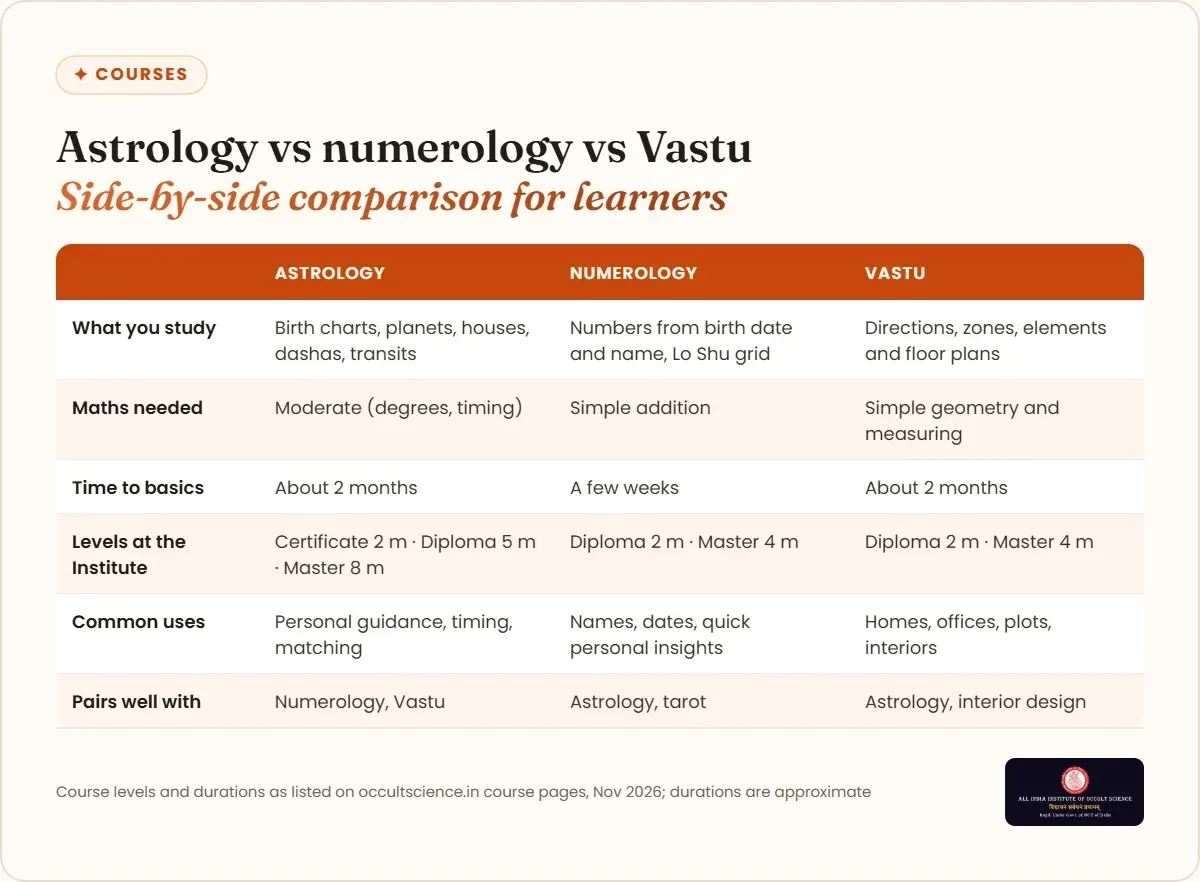
- At the Institute, astrology runs from a 2-month Certificate to an 8-month Master; numerology and Vastu each run as a 2-month Diploma and 4-month Master (as of Nov 2026).
- Choose by goal: depth and timing (astrology), quick personal insight (numerology), homes and design (Vastu).
- Tarot, Reiki, palmistry, graphology and Akashic Records are good first or second subjects depending on your temperament.
"I want to learn something in occult science, but where do I start?" It is one of the most common questions admissions teams hear. Some people come in sure they want astrology, then discover numerology fits their schedule better. Others start with numerology for its simplicity and realise they love the depth of astrology.
There is no single right answer, but there is usually a right answer for you. This guide compares astrology, numerology and Vastu side by side: what each involves, how much maths it needs, how long the basics take, how each is used, and who it suits. It also explains where tarot, Reiki, palmistry, graphology and the Akashic Records fit in.
The Quick Answer
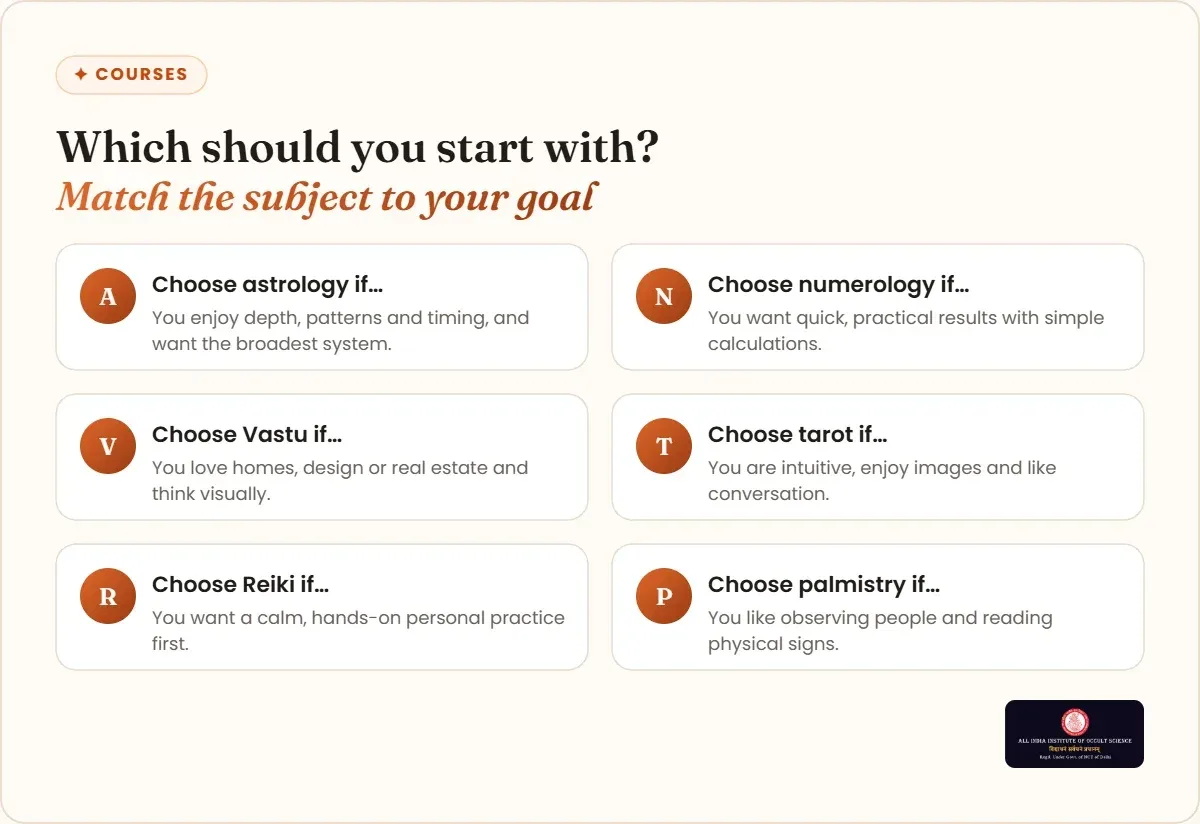
If you want the broadest, deepest system and enjoy patterns, choose astrology. If you want quick, practical insight with simple calculations, choose numerology. If you love homes, design or real estate, choose Vastu. Many students eventually learn two, and the order matters less than starting with real interest.
Side-by-Side Comparison
Astrology: The Broadest System
Vedic astrology, or Jyotish, studies the positions of the grahas (planets) at the time of birth across twelve signs and twelve houses. It adds the 27 nakshatras, planetary periods (dashas), transits and divisional charts. Because of this depth, astrology is often called the mother subject of the occult sciences.
What you will learn
- Reading a birth chart (kundali): planets, signs, houses and aspects.
- Yogas, strengths and weaknesses of planets.
- Timing through mahadasha, antardasha and transits.
- Applications such as matching and muhurat at advanced levels.
Who it suits
People who enjoy depth, are patient with complexity, and like the idea of a lifelong study. It also suits those who want to understand timing: why certain themes rise at certain periods of life.
Formal study of Jyotish exists at university level too; IGNOU, for example, offers a two-year Master of Arts in Jyotish (MAJY). If astrology is your goal, our guide on how to become an astrologer shows the full path.
Numerology: The Quickest Start
Numerology studies the numbers derived from your date of birth and name. In Indian practice (ank jyotish), each number from 1 to 9 is linked with a planet, which connects numerology closely to astrology. Britannica traces numerology back to ancient number mysticism, and modern systems such as Chaldean and Pythagorean numerology developed from it.
What you will learn
- Mulank (birth number), bhagyank (destiny number) and name number.
- The Lo Shu grid, missing numbers and planes.
- Compatibility, personal years and choosing dates.
- Name and business name analysis.
Who it suits
People who want practical results quickly, prefer simple calculations, and enjoy giving short, focused readings. It also suits working professionals with limited time. Our page on what numerology is is a good first read.
Vastu: The Science of Space
Vastu Shastra is the traditional Indian system of architecture and space planning. It uses the Vastu Purusha Mandala, the eight directions, sixteen zones and the five elements to plan homes, offices and plots.
What you will learn
- Directions, zones and the five elements (panch tattva).
- Entrance placement, room allocation and the Brahmasthan.
- Reading floor plans and suggesting practical corrections.
- Vastu for homes, flats, offices, shops and plots.
Who it suits
Visual thinkers, homeowners, interior designers, architects and real-estate professionals. Vastu is often the most tangible subject, because you can see its principles on a floor plan. Read our guide to Vastu Shastra for an overview.
How Much Maths Does Each Need?
Many people avoid astrology because they fear the maths. In reality, modern software calculates charts accurately, so the student's job is mainly interpretation. You still need to understand degrees, signs and time periods, but not advanced mathematics.
- Numerology: addition and reduction to a single digit. That is all.
- Vastu: measuring, dividing a plot into a grid and reading a compass.
- Astrology: understanding degrees, time zones and periods; software handles heavy calculation.
How Long Does Each Take?
Durations depend on the course and your practice, but the Institute's current levels give a useful benchmark (as of Nov 2026):
- Astrology: Certificate (about 2 months), Diploma (about 5 months), Master (about 8 months).
- Numerology: Diploma (about 2 months), Master (about 4 months).
- Vastu: Diploma (about 2 months), Master (about 4 months).
Learning does not stop with a certificate. Most practitioners say real skill comes from years of reading real charts, numbers and plans.
What a Typical Session Looks Like in Each Subject
Another way to choose is to picture yourself doing the work. Here is how a typical consultation or practice session tends to look in each subject.
An astrology session
You begin with the person's date, time and place of birth and generate the chart. You study the ascendant, the Moon, key houses and the running dasha before the session. During the conversation, you listen to the question, connect it to the relevant houses and periods, and explain tendencies and timing in plain language. A careful reading often takes 45 to 60 minutes, plus preparation.
A numerology session
You calculate the mulank, bhagyank and name number, draw the Lo Shu grid and note missing or repeated numbers. Sessions are often shorter, around 20 to 40 minutes, and focus on personality, strengths, suitable dates or name choices. Many numerologists enjoy the speed and clarity of this work.
A Vastu consultation
You start with a floor plan and a compass reading. You mark the centre, divide the plan into zones, check the entrance and key rooms, and suggest practical changes. Some consultations happen on site; many are done from plans and photographs. The work is visual, practical and often involves families making real decisions about their homes.
Three Learner Profiles (Invented Examples)
These invented profiles show how different people often choose:
- Anita, 42, homemaker: curious about her family's charts and keen on a long-term study. She starts with the astrology Certificate, enjoys it, and continues to the Diploma, adding numerology a year later.
- Rohan, 29, software professional: limited time on weekdays, wants quick results. He begins with the numerology Diploma, then adds tarot because he enjoys conversations with friends.
- Farah, 35, interior designer: clients keep asking about Vastu. She takes the Vastu Diploma and Master, and now offers Vastu-aware design as part of her existing practice.
None of these paths is better than the others. Each started from a clear reason, which is the best predictor of finishing a course and continuing to practise.
Which Should You Learn First? A Simple Guide
If you are a complete beginner
Numerology is often the gentlest entry point because results come quickly and build confidence. Many students then move to astrology, where the planetary meanings of numbers make immediate sense.
If you want a long-term practice
Astrology gives the widest foundation. Once you understand planets and houses, Vastu and numerology both become easier, because they share many of the same planetary ideas.
If your work involves spaces
Vastu fits naturally with interior design, architecture and real estate, and it can add a valued service to an existing profession.
What About Tarot, Reiki, Palmistry and Others?
The Institute teaches eight subjects in all. The other five suit different temperaments:
- Tarot (Card Reading): intuitive, image-based and conversational. A good first subject for people who like reading for others. See how to become a tarot card reader. Levels: Diploma (about 2 months) and Master (about 4 months).
- Reiki: a hands-on, meditative practice focused first on yourself. It is taught in short levels; our guide to Reiki levels explains the path.
- Palmistry: reading the hand's lines, mounts and shape. It suits observant people who like face-to-face sessions. Start with our palmistry guide for beginners. Levels: Diploma (about 2 months) and Master (about 4 months).
- Graphology: handwriting analysis for self-understanding; a calm, analytical subject. See our complete guide to graphology.
- Akashic Records: a meditative, reflective spiritual practice. Read what the Akashic Records are. Level: Diploma (about 2 months).
Can You Learn Two Subjects Together?
You can, but most students do better with one at a time. A common pattern is to finish the first level of one subject, practise for a few months, then start a second. Natural pairings include:
- Astrology and numerology: both use planetary meanings.
- Astrology and Vastu: directions and planets are closely linked.
- Tarot and numerology: card numbers echo numerological meanings.
- Reiki and Akashic Records: both rest on meditation and intention.
How the Three Subjects Work Together
Experienced practitioners often combine all three. Imagine a family about to buy a new home. Astrology may be used to consider a suitable period for the move. Numerology may be used to look at the house number or a date for the griha pravesh. Vastu is used to study the plan itself: the entrance, the kitchen, the bedrooms and the open north-east.
Each subject answers a different question, so together they give a fuller picture. This is one reason many students who begin with one subject eventually study a second or third.
Myths About Learning Occult Science
"You need a special gift."
Astrology, numerology and Vastu are systems with rules, methods and texts. Intuition helps, but steady study and practice matter far more.
"You must be good at maths."
Numerology needs only addition, Vastu needs measuring, and astrology software handles heavy calculations. Patience matters more than mathematical skill.
"It is too late to start."
People begin these subjects at every stage of life, including after retirement. Life experience often makes readings wiser and kinder.
"A certificate makes you an expert."
A certificate shows completed training. Expertise grows from years of practice on real cases, with humility and good ethics.
Using These Subjects in a Career
People use occult sciences in very different ways: as a personal interest, as an added service in an existing profession (an interior designer offering Vastu, for instance), or as a full-time consulting practice. Each path needs training, practice on real cases, clear ethics and patience in building trust.
No course can guarantee income, and earnings vary widely with skill, experience and how a practice is run. What training does offer is method, confidence and a recognised certificate of the training you have completed.
Ethics across every subject
- Never use fear to sell remedies or services.
- Never give medical, legal or investment verdicts.
- Keep client information confidential.
- Encourage clients to make their own decisions.
Study Tips for Your First Three Months
Whichever subject you pick, the first three months decide whether learning becomes a habit. These tips come up again and again from teachers and successful students:
- Fix a weekly schedule: two or three short sessions a week beat one long weekend session.
- Keep a practice notebook: charts you read, numbers you calculated, plans you studied, with your notes and later corrections.
- Practise on familiar cases: your own chart, your family's numbers, your own home's plan. Familiar cases show quickly whether a rule makes sense.
- Revise with recordings: re-watching a difficult class within a day or two helps it stick.
- Ask questions early: small doubts left unanswered grow into big confusions later.
- Avoid mixing systems: learn one method well before comparing it with others.
Online or Classroom Learning?
Both can work well. Classroom study offers face-to-face contact and a fixed routine. Live online study removes travel, opens access to teachers anywhere and usually adds recordings for revision. For working professionals, homemakers and learners outside big cities, live online classes are often the practical choice.
What matters most is that the class is live and interactive, that you can ask doubts, and that you practise between sessions. A recorded course with no feedback is closer to self-study than to guided learning.
| Format | Best for | Watch out for |
|---|---|---|
| Live online | Busy schedules, learners anywhere, revision via recordings | Needs a quiet space and steady internet |
| Classroom | Learners who prefer in-person routine | Travel time; limited to one city |
| Recorded only | Very self-driven learners | No correction or feedback |
Questions to Ask Before Choosing a Course
- Are classes live, with time for questions and practice?
- Is there a clear syllabus for each level?
- How are students assessed before receiving a certificate?
- Are recordings available for revision?
- Does the course teach ethics and the limits of the subject?
At the Institute, classes are live online through its app in batches of 10 to 15 students, with recordings uploaded within 4 hours and doubt support in class and in the app. Courses are described on their pages as ISO Certified and Govt. Recognised (as of Nov 2026). You can download any course syllabus before deciding.
Course Pages at a Glance
- Astrology course
- Numerology course
- Vastu course
- Card reading (tarot) course
- Palmistry course
- Reiki course
- Graphology course
- Akashic Records course
What the First Level Covers in Each Subject
Knowing what the first level actually teaches helps you choose with confidence. Here is the typical scope of a beginner level in each of the three main subjects.
Astrology: first level
- The nine grahas, their natures, friendships and significations.
- The twelve rashis and twelve bhavas, and how to read the chart layout.
- Aspects (drishti), house lords and basic strength.
- An introduction to nakshatras and the Vimshottari dasha system.
- Reading simple charts of family and friends with guidance.
Numerology: first level
- Mulank, bhagyank and name number, with the Chaldean letter chart.
- Planetary rulers and traits of numbers 1 to 9.
- The Lo Shu grid, missing numbers and the main planes.
- Friendly and unfriendly numbers, and choosing favourable dates.
- Short practice readings for personality and compatibility.
Vastu: first level
- The Vastu Purusha Mandala, eight directions and sixteen zones.
- The five elements and how they map onto a plan.
- Entrance padas and the placement of key rooms.
- Finding the centre and reading compass directions on a floor plan.
- Simple, non-structural corrections for common problems.
Time and Practice: A Realistic Weekly Commitment
Course duration is only part of the picture. Most learners also need regular practice outside class. A realistic weekly commitment looks like this:
| Subject | Classes | Practice outside class |
|---|---|---|
| Astrology | 2 to 3 live sessions | 3 to 5 hours reading charts and revising |
| Numerology | 2 to 3 live sessions | 1 to 3 hours of calculations and practice readings |
| Vastu | 2 to 3 live sessions | 2 to 4 hours studying plans and visiting spaces |
These are typical ranges, not rules. Students who practise consistently, even in short sessions, usually progress faster than those who study for long stretches only before exams.
Building a Portfolio of Practice Cases
Whichever subject you choose, keep a simple portfolio from the first month: anonymised charts, number profiles or floor plans you have studied, each with your notes and your teacher's corrections. By the end of a course, this record shows how your judgement has grown, and it gives you confidence before you read for anyone outside family and friends.
What These Subjects Can and Cannot Do
| They can | They cannot |
|---|---|
| Offer traditional frameworks for self-understanding and planning | Guarantee outcomes in health, wealth or relationships |
| Become a meaningful hobby, added skill or consulting practice | Promise income or replace professional qualifications |
| Encourage reflection and better questions | Replace medical, legal or financial advice |
Conclusion
Astrology, numerology and Vastu each open a different door. Astrology offers the deepest system, numerology the quickest start, and Vastu the most tangible, space-based practice. Choose the one that matches your curiosity and your time, learn it well, and add a second subject when you are ready. To compare every programme in one place, explore the courses at the All India Institute of Occult Science.
This article is for educational purposes. Occult sciences are traditional systems and not a substitute for professional medical, legal or financial advice. Please read our disclaimer.