

 contact@occultscience.in
 +91 96724 36436
 Send Your Query
 Get Syllabus


 +91 96724 36436
 contact@occultscience.in

Written by Jyoti Chauhan, Content Writer · Reviewed by Gurudev Shrie Kashyap, Chairman & Founder, All India Institute of Occult Science · Published 21 Nov 2026
Key Takeaways
- Reiki levels follow a set order: Level 1 (self-healing), Level 2 (symbols and distance Reiki), Level 3 (Master) and, in many schools, a Teacher and Grand Master stage.
- Each level includes an attunement, a short initiation that practitioners believe opens the student to channel Reiki.
- Most teachers suggest 21 days of daily self-practice after Level 1 and several weeks to months of practice between later levels.
- At the Institute, Levels 1, 2 and 3 (A) are one-day trainings, while Level 3 (B) and Grand Master are two-day trainings, taught live online (as of Nov 2026).
- Reiki is a complementary practice for relaxation and wellbeing; it is not a substitute for medical care.
Once someone experiences a Reiki session they enjoy, the next question usually follows quickly: "Can I learn this myself?" Then come the confusing terms: Level 1, second degree, attunements, symbols, Master, Grand Master. Different teachers use slightly different names, which makes the path harder to understand.
This guide explains Reiki levels in plain language: what each level teaches, what an attunement is, how long to practise between levels, how online training works, and what Reiki can and cannot do. If you are new to the practice itself, start with our guide on what Reiki is.
A Short Background: Where the Levels Come From
Usui Reiki is traced to Mikao Usui, who taught the practice in Japan in the early twentieth century. His teaching was passed on through students and later spread worldwide, especially after it reached the United States in the mid-twentieth century. Along the way, the training was organised into degrees, so students could progress step by step.
Today the broad structure is shared by most Usui-based schools, but details differ between lineages: the number of levels, the names used and what each level includes. That is why it is worth checking a course's syllabus rather than relying on the level name alone.
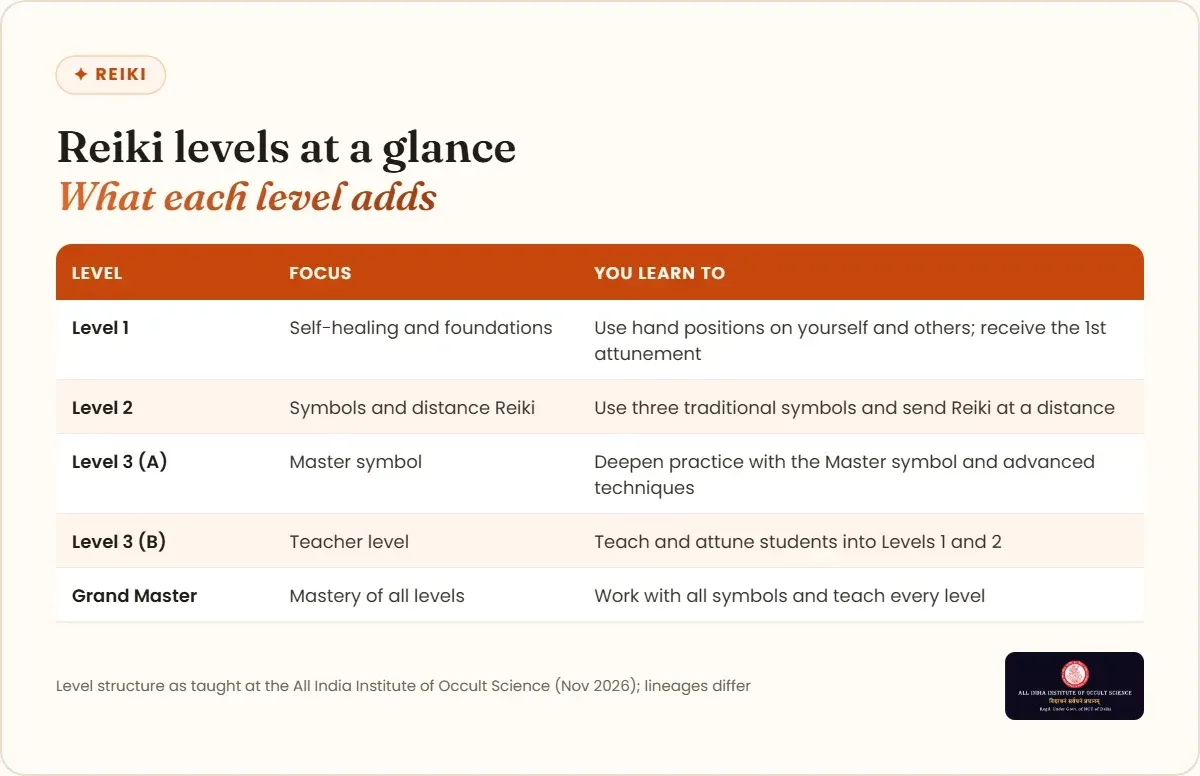
Reiki Levels at a Glance
Reiki Level 1: Foundations and Self-Healing
Level 1, sometimes called the first degree or Shoden, is where everyone begins. The focus is on you: building a daily habit and learning to feel calm, present and grounded.
Typical Level 1 topics include:
- The history and principles of Reiki, including the five Reiki precepts.
- The traditional hand positions for self-treatment.
- Hand positions for giving a session to family or friends.
- Grounding, breathing and the gassho meditation.
- The first attunement.
At the Institute, Level 1 is a one-day training of about 3 to 4 hours, taught online with theory and practice.
The 21-day practice
Many teachers suggest daily self-Reiki for 21 days after Level 1. It is a simple way to make the practice a habit. Students often keep a short journal of how they feel before and after each session.
Reiki Level 2: Symbols and Distance Reiki
Level 2, also called the second degree or Okuden, introduces three traditional symbols and the practice of sending Reiki at a distance. Practitioners believe distance Reiki can be offered to a person who is not physically present, or to a situation, by holding a clear intention.
Typical Level 2 topics include:
- The three Level 2 symbols and how they are used in sessions.
- Distance Reiki methods and a simple session structure.
- Mental and emotional focus during sessions.
- Session ethics: consent, confidentiality and boundaries.
- The second attunement.
The symbols are traditionally taught directly by a teacher, which is why most schools do not publish them in detail. At the Institute, Level 2 is also a one-day training of about 3 to 4 hours.
Reiki Level 3: The Master Level
Level 3, called the Master level or Shinpiden, is often split into two parts.
Level 3 (A): personal mastery
This part introduces the Master symbol and advanced techniques, with a focus on deepening your own practice. At the Institute, Level 3 (A) is a one-day training and includes the third attunement.
Level 3 (B): teacher level
This part teaches you how to teach: running classes, explaining the principles, and conducting attunements for Levels 1 and 2. At the Institute, Level 3 (B) is a two-day training.
The Grand Master Path
Some schools, including the Institute, offer a Grand Master course after the Master and Teacher levels. It focuses on mastery of all the Reiki symbols taught in the lineage, advanced spiritual practice and the ability to teach every level of Reiki. At the Institute this is a two-day programme.
The term "Grand Master" is used differently across lineages, and it is not a regulated qualification. What matters is the depth of practice behind it, not the title.
Reiki Level Names Across Schools
Because lineages name their levels differently, the same training can appear under several names. This quick guide helps you compare courses:
| Common name | Also called | Main focus |
|---|---|---|
| Level 1 | First degree, Shoden, Practitioner 1 | Self-practice and hand positions |
| Level 2 | Second degree, Okuden, Practitioner 2 | Symbols and distance Reiki |
| Level 3 | Master, Shinpiden, Master Practitioner | Master symbol and deeper practice |
| Teacher level | Master Teacher, Level 3B | Teaching and attuning students |
| Grand Master | Used by some schools only | All symbols; teaching every level |
Signs You Are Ready to Teach Reiki
Teaching is a responsibility, not just the next certificate. Experienced teachers often look for a few signs before a student moves to the teacher level:
- You practise self-Reiki regularly and have done so for months.
- You have given many sessions to others and can explain what you do simply.
- You can describe Reiki honestly, including what it cannot do.
- You are comfortable answering beginners' questions without overstating claims.
- You see teaching as service, with clear ethics around consent and fees.
What Is an Attunement?
An attunement, also called an initiation or reiju in some lineages, is a short ceremony performed by a Reiki Master. Practitioners believe it opens the student to channel Reiki more fully. Students describe a range of experiences: warmth, calm, tingling, emotion, or sometimes nothing noticeable at all. All of these are considered normal.
It is important to be clear that attunements are a spiritual practice. They have not been measured by science, and a responsible teacher will say so.
How Long to Practise Between Levels
A common mistake is rushing through all levels in a few weeks. Each level is meant to be lived with, not just completed. Here is a sensible practice path many teachers recommend:
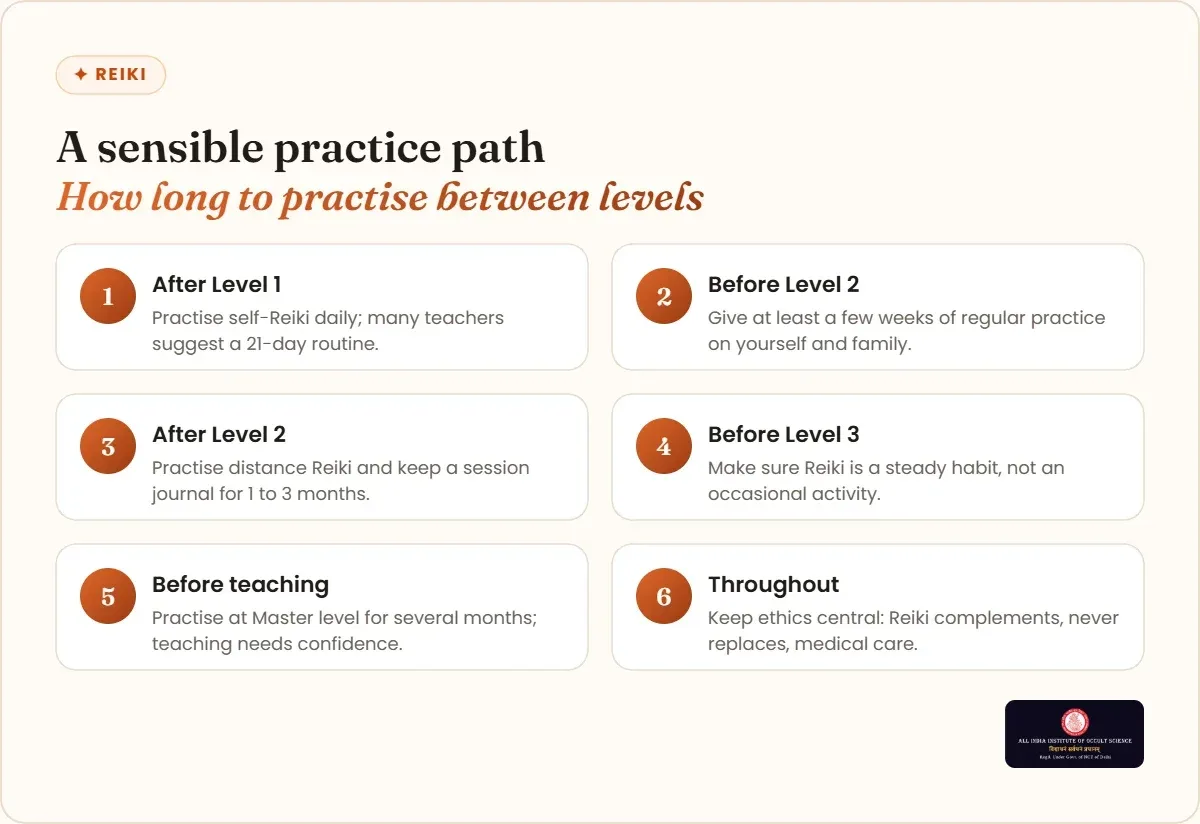
If you are unsure whether you are ready for the next level, a simple test helps: is Reiki already part of your normal week? If yes, you are probably ready. If you still have to remind yourself, keep practising first.
The Five Reiki Principles at Every Level
Whatever level you are at, the five Reiki principles (gokai) stay the same. They are traditionally recited morning and evening, and many teachers say they matter more than any symbol. In a common English rendering, they invite you, just for today, to let go of anger, let go of worry, be grateful, work honestly and be kind to every living thing.
At Level 1 the principles are a daily reminder. At Level 2 they shape how you treat clients and handle distance sessions. At the Master and teacher levels, they become the standard you model for students. A practitioner who lives the principles is usually more trusted than one who simply holds a higher certificate.
What a Typical Self-Practice Session Looks Like
Because self-practice is the backbone of every level, here is a simple routine many beginners follow after Level 1:
- Sit or lie comfortably and take a few slow breaths with your hands in gassho (palms together at the chest).
- Recite the five principles silently or aloud.
- Place your hands on the head positions (eyes, temples, back of the head, throat) for two to three minutes each.
- Move to the front of the body: chest, upper abdomen, lower abdomen.
- Finish with the knees and feet if you are lying down, then rest your hands and breathe quietly.
- Close with gassho and a moment of gratitude, then note in a journal how you feel.
A full routine takes 20 to 40 minutes, but even ten minutes a day keeps the habit alive on busy days. Consistency, not length, is what teachers look for before a student moves to the next level.
Learning Reiki Online
Many students now learn Reiki through live online classes. Practitioners teach that Reiki can be sent at a distance, and online attunements follow that same principle. What makes online learning work well is not the format but the structure:
- Live sessions with real-time guidance, not just videos.
- Practice time during class, with feedback.
- Clear notes on hand positions and session structure.
- Support after class, so questions do not go unanswered.
Reiki and Meditation
Students often notice how much Reiki practice resembles meditation: the quiet breathing, the focus, the stillness. The two practices share a lot but are not the same. Our article on Reiki vs meditation compares them in detail and explains how many people combine both.
What Research Says, and Using Reiki Responsibly
The US National Center for Complementary and Integrative Health (NCCIH) notes that Reiki has not been clearly shown to be useful for any health-related purpose, that studies are generally small and of mixed quality, and that there is no scientific evidence for the energy field Reiki is based on. It also notes that Reiki has not been shown to have harmful effects.
For practitioners, this means describing Reiki honestly: as a complementary practice that many people find relaxing and supportive, used alongside, never instead of, proper medical care.
| Reiki can | Reiki cannot |
|---|---|
| Offer a calm, restful experience many people enjoy | Diagnose, treat or cure a disease |
| Support a daily habit of stillness and self-care | Replace medicines, therapy or a doctor's advice |
| Give a structured spiritual practice to grow with | Guarantee any specific outcome |
Choosing a Reiki Course
When comparing Reiki courses, look beyond the level names:
- Does the syllabus clearly list what each level teaches?
- Are classes live, with time for practice and questions?
- Does the teacher discuss ethics and the limits of Reiki?
- Is there support after the course ends?
- Are you encouraged to practise between levels rather than rushed?
For broader reading, you can browse more articles in our Reiki blog, or explore a related contemplative practice in our guide to the Akashic Records.
How to Learn Reiki Properly
The Institute's Reiki Grand Master course is taught in five stages: Level 1, Level 2 and Level 3 (A) as one-day trainings, followed by Level 3 (B) and Grand Master as two-day trainings. Classes are live online with theory and practice, and the course is ISO Certified and Govt. Registered (as of Nov 2026). You can download the syllabus to see each level's topics.
Conclusion
Reiki levels are a step-by-step path: Level 1 builds your self-practice, Level 2 adds symbols and distance Reiki, Level 3 deepens mastery and teaching, and the Grand Master stage brings it all together. Take your time between levels and let practice, not titles, lead the way. When you are ready to begin, explore the Reiki course at the All India Institute of Occult Science.
Reiki is a complementary practice and is not a substitute for medical diagnosis or treatment. Please consult a qualified doctor for any health concern. This article is for educational purposes only; please read our disclaimer.


