contact@occultscience.in
 +91 96724 36436
 Send Your Query
 Get Syllabus


 +91 96724 36436
 contact@occultscience.in


Written by Jyoti Chauhan, Content Writer · Reviewed by Gurudev Shrie Kashyap, Chairman & Founder, All India Institute of Occult Science · Published 23 Nov 2026
Key Takeaways
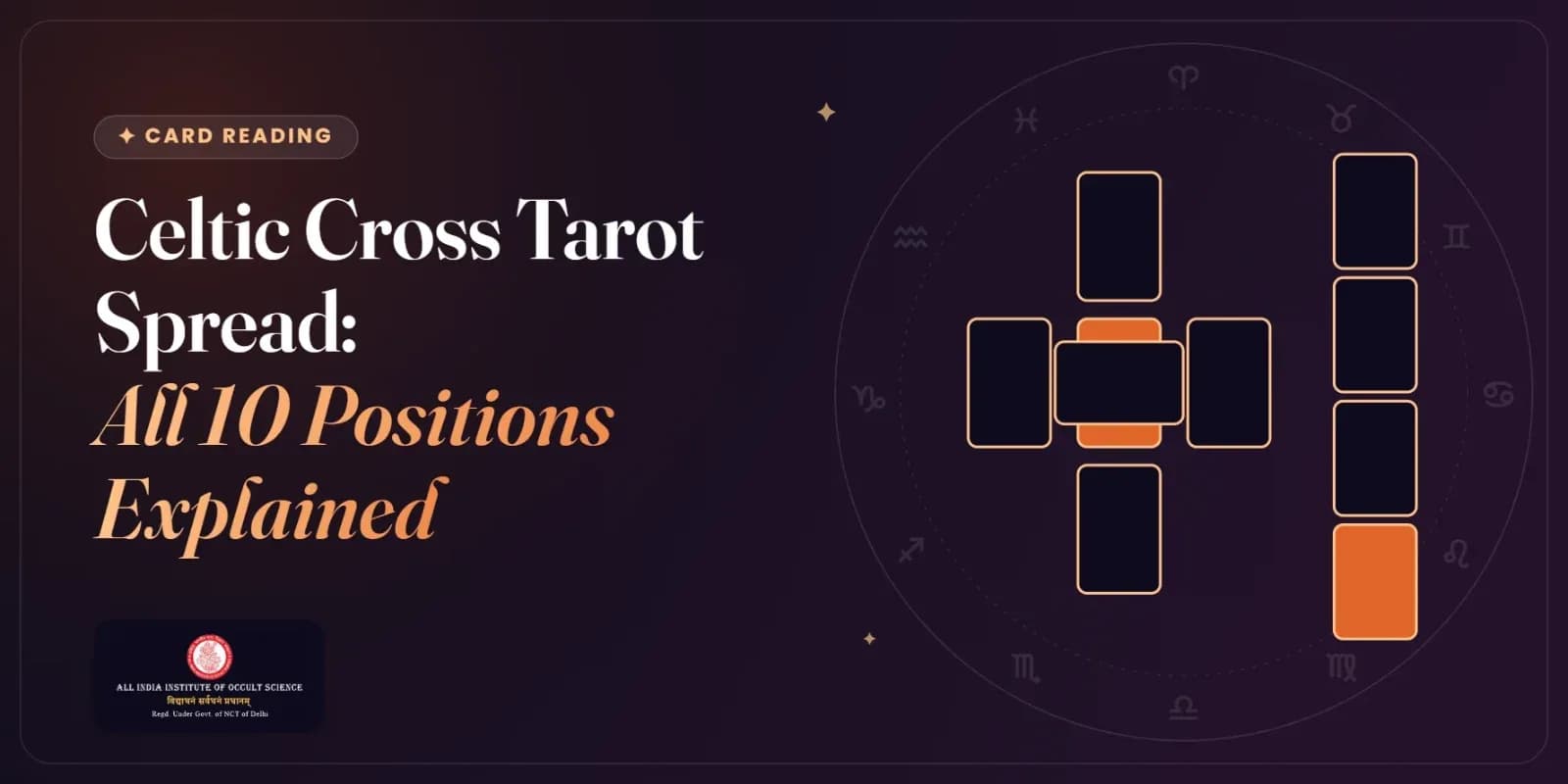
- The Celtic Cross tarot spread uses 10 cards: a cross of six cards in the centre and a staff of four cards on the right.
- Cards 1 and 2 are the core: the present situation and the challenge crossing it.
- Reading positions in pairs (3 with 4, 5 with 6, 9 with 10) turns ten separate cards into one story.
- A careful reading takes about 30 to 45 minutes; it suits complex questions, not quick yes/no ones.
- The outcome card shows a likely direction, not a fixed fate; the querent's choices still shape what happens.
If you have watched an experienced tarot reader at work, you have probably seen it: a cross of cards in the middle of the table, a column of four beside it, and a reader moving slowly between them, connecting one image to the next. That is the Celtic Cross, the best-known spread in tarot.
It looks complicated, but each of its ten positions has a clear job. Once you understand those jobs, the spread becomes one of the most useful tools a reader has.
This guide explains the Celtic Cross tarot spread position by position, shows the order to lay the cards, explains how to read the positions together, and walks through a full sample reading on an invented question. If you are new to tarot, our guide to tarot cards covers the deck first.
Where the Celtic Cross Comes From
Tarot decks first appeared in Italy in the fifteenth century as playing cards; Britannica traces their later use for divination. The Celtic Cross as most readers know it was published by A. E. Waite in 1910 in The Pictorial Key to the Tarot, where he called it "An Ancient Celtic Method of Divination". Waite recommended it as the method most suitable for obtaining an answer to a definite question.
Despite the name, there is no firm evidence the method is ancient or Celtic; the name likely reflects the cross-shaped layout. Over the last century, readers have adapted Waite's wording, but the structure has stayed remarkably stable.
How to Lay Out the Celtic Cross
Shuffle while focusing on the question, then lay the cards in this order:
- Card 1 in the centre.
- Card 2 across card 1, turned sideways.
- Card 3 above the centre.
- Card 4 below the centre.
- Card 5 to the left (the past side).
- Card 6 to the right (the future side).
- Cards 7 to 10 in a vertical column further to the right, starting at the bottom.
Some readers swap the sides for cards 5 and 6, or follow the direction the court card in position 1 faces, as Waite suggested. Choose one convention and use it consistently.
The 10 Positions Explained
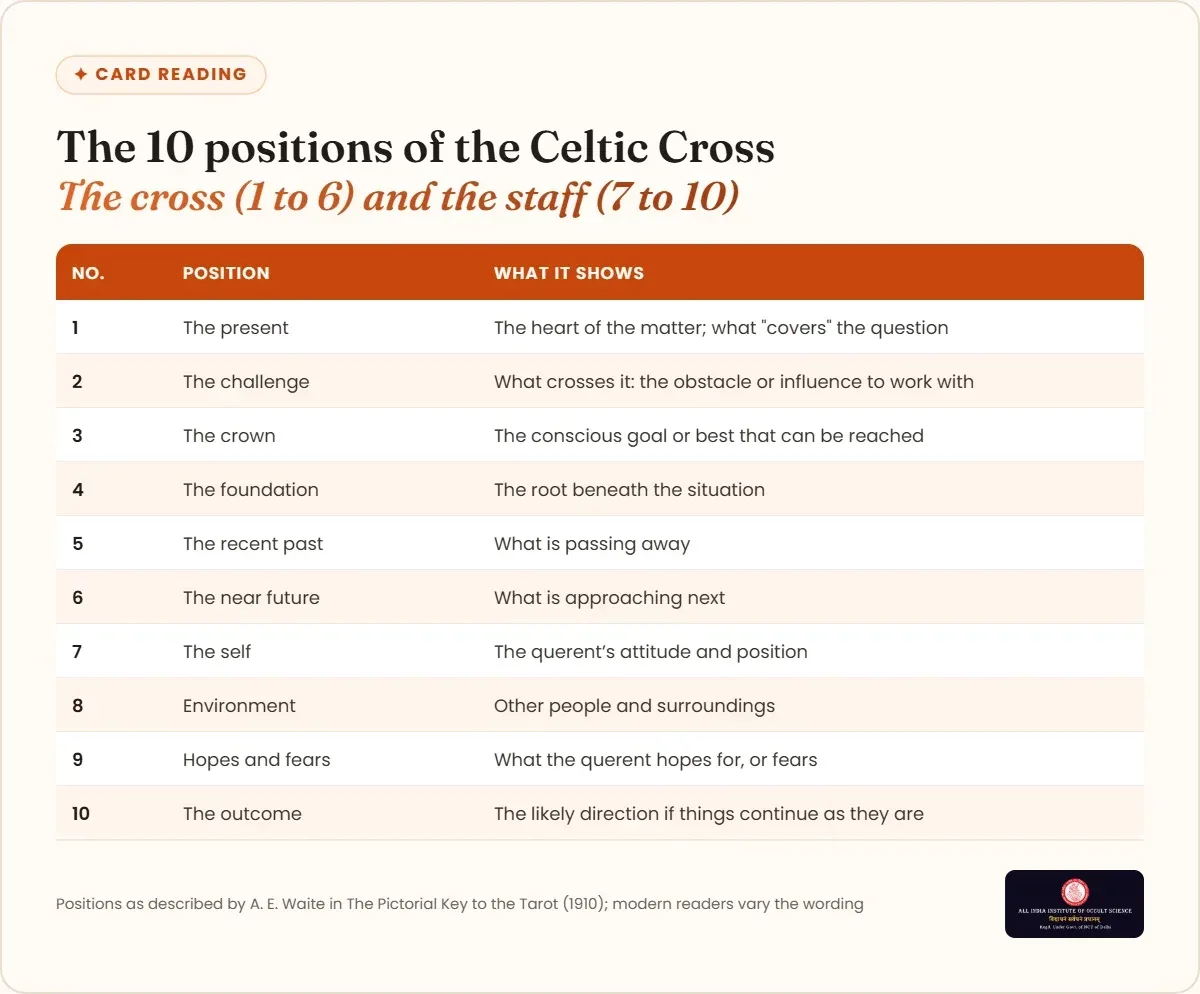
The cross: cards 1 to 6
1. The present. The heart of the question as it stands now. Read this card first and slowly; everything else relates to it.
2. The challenge. Laid across card 1, it shows what is crossing the situation: an obstacle, a tension or an influence that must be worked with. A "positive" card here can mean too much of a good thing.
3. The crown. What the querent consciously aims for, or the best that can be achieved in the situation.
4. The foundation. The root of the matter: past experiences, underlying feelings or hidden factors beneath the surface.
5. The recent past. What has just happened or is passing away. It often explains why the question is being asked now.
6. The near future. What is approaching in the coming weeks or months. It is a next step, not the final outcome.
The staff: cards 7 to 10
7. The self. The querent's attitude, feelings and position in the situation. Often the most revealing card for advice.
8. Environment. Other people, home, work and outside influences.
9. Hopes and fears. Interesting because hopes and fears are often two sides of the same coin; one card can show both.
10. The outcome. The likely direction if things continue as they are. Readers frame it as a tendency that choices can change.
How to Read the Spread as One Story
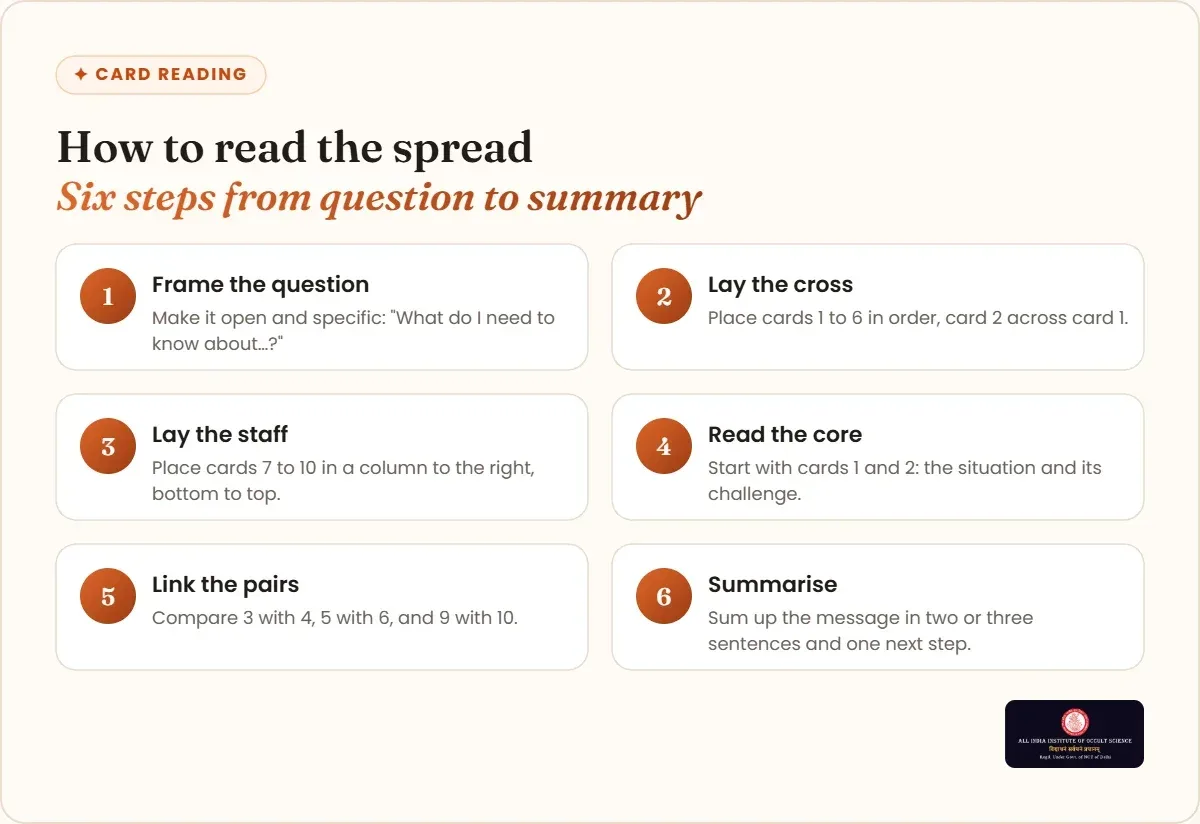
New readers often read ten cards one by one and end up with ten separate messages. Experienced readers look for relationships:
- Cards 1 and 2: the situation and its tension, the core of the reading.
- Cards 3 and 4: conscious goal versus underlying root. Do they agree, or is there an inner conflict?
- Cards 5 and 6: the movement from past to future. What is ending, and what is arriving?
- Cards 7 and 8: how the querent sees things versus how others see them.
- Cards 9 and 10: hopes and fears beside the outcome. Fear can shape the outcome if left unexamined.
Also look at the whole layout: many Major Arcana suggest a significant life chapter; a suit that dominates shows the main area involved, such as Cups for emotions or Pentacles for work and money.
A Full Sample Reading (Invented Question)
Here is an invented practice reading. The question: "What do I need to understand about accepting a job offer in another city?"
- 1. Present: Eight of Pentacles. The querent is skilled and hard-working; the offer recognises real effort.
- 2. Challenge: Four of Cups. Some emotional hesitation or indifference; perhaps not fully seeing the opportunity.
- 3. Crown: The Star. The hope is for renewal and a more inspiring life.
- 4. Foundation: Six of Cups. Strong attachment to home, family and familiar places.
- 5. Recent past: Ten of Wands. A period of heavy workload and burden is ending.
- 6. Near future: Knight of Wands. Movement, travel or a burst of energy is approaching.
- 7. Self: Two of Swords. The querent feels stuck between two choices and is avoiding a decision.
- 8. Environment: Three of Pentacles. Colleagues and collaborators value the querent's work.
- 9. Hopes and fears: Page of Cups. Hope for emotional freshness, and fear of feeling alone in a new place.
- 10. Outcome: Six of Wands. Recognition and progress, if the querent moves forward with confidence.
A reader might summarise: "Your skills are being recognised, and a tiring phase is ending. Your hesitation comes mainly from attachment to home and a fear of loneliness, not from doubts about the work. If you decide, the cards point toward progress and recognition. Before deciding, it may help to plan how you will stay connected to family and build a support circle in the new city." The decision itself stays with the querent.
Should You Use a Significator?
In Waite's original method, the reader first chose a significator: a card, usually a court card, placed to represent the querent before the other cards were laid. The rest of the spread was then built around it. Many modern readers skip this step and let card 1 describe the situation directly, which keeps all 78 cards available for the reading.
Both approaches work. If you like ritual and structure, choosing a significator can help you focus on the person. If you prefer simplicity, leave it out. What matters is using the same method each time so that your readings stay consistent.
A Practice Exercise for Learners
To build confidence, try this exercise once a week for a month. Lay a Celtic Cross for an invented character with a clear situation, such as a student choosing between two colleges. Write one sentence for each position, then a three-sentence summary. A week later, read your notes and ask: did the summary connect the cards, or did it only list them? Over four weeks, most learners notice their summaries becoming shorter, clearer and more useful.
Reversals in the Celtic Cross
If you read reversed cards, the Celtic Cross becomes richer but also more complex. Many readers treat a reversal as an energy that is blocked, internal or still developing, rather than "negative". If you are still deciding how to handle reversals, read our guide to reversed tarot cards first and practise the spread upright for a while.
Common Mistakes With the Celtic Cross
- Vague questions: "Tell me about my life" gives a scattered reading. Narrow the focus.
- Treating card 10 as fate: it is a likely direction, not a verdict.
- Ignoring card 7: the self card often holds the most useful advice.
- Reading too fast: ten cards need time; rushing loses the connections.
- Using it for yes/no: choose a simpler spread for quick questions.
Patterns to Notice Across the Whole Spread
Before reading any single position, experienced readers take ten seconds to look at the layout as a whole. A few patterns carry a lot of meaning:
- Many Major Arcana (four or more): a significant chapter of life, often bigger than the question itself.
- One suit dominating: Cups point to feelings and relationships, Wands to energy and ambition, Swords to thoughts and conflict, Pentacles to work, money and the body.
- A missing suit: an area of life that is not part of this situation, or one being neglected.
- Many court cards: other people play a large role, or the querent is playing several roles at once.
- Repeated numbers: several Threes suggest growth and collaboration; several Fives, tension and change.
Note these patterns first, then use them as a lens for each position. They often explain why a reading feels heavy, hopeful or busy before you have interpreted a single card.
How to Phrase a Good Celtic Cross Question
The spread is only as clear as the question. Strong questions are open, personal and focused on understanding:
- "What do I need to understand about my situation at work?"
- "What is helping and what is blocking my plans to study abroad?"
- "How can I approach the conflict with my sister more wisely?"
Avoid questions about another person's private thoughts, exact dates, or outcomes outside the querent's influence. Reframing them around the querent's own choices produces a more useful and ethical reading.
Celtic Cross vs Simpler Spreads
| Spread | Cards | Best for |
|---|---|---|
| Single card | 1 | Daily reflection, quick focus |
| Three-card | 3 | Past-present-future, simple decisions |
| Celtic Cross | 10 | Complex situations needing depth |
What a Celtic Cross Reading Can and Cannot Do
Used well, the spread helps a querent see a situation from several angles: the visible problem, the hidden root, other people's influence and their own fears. It cannot guarantee outcomes, predict exact dates, or replace professional advice on health, law or money. Responsible readers frame the outcome as one possible direction and leave decisions to the querent.
How to Learn Tarot Properly
The Celtic Cross is where card knowledge, storytelling and ethics come together, so it is best practised with feedback. If you plan to read for others, our guide on how to become a tarot card reader outlines the full path. The Institute teaches tarot as a Diploma in Card Reading (about 2 months) and a Master in Card Reading (about 4 months), live online with practice spreads. You can download the syllabus to see the spreads covered.
Conclusion
The Celtic Cross tarot spread turns ten cards into a full picture: the present and its challenge, the goal and its root, past and future, self and environment, hopes, fears and a likely outcome. Learn each position's job, read the cards in pairs, and always end with a clear, kind summary. For guided practice with feedback, explore the card reading course at the All India Institute of Occult Science.
This article shares traditional tarot knowledge for educational purposes. It is not a substitute for professional medical, legal, psychological or financial advice. Please read our disclaimer.