

 contact@occultscience.in
 +91 96724 36436
 Send Your Query
 Get Syllabus


 +91 96724 36436
 contact@occultscience.in


Written by Jyoti Chauhan, Content Writer · Reviewed by Gurudev Shrie Kashyap, Chairman & Founder, All India Institute of Occult Science · Published 20 Nov 2026
Key Takeaways
- Mulank and bhagyank are the two core numbers of Indian numerology: mulank from your birth day, bhagyank from your full date of birth.
- Both are reduced to a single digit from 1 to 9, each linked with a planet.
- Example: sample DOB 29-03-1988 gives mulank 2 and bhagyank 4.
- Mulank describes how you are; bhagyank describes where life tends to lead you. Numerologists always read them together.
- These numbers are a traditional tool for self-reflection, not a fixed fate or a guide for gambling or investment.
Ask any numerologist about your numbers and the first two things they will calculate are your mulank and your bhagyank. Both take less than a minute to work out with a pen and paper, and together they form the base of almost every reading in Indian numerology, or ank jyotish.
This guide shows you exactly how to calculate both numbers with worked examples, what each number from 1 to 9 means as a mulank and as a bhagyank, and how numerologists combine the two. For a wider introduction, see our guide on what numerology is.
What Is Mulank?
Mulank (root number), also called the birth number or psychic number, is calculated only from the day of the month you were born. Numerologists read it as your basic nature: how you think, react and see yourself, especially in everyday life.
What Is Bhagyank?
Bhagyank (fortune number), also called the destiny number, is calculated from your full date of birth. It is read as the broader direction of your life: the opportunities, lessons and roles you tend to grow into over time. Western numerology calls the same calculation the life path number; our page on the life path number covers that system in detail.
How to Calculate Mulank and Bhagyank
Step 1: Mulank
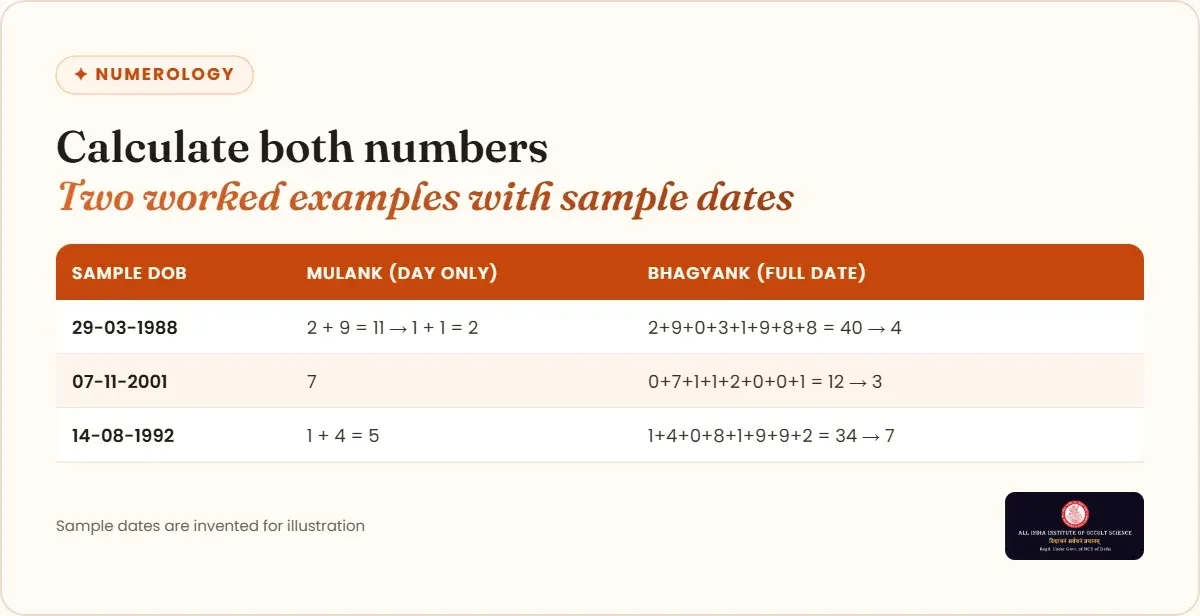
Take the day of your birth and add its digits until you reach a single number from 1 to 9.
- Born on the 7th: mulank 7.
- Born on the 14th: 1 + 4 = 5.
- Born on the 29th: 2 + 9 = 11, then 1 + 1 = 2.
Step 2: Bhagyank
Write your full date of birth as DD-MM-YYYY, add every digit and keep reducing to a single digit.
Some numerologists keep 11 and 22 unreduced when they appear in the bhagyank total, treating them as master numbers. Our page on master numbers in numerology explains when and why.
If you would rather not calculate by hand, the free Lo Shu grid calculator also shows both numbers alongside your full grid.
Mulank and Bhagyank Meanings for Numbers 1 to 9
Each number is linked with a graha, following the planetary associations found in Indian numerology and in the work of Western writers such as Cheiro, whose Book of Numbers popularised the system worldwide. The same number reads slightly differently depending on whether it appears as your mulank or your bhagyank:

For a fuller description of each number's traits, read our guide on the meaning of numbers 1 to 9.
How Mulank and Bhagyank Work Together
A numerologist never reads one number alone. The relationship between the two is where a reading becomes personal. There are three broad situations:
1. Same number
When mulank and bhagyank match, for example 3 and 3, the number's qualities are seen as strong and consistent. The person's nature and life direction pull the same way. The advice is usually to build on those strengths while staying aware of that number's blind spots.
2. Friendly numbers
Numbers whose ruling planets are traditional friends, such as 1 (Sun) and 9 (Mars), or 5 (Mercury) and 6 (Venus), are read as supportive. Personality and destiny cooperate, even if they are not identical.
3. Contrasting numbers
Some pairs pull in different directions, such as 1 (Sun) and 8 (Saturn). A person with mulank 1 and bhagyank 8 may be naturally quick and independent, yet find that life rewards patience and slow building. Numerologists do not call this "bad". They read it as a lesson: learning to combine confidence with persistence.
Worked Example: Reading Both Numbers Together
Take the sample DOB 29-03-1988 again. Mulank 2 (Moon) suggests a sensitive, caring and imaginative nature. Bhagyank 4 (Rahu) suggests a life that brings change, unconventional situations and the need to build systems.
A numerologist might read this combination as a gentle person whose life keeps pushing them toward new, unfamiliar situations. The growth lies in letting sensitivity become intuition, and learning to stay steady through change. Notice that the reading describes tendencies and lessons, not events.
Mulank and Bhagyank Compatibility in Relationships
Many people compare numbers with a partner. Numerologists usually look at three pairs: both mulanks, both bhagyanks, and each person's mulank against the other's bhagyank. Friendly or matching numbers are read as natural ease, while contrasting numbers are read as areas that need understanding.
No number pair makes a relationship succeed or fail. Communication, values and effort matter far more, and numerology is best used as a conversation starter, not a verdict.
Mulank, Bhagyank and Career Choices
One of the most common reasons people look up these numbers is career. Numerologists read the mulank as the working style that comes naturally to you and the bhagyank as the kind of contribution life tends to ask of you. A few traditional pairings illustrate the idea:
- Mulank 1 or bhagyank 1: roles with independence and responsibility, such as running a team or a business.
- Mulank 3 or bhagyank 3: teaching, advising, counselling and other roles that share knowledge.
- Mulank 5 or bhagyank 5: communication, sales, media, travel and trade.
- Mulank 6 or bhagyank 6: design, hospitality, care and creative work.
- Mulank 8 or bhagyank 8: long-term, structured work where patience is rewarded, such as administration, law or engineering.
These are tendencies, not limits. Plenty of people with mulank 2 lead large teams, and plenty with mulank 1 thrive in quiet, supportive roles. Use the numbers to understand what energises you, then decide with your skills, interests and real opportunities in view.
How Your Name Number Fits In
Mulank and bhagyank come from your date of birth, which never changes. The third core number, the name number, comes from the letters of the name you use. Numerologists check whether the name number is friendly with your mulank and bhagyank. When all three agree, the reading is considered especially harmonious; when they clash, some people consider a small spelling change. That is a personal decision with practical costs, and it is never necessary to understand yourself through numerology.
Using These Numbers in Daily Life
Most people use mulank and bhagyank in small, light-hearted ways: choosing a date for a celebration that reduces to a friendly number, reflecting on a habit their number is said to encourage, or simply understanding why a partner or child approaches life differently. Used this way, numerology becomes a tool for self-awareness and kinder conversations rather than a set of rules.
Mulank and Bhagyank for Children
Parents often calculate these numbers for their children out of curiosity. Used gently, they can be a way to notice a child's natural style: a mulank 1 child who wants to do things alone, or a mulank 6 child who loves art and harmony. Numerologists who work with families stress that numbers describe tendencies, never limits. A child should never be labelled, compared or pushed into a path because of a number. The healthiest use is to understand and encourage, while letting the child's own interests lead.
When Master Numbers Appear
If your bhagyank total adds up to 11 or 22 before the final reduction, some numerologists read it as a master number with heightened potential and responsibility, while others simply reduce it to 2 or 4. Both approaches are traditional; what matters is using one method consistently.
Common Mistakes When Calculating
- Using the month for mulank: mulank uses the day only.
- Using a two-digit year: bhagyank needs the full four-digit year.
- Stopping at two digits: keep reducing to 1-9 unless you are deliberately keeping a master number.
- Using a document date: use your actual birth date, not a later registration date.
What These Numbers Can and Cannot Tell You
| They can | They cannot |
|---|---|
| Offer a traditional lens on personality and life themes | Fix your destiny or remove your choices |
| Prompt reflection on strengths and lessons | Predict lottery, betting or market outcomes |
| Help you choose dates and preferences you feel good about | Replace medical, legal or financial advice |
Many people first meet these numbers when looking for a lucky number; our guide to the lucky number by date of birth shows how mulank is used that way.
How to Learn Numerology Properly
Mulank and bhagyank are the first step. A complete reading also uses the name number, the Lo Shu grid, personal years and compatibility. The Institute's numerology course runs as a Diploma in Numerology (about 2 months) and a Master in Numerology (about 4 months), taught live online in small batches.
Conclusion
Your mulank and bhagyank take a minute to calculate and a lifetime to understand. Mulank, from your birth day, describes how you are; bhagyank, from your full date, describes where life tends to lead. Read them together, gently, as a mirror rather than a map. Want to see both numbers instantly, along with your name number? Try the free numerology calculator.
This article shares traditional numerology knowledge for educational purposes. It is not a substitute for professional medical, legal or financial advice. Please read our disclaimer.


