 contact@occultscience.in
 +91 96724 36436
 Send Your Query
 Get Syllabus

 +91 96724 36436
 contact@occultscience.in







Loading…

 Celebrating 22 Years of Trust — Enrol Now and Get Exclusive Discounts!
 All India Institute ofOccult Scienceविद्याधनं सर्वधनं प्रधानम्
Login with your mobile number
See upcoming batches, demo classes and your syllabus in one place.
Login / RegisterLoading…
Login with your mobile number
See upcoming batches, demo classes and your syllabus in one place.
Login / RegisterCard Reading
11 min readCard Reading
No law in India requires a certificate to read tarot. Still, a certificate from a structured course shows clients that you have trained, practised and been assessed, and the training itself builds confidence, method and ethics.
Most learners can read simple spreads within a few weeks of daily practice. Reading confidently for others usually takes several months. A structured course such as a 2-month diploma followed by a 4-month master level gives a clear timeline.
Yes. Live online classes work well for tarot because cards, spreads and practice readings can be shown on screen. Look for live sessions, recordings, practice readings with feedback and a way to ask doubts.
Most begin with friends and referrals, then add a simple profile on social media, a booking method and clear session terms. Consistent, ethical readings and word of mouth matter far more than advertising.
Get consent, keep sessions confidential, avoid fear-based predictions, never give medical, legal or financial verdicts, do not create dependence, and refer clients to doctors, lawyers or counsellors when their question needs professional help.

Reversed tarot cards are not bad omens. Learn 4 ways to read an upside-down card, a reversed Major Arcana table and a worked three-card example.
Written by Jyoti Chauhan, Content Writer · Reviewed by Gurudev Shrie Kashyap, Chairman & Founder, All India Institute of Occult Science · Published 19 Nov 2026
Maybe it started with a deck a friend gifted you. You pulled a card each morning, noticed how often it fit your day, and then a cousin asked, "Can you read for me?" That moment, when someone else trusts you with a question, is where many tarot readers begin.
Turning that interest into a skill people can rely on takes more than memorising card meanings. It needs practice, structure, communication skills and a firm sense of ethics.
This guide walks you through how to become a tarot card reader step by step: the skills, a practice routine, how certification works, how readers find their first clients, and the ethical lines every good reader keeps. If you are completely new to tarot, our complete guide to tarot cards explains the deck itself.
A tarot reader uses a deck of 78 illustrated cards to help a person reflect on a question. The reader shuffles, lays the cards in a spread, and interprets the images and their positions as a story about the situation.
Tarot cards first appeared in fifteenth-century Italy as playing cards; Britannica traces the deck's history from those games to its later use for divination. The deck most learners use today is the Rider-Waite-Smith deck of 1909, whose companion book by A. E. Waite, The Pictorial Key to the Tarot, is now in the public domain.
In practice, a good reading is less about predicting events and more about clarity: helping someone see their options, feelings and next steps more clearly.
The deck has two parts. The Major Arcana (22 cards, from The Fool to The World) represent big life themes. The Minor Arcana (56 cards) cover daily life through four suits: Cups (emotions), Wands (energy and ambition), Swords (thoughts and conflict) and Pentacles (money, work and the material world).
Rather than memorising 78 separate meanings, learn the system:
Once these patterns click, a card you have never studied in depth still "speaks" to you.
Consistency matters more than long study sessions. A simple routine that many teachers recommend:
After a month you will have a personal tarot journal of around 30 entries, which is often more useful than any book.
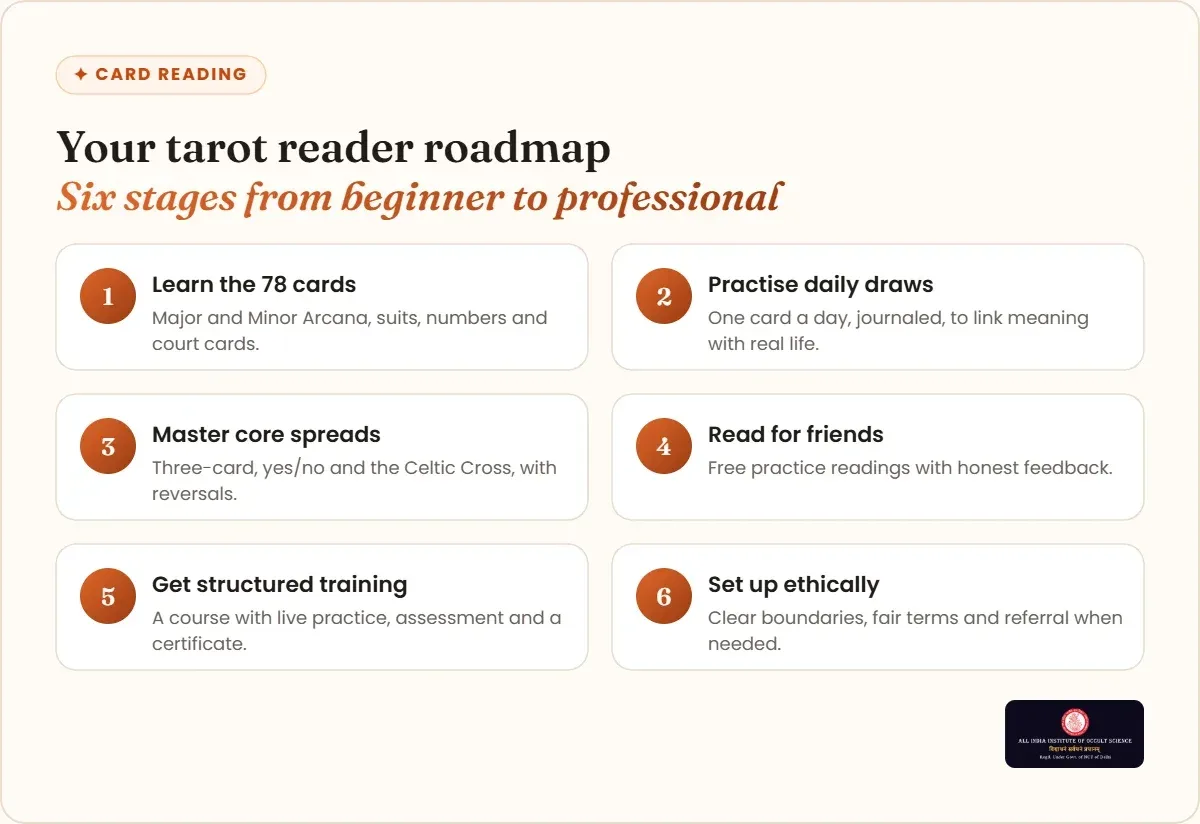
If you like structure, this four-week plan turns the steps above into a routine. Spend 20 to 30 minutes a day.
Study three or four Major Arcana cards a day. For each one, describe the picture in your own words before reading any meaning. By the end of the week, lay all 22 cards in order and tell the story of The Fool's journey aloud.
Work through one suit at a time, Ace to Ten, then the court cards. Notice how the numbers repeat their themes across suits. Keep drawing your daily card and journaling it.
Repeat the method with the last two suits. Swords often feel heavy to beginners, so practise describing them in calm, practical language: decisions, clarity, honest conversations.
Do one three-card spread every day on a real but low-stakes question, such as how to approach a conversation at work. At the end of the week, review your notes and see which readings proved useful.
After 30 days you will not be an expert, but you will know the deck well enough to start practice readings for others.
Spreads give each card a position and a question to answer. Start with three:
You will also need to decide whether to read reversed cards. Our guide to reversed tarot cards explains the main approaches so you can choose one and use it consistently.
Reading for yourself is a different skill from reading for someone else. Offer free practice readings to friends or classmates, and ask for honest feedback:
Twenty to thirty practice readings with different people will teach you more about communication than months of solo study.
Card knowledge is only part of the job. The readers people return to tend to share a set of practical skills:
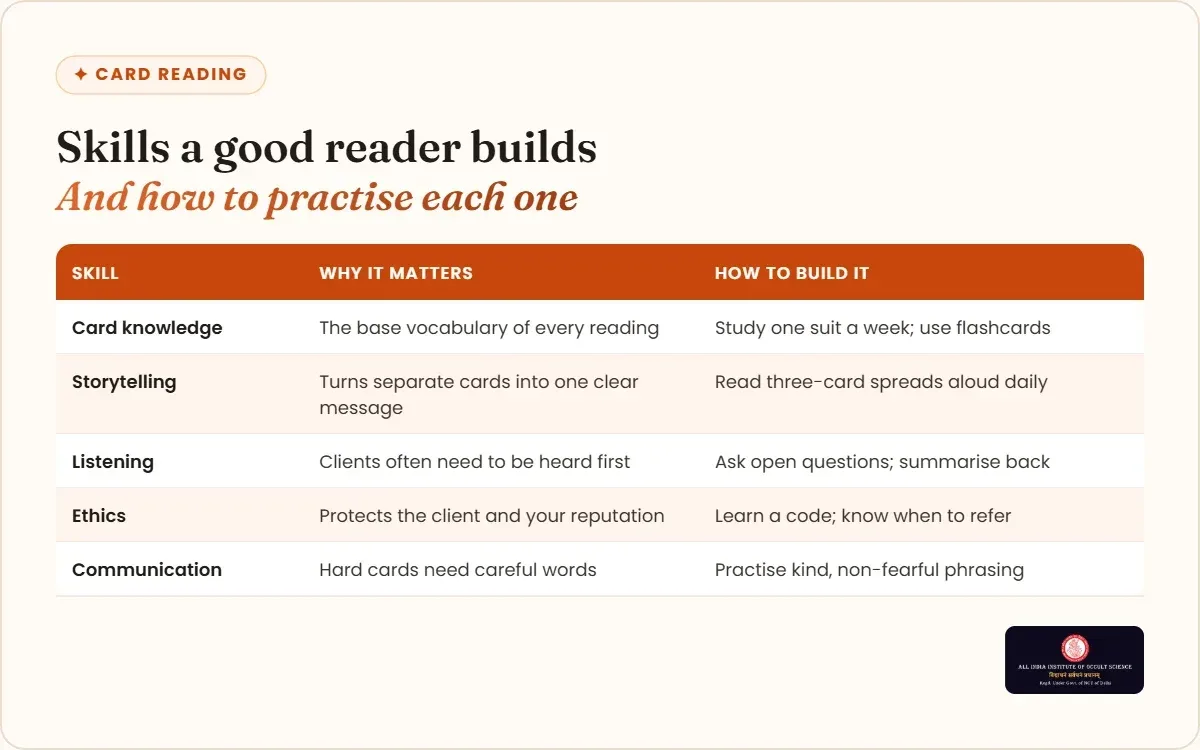
Listening deserves special mention. Many clients arrive anxious. Letting them explain their question in their own words, then repeating it back, often calms them before a single card is drawn.
Self-study can take you far, but structured training fills gaps you may not know you have: consistent meanings, spread logic, combining cards, handling difficult questions and ethical practice.
When comparing courses, look for:
There is no government licence for tarot reading in India, so a certificate is about the quality of your training rather than a legal requirement.
When you begin reading for others regularly, a few practical foundations help:
Most readers grow through referrals. Honest, kind readings bring people back far more reliably than bold promises.
Knowing the common questions helps you prepare thoughtful, ethical answers. In most practices, the same themes come up again and again:
Practising your responses to these four themes during training will make your first paid sessions far calmer.
You do not need much to start. A standard Rider-Waite-Smith style deck is the easiest to learn, because most books and courses use its images. Add a notebook for your journal, a plain cloth to lay cards on, and one good reference book. Waite's own guide is a useful historical reference, though its language is old-fashioned, so many learners pair it with a modern teacher's explanations.
Avoid buying several decks at once. Learning one deck deeply builds confidence faster than switching between artistic styles.
Timelines vary with practice, but a realistic picture looks like this: a few weeks to learn the basic structure of the deck, two to three months of regular practice to read simple spreads smoothly, and around four to six months, with feedback, to read for others with confidence. Structured training shortens the path because a teacher corrects habits early.
| Do | Don't |
|---|---|
| Ask for consent before reading about anyone | Read about third parties in invasive ways |
| Frame difficult cards with care and options | Predict death, illness or disaster |
| Keep sessions confidential | Share client stories without permission |
| Refer to doctors, lawyers or counsellors when needed | Give medical, legal or investment verdicts |
| Encourage clients' own decisions | Create dependence or sell costly "remedies" |
Many readers today work mostly online, and clients are comfortable with it. Each format has its own strengths:
| Format | Strengths | Things to manage |
|---|---|---|
| In person | Personal connection; the client sees the cards being drawn | Limited to your city; travel and space needed |
| Video call | Reach clients anywhere; cards can still be shown on camera | Good lighting and a stable connection |
| Chat or recorded | Flexible for both sides; easy to revisit | Harder to read emotions; write with extra care |
Whatever the format, the same rules apply: confirm the question, read with care, and close the session with clear next steps the client controls.
The jump from free practice to a paid session feels big, but it becomes easier with a simple structure. Open by explaining how you read and what tarot can and cannot do. Ask the client to share the question in their own words. Draw the cards slowly and describe what you see before you interpret it. End by summarising the key message in two or three sentences and inviting questions.
Afterwards, write a short private note on what went well and what you would change. Ten such reviews will sharpen your readings more than any new book.
Many tarot readers later add a second skill, such as numerology or astrology, to give richer sessions. The path is similar in each field: learn the system, practise on real cases, then train with a teacher. Our article on how to become an astrologer shows how that path looks in Jyotish.
You can also browse every tarot article in our card reading blog.
The Institute teaches tarot as Card Reading in two levels: a Diploma in Card Reading (about 2 months) and a Master in Card Reading (about 4 months). Classes are live online through the Institute's app, in small batches of 10 to 15 students, with recordings uploaded within 4 hours and doubt support in class and in the app (as of Nov 2026). Certificates are awarded after the course exam. You can download the syllabus to see each module.
Becoming a tarot card reader is a step-by-step journey: learn the system of the 78 cards, practise every day, master a few spreads, read for others, then train with structure and a clear ethical code. Give yourself a few months, keep a journal, and let your confidence grow with real readings. When you are ready for guided training, explore the card reading course at the All India Institute of Occult Science.
This article shares traditional tarot knowledge for educational purposes. It is not a substitute for professional medical, legal, psychological or financial advice. Please read our disclaimer.
 Login or Sign up
Login or Sign Up to Get Course Details
Enter your mobile number to continue. You’ll land on your dashboard with the full course syllabus, special offers and upcoming batches.
 By continuing you agree to our Terms & Conditions and Privacy Policy.


