

 contact@occultscience.in
 +91 96724 36436
 Send Your Query
 Get Syllabus


 +91 96724 36436
 contact@occultscience.in







Written by Jyoti Chauhan, Content Writer · Reviewed by Gurudev Shrie Kashyap, Chairman & Founder, All India Institute of Occult Science · Published 19 Nov 2026
Key Takeaways
- Practitioners link the Akashic Records and karma by describing the Records as a soul-level account of actions and experiences, where karmic patterns can be reflected on.
- Indian philosophy names 3 kinds of karma: sanchita (accumulated), prarabdha (ripening now) and kriyamana (being created by present choices).
- A karmic pattern is a repeating situation or feeling; the tradition treats it as a lesson, not a punishment.
- Karma is not fate: present choices remain part of the picture.
- Akashic work is a reflective spiritual practice and never a substitute for therapy or medical care.
Have you ever noticed the same story playing out in your life with different people? A new job, a new boss, and somehow the same feeling of not being heard. A new relationship, and the same argument by the third month.
Many spiritual traditions have a word for this: karma. In Akashic Records practice, these repeating patterns are among the most common reasons people seek a reading.
This guide explains how practitioners connect the Akashic Records with karma, the three kinds of karma described in Indian philosophy, what a "karmic pattern" means, and a gentle, practical way to explore one yourself. If the Akashic Records are new to you, start with our guide on what the Akashic Records are.
What Are the Akashic Records, in Brief?
The word comes from the Sanskrit akasha, meaning space or ether, the subtlest of the five elements in Indian thought. Practitioners describe the Akashic Records as a non-physical "library" holding the thoughts, words, actions and experiences of every soul.
The modern idea was popularised in the late nineteenth century through Theosophical writers, who drew on Indian concepts and described them in their own way. Today it is practised as a meditative, spiritual approach to self-understanding. It is a matter of belief, not something science has measured.
What Is Karma?
At its simplest, karma means action, and the principle that actions have consequences. Britannica describes karma in Indian religions as the principle linking a person's actions to the conditions they later experience.
Indian philosophy, especially Vedanta, explains karma in three parts. This framework is useful because it shows that karma is not only about the past:
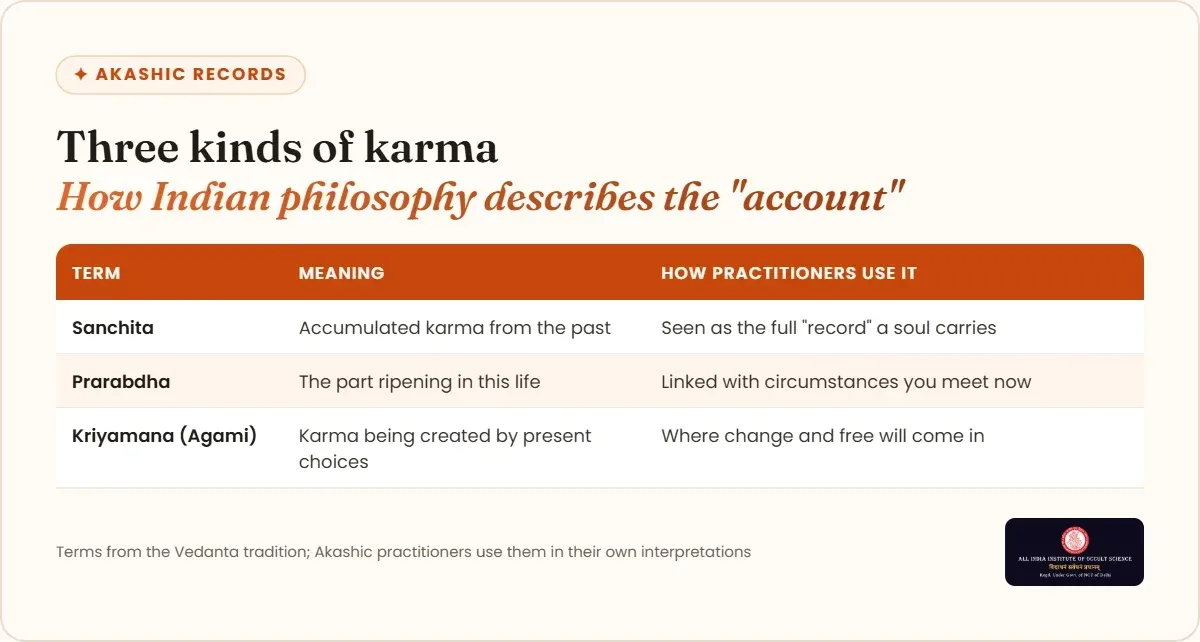
The third kind, kriyamana, is the hopeful part of the teaching. It says that what you choose today shapes what comes next. This is why most teachers insist that karma and fate are not the same thing.
How Practitioners Connect the Akashic Records and Karma
In Akashic practice, the Records are described as the place where this "account" of karma is held. Practitioners believe that, in a calm and focused state, a person can receive impressions, insights or guidance from the Records about why certain experiences keep returning.
Practitioners usually describe three ways this connection shows up:
- Patterns: repeating situations that seem to carry a lesson.
- Soul lessons: qualities such as patience, self-worth or forgiveness that a person is believed to be learning.
- Past-life impressions: some practitioners interpret strong, unexplained fears or attractions as echoes of earlier lives. This is a belief within the tradition, and readers vary widely in how much weight they give it.
Indian astrology offers a parallel lens. In Jyotish, planetary periods called mahadashas are often read as times when particular karmic themes come forward. Both traditions share the idea that life unfolds in meaningful cycles.
What Is a Karmic Pattern? Common Examples
A karmic pattern, in this tradition, is any situation, emotion or relationship dynamic that keeps repeating despite changes in people and places. Common examples people bring to readings include:
- Relationships: attracting partners who are emotionally unavailable, or the same type of conflict again and again.
- Work: feeling overlooked in every job, or leaving projects just before they succeed.
- Money: repeated cycles of saving and sudden loss, or a strong fear of not having enough.
- Family: taking on the same role, such as the peacemaker or the caretaker, in every group.
- Self-worth: a persistent feeling of "not being good enough", whatever is achieved.
Practitioners stress that naming a pattern is not the same as blaming yourself for it. The aim is understanding, which opens the door to choosing differently.
Karma Is Not Punishment: Reframing the Idea
Popular culture often uses karma as a threat: "you'll pay for that". Teachers in both the Indian and Akashic traditions reject this framing. Karma is usually described as cause and effect, more like a teacher than a judge.
This matters because fear-based thinking can make patterns worse. If you believe a painful experience is something you "deserve", you are less likely to set healthy boundaries or seek help. A calmer reading of karma says: this is happening, I can understand it, and I can respond in a new way.
A Gentle Way to Explore a Repeating Pattern
You do not need special abilities to begin. Many practitioners suggest starting with simple reflection, then adding meditation once you feel settled. Here is a five-step practice you can try in a notebook:
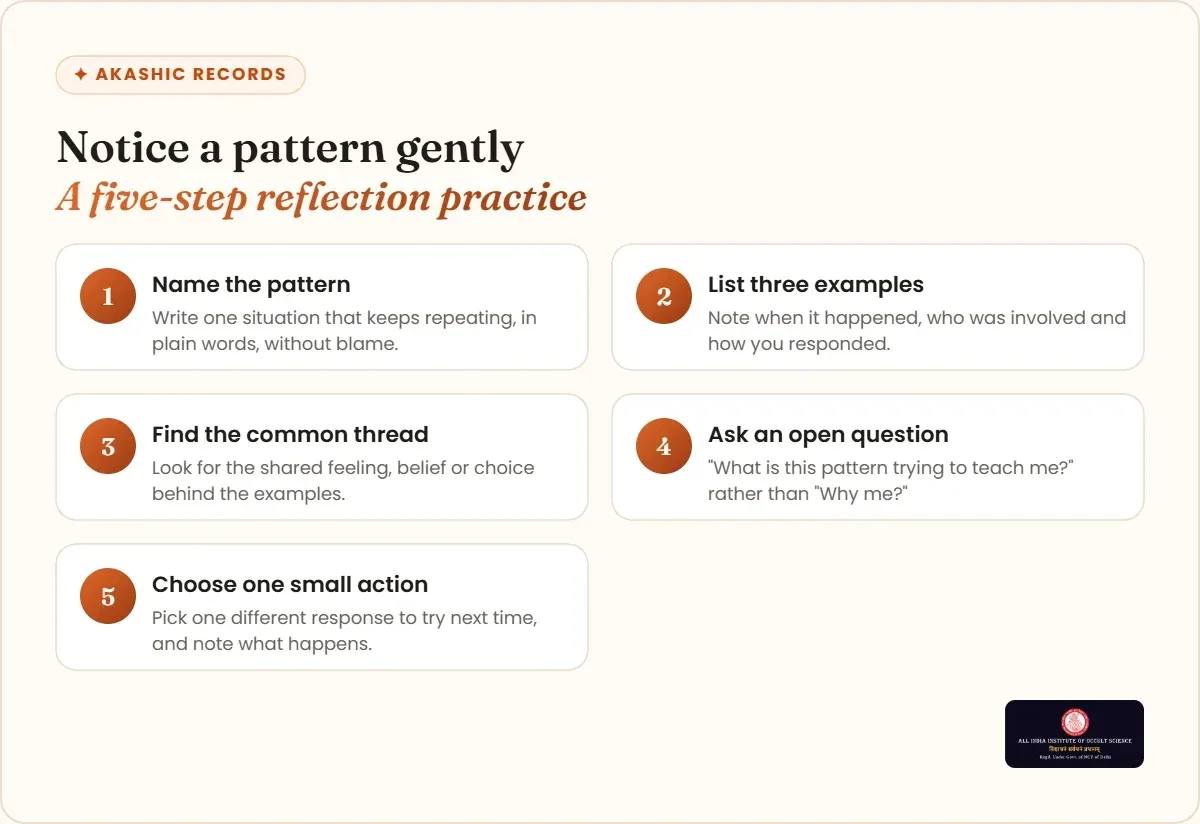
Keep it light and curious. Spend no more than 20 to 30 minutes at a time, and stop if strong emotions come up. Practices such as Reiki or quiet meditation help some people feel calm before reflecting.
A sample reflection
Here is an invented example of how the practice might look on paper. Sample pattern: "I always end up doing everyone's work in group projects." Three examples: a college assignment, a family wedding, and the current office team. Common thread: a fear that things will go wrong if I don't take control. Open question: "What would happen if I trusted others with one task?" Small action: at the next team meeting, ask a colleague to own one part and resist checking it twice.
Notice that nothing in this example blames anyone, and nothing claims a hidden cause. The value lies in seeing the pattern clearly enough to respond to it.
How Long Does a Pattern Take to Shift?
There is no fixed timeline, and practitioners are careful not to promise one. Some people notice a small change the very next time a familiar situation appears, simply because they recognise it sooner. Deeper patterns, especially those rooted in family habits or long-held beliefs, usually take months of patient attention.
Three habits seem to help most people:
- Consistency: a short reflection once a week does more than a long session once a year.
- Kindness: slipping back into an old response is part of the process, not proof of failure.
- Support: sharing what you notice with a trusted friend, teacher or counsellor keeps the work grounded.
What Akashic Work Can and Cannot Do
| It can | It cannot |
|---|---|
| Offer a reflective, spiritual frame for repeating experiences | Prove past lives or verify what happened before birth |
| Encourage self-awareness and kinder choices | Diagnose or treat anxiety, depression or trauma |
| Give a calm space to ask meaningful questions | Predict events or replace legal, medical or financial advice |
If a pattern is causing ongoing distress, such as in a harmful relationship, please speak with a qualified counsellor, therapist or doctor. Spiritual reflection works best alongside professional support, never instead of it.
How Astrology and the Akashic Records Look at the Same Question
Many students explore more than one tradition. Astrology maps life themes through the birth chart and planetary periods, while Akashic practice works through meditation and intuitive insight. Neither needs the other, but both ask a similar question: what is this phase of life asking me to learn?
How to Learn Akashic Records Practice Properly
Reading about karma is a good start; practising with structure is where understanding deepens. The Institute offers a Diploma in Akashic Records (about 2 months), taught live online with practice sessions, clear ethics and guidance on reading for yourself before reading for others.
Conclusion
In Akashic Records practice, karma is not a sentence to be served but a set of patterns to be understood. Naming a repeating situation, reflecting on it without blame and choosing one small new response is the heart of the work. If you would like to learn this practice with a teacher, explore the Akashic Records course at the All India Institute of Occult Science.
This article shares traditional spiritual knowledge for educational purposes. It is not a substitute for professional medical, psychological, legal or financial advice. Please read our disclaimer.


