

 contact@occultscience.in
 +91 96724 36436
 Send Your Query
 Get Syllabus


 +91 96724 36436
 contact@occultscience.in






Written by Jyoti Chauhan, Content Writer · Reviewed by Gurudev Shrie Kashyap, Chairman & Founder, All India Institute of Occult Science · Published 20 Nov 2026
Key Takeaways
- Yes, you can learn astrology without a guru up to a point: the basics of planets, signs and houses are well covered by books and tools.
- Most learners get stuck at interpretation: weighing many factors together, timing with dashas and speaking about results responsibly.
- The guru-shishya tradition is about correction and guidance, which a good teacher can offer in person or in live online classes.
- A practical path: self-study for 2 to 3 months, then a structured course with feedback before reading for others.
- Astrology describes tendencies and timing in a traditional framework; it should never replace medical, legal or financial advice.
Every year, thousands of people open a kundali app, look at the square chart full of numbers and glyphs, and think: "I could learn this." Then someone at a family gathering says, "Astrology can't be learned from books. You need a guru." Both thoughts are partly right.
This post gives an honest answer to a common question: can you learn astrology without a guru? We look at what self-study does well, where learners usually hit a wall, what the guru tradition really offered, and how to choose a path that fits your life today.
If you are just starting, our step-by-step guide on how to learn Vedic astrology lays out the subjects in order.
The Short Answer
You can learn the foundations of astrology on your own. You will find it much harder to learn sound interpretation on your own. The basics are like learning the alphabet and grammar of a language. Interpretation is like writing a good essay: it improves fastest when someone reads your work and shows you what to fix.
So the real question is not "guru or no guru" but "when do I need guidance, and what kind?"
What the Guru-Shishya Tradition Really Offered
In the traditional guru-shishya parampara, a student lived or studied closely with a teacher for years. Jyotish was passed down through recitation of texts, worked examples and the teacher's own experience. Three things made this system powerful:
- Correction: the teacher saw mistakes early and explained why a judgement was wrong.
- Context: rules were taught with exceptions, priorities and real cases, not as isolated lines.
- Character: students absorbed ethics, humility and responsibility toward the people they would advise.
None of these three depends on a particular building or a particular era. They depend on regular contact with someone who knows more than you and cares about how you learn.
What Self-Study Does Well
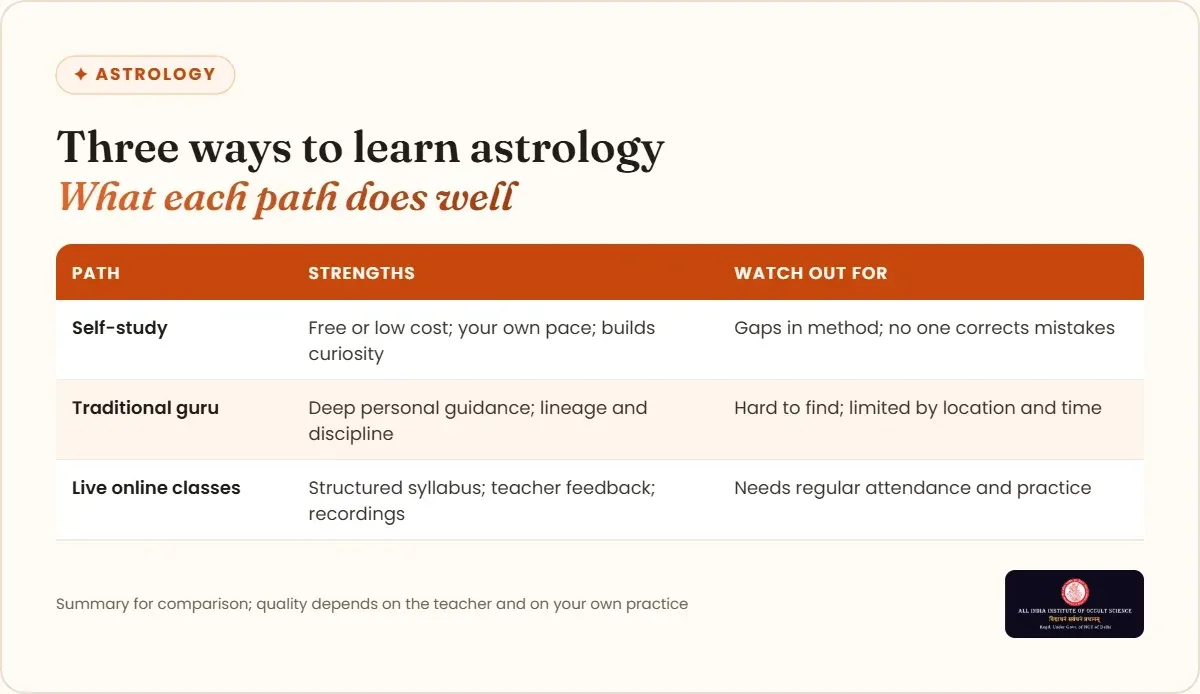
Learning on your own has real strengths, and many good astrologers began this way:
- Low barrier: books, free kundali tools and articles let you start today.
- Your own pace: you can spend a month on houses if you need to.
- Curiosity: exploring on your own builds genuine interest, which keeps you going later.
- Personal relevance: studying your own chart and those of family members makes ideas memorable.
A free tool such as the Institute's kundali generator gives you an accurate chart to practise on, so you can focus on reading rather than calculation.
Where Self-Taught Learners Usually Get Stuck
Teachers who take on self-taught students tend to see the same gaps again and again:
1. Reading one factor in isolation
A beginner reads "Saturn in the 7th house" in a book and draws a firm conclusion about marriage, without checking the sign, aspects, the lord of the 7th, the navamsa or the running dasha. Classical astrology always weighs many factors together.
2. Mixing systems
Internet learners often combine rules from Parashari, KP, Western and Lal Kitab sources in one reading. Each system has its own logic, and mixing them carelessly produces contradictions.
3. Ignoring timing
A placement shows a potential; dashas and transits show when it may come forward. Many self-learners skip timing because it is harder, which makes their readings vague.
4. Trusting the birth time blindly
A difference of a few minutes can change the ascendant or house cusps. Learners rarely check whether a chart's events actually fit the recorded time.
5. Speaking about results carelessly
The biggest risk is ethical. Telling someone their chart shows a "bad marriage" or "loss" without nuance can cause real distress. A teacher models how to speak about difficult placements calmly and constructively.
An Honest Self-Study Plan
If you want to start on your own, here is a structure that avoids the common traps:
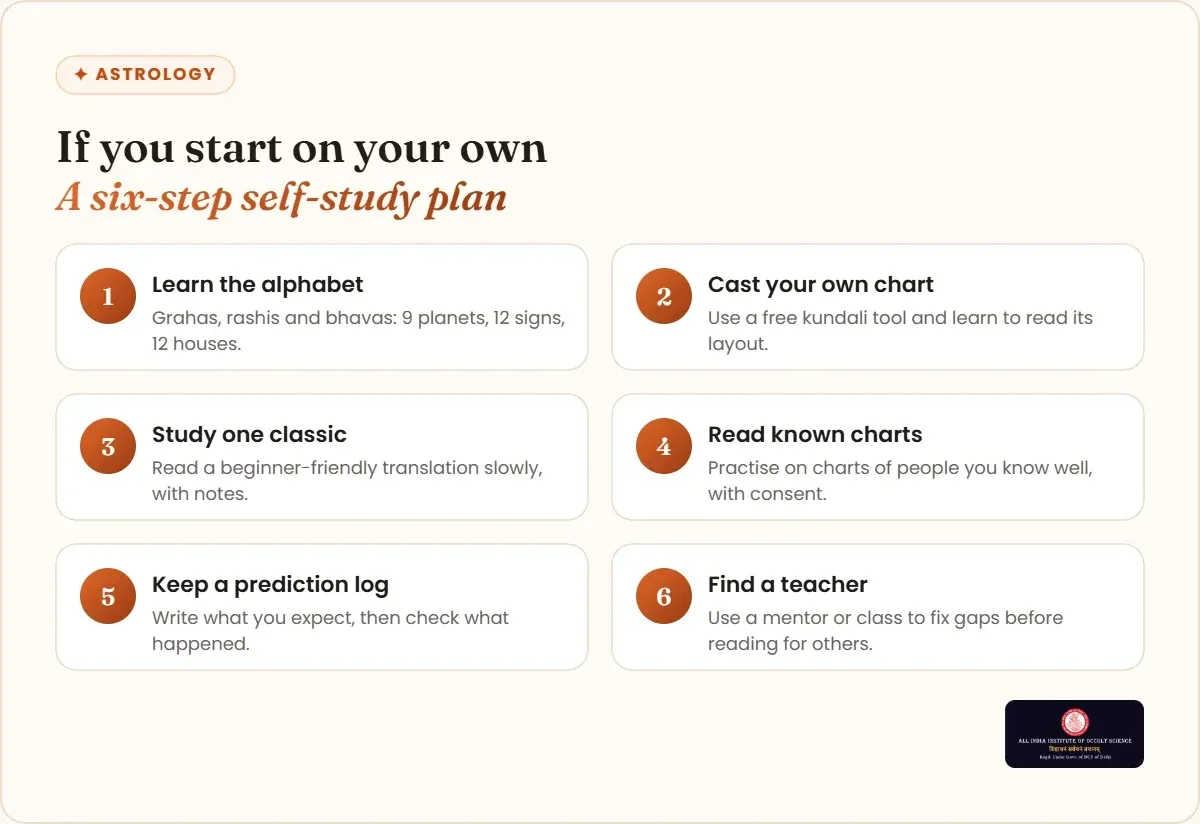
For reading material, our guide to the best books to learn Vedic astrology sorts titles from beginner to advanced, so you can pick one classic and one modern explanation instead of ten books at once.
Keep a prediction journal
This single habit separates serious learners from casual ones. Before an event in your own life, such as a dasha change or a major transit, write down what you expect and why. Afterwards, note what actually happened. Over a year, this journal shows you which rules you understand and which you are guessing at.
How the Tradition Fits Learning Today
Formal study of Jyotish has moved into universities and structured programmes. IGNOU, for example, offers a two-year Master of Arts in Jyotish (MAJY) through distance learning, with published study material. Private institutes run certificate and diploma courses, many of them live online.
What matters is not the label but whether the learning keeps the three core strengths of the guru tradition: correction, context and character. A live online class where a teacher works through real charts, answers your doubts and corrects your reasoning offers much of what the old system offered, with the added benefit of recordings and access from anywhere.
A Realistic Learning Timeline
Learners often ask how long each stage takes. Experiences vary, but this rough timeline is common among students who practise a few hours a week:
- Months 1 to 2: planets, signs, houses and reading the layout of a chart.
- Months 3 to 5: aspects, house lords, yogas and the basics of dashas.
- Months 6 to 8: divisional charts, transits, matching and combining factors into one judgement.
- Beyond: years of practice on real charts, which is where real skill grows.
Self-study can cover the first stage well. The later stages are where most learners benefit from a teacher's feedback.
How to Choose an Astrology Teacher
Whether you look for a personal mentor or a course, these signs point to good teaching:
- Explains the why: rules come with reasoning, not just lists.
- Uses real charts: examples are worked out, with consent and anonymity.
- Welcomes questions: doubts are encouraged, not brushed aside.
- Teaches timing: dashas and transits are part of the syllabus.
- Practises ethics: no fear-selling, no pressure to buy gemstones or pujas.
- Assesses you: exams or practical evaluations before a certificate.
Be careful with any teacher who promises you will "become an expert in a few days" or who uses fear to sell remedies. Real learning takes time, and honest teachers say so.
Self-Study vs Guided Learning: Which Suits You?
| Your situation | A sensible path |
|---|---|
| Curious, want to understand your own chart | Self-study with a good book and a free kundali tool |
| Serious about learning interpretation | A few months of self-study, then a structured course |
| Planning to read for others or practise professionally | Structured training with assessment and supervised practice |
| Working professional with limited time | Live online classes with recordings for revision |
If a professional practice is your goal, our guide on how to become an astrologer covers the full path.
What Astrology Can and Cannot Tell You
Whichever path you choose, keep a clear view of the subject's limits. In the Jyotish tradition, a chart describes tendencies, strengths, challenges and periods when certain themes are emphasised. It cannot guarantee events, diagnose illness, predict investments or decide on your behalf. As the Institute's founder often frames it, planets show the terrain; you still choose the path.
How to Learn Astrology Properly
The Institute teaches astrology in three levels: a Certificate in Astrology (about 2 months), a Diploma in Astrology (about 5 months) and a Master in Astrology (about 8 months). Classes are live online in small batches of 10 to 15 students, with recordings uploaded within 4 hours and doubt support in class and in the app (as of Nov 2026). The programme is guided by the Institute's founder, Gurudev Shrie Kashyap, who has over 30 years of practice.
You can also read more about the subject itself in our guide to what astrology is.
Conclusion
You can learn astrology without a guru, but only up to the point where interpretation begins. Self-study builds the foundations; guidance turns knowledge into sound, ethical judgement. Start with the basics on your own, keep a prediction journal, and when you are ready for correction and structure, explore the astrology course at the All India Institute of Occult Science.
This article shares traditional astrology knowledge for educational purposes. It is not a substitute for professional medical, legal, psychological or financial advice. Please read our disclaimer.


