 contact@occultscience.in
 +91 96724 36436
 Send Your Query
 Get Syllabus

 +91 96724 36436
 contact@occultscience.in







Loading…

 Celebrating 22 Years of Trust — Enrol Now and Get Exclusive Discounts!
 All India Institute ofOccult Scienceविद्याधनं सर्वधनं प्रधानम्
Login with your mobile number
See upcoming batches, demo classes and your syllabus in one place.
Login / RegisterLoading…
Login with your mobile number
See upcoming batches, demo classes and your syllabus in one place.
Login / RegisterVastu
9 min readVastu
Classical Vastu generally favours a north or east-facing main door, linked with Kubera (wealth) and Indra or Surya (growth). What matters more is the exact pada: a well-placed door on any side is considered workable.
No. Vastu texts do not call every south-facing door unlucky. Practitioners look at the pada the door sits in; the third and fourth padas on the south wall are traditionally considered favourable. Many south-facing homes are simply well planned.
Usually, yes. Practitioners first suggest simple steps: keep the entrance clean and well lit, fix creaks, add a nameplate and threshold, remove clutter and shoes, and keep the door opening inward. Structural changes are rarely the first advice.
Tradition favours a clean, bright and welcoming entrance: good lighting, a clear nameplate, a doormat, healthy plants and an auspicious symbol such as a swastika or Om if it matches your beliefs. Dustbins, broken items and shoe piles are kept away.
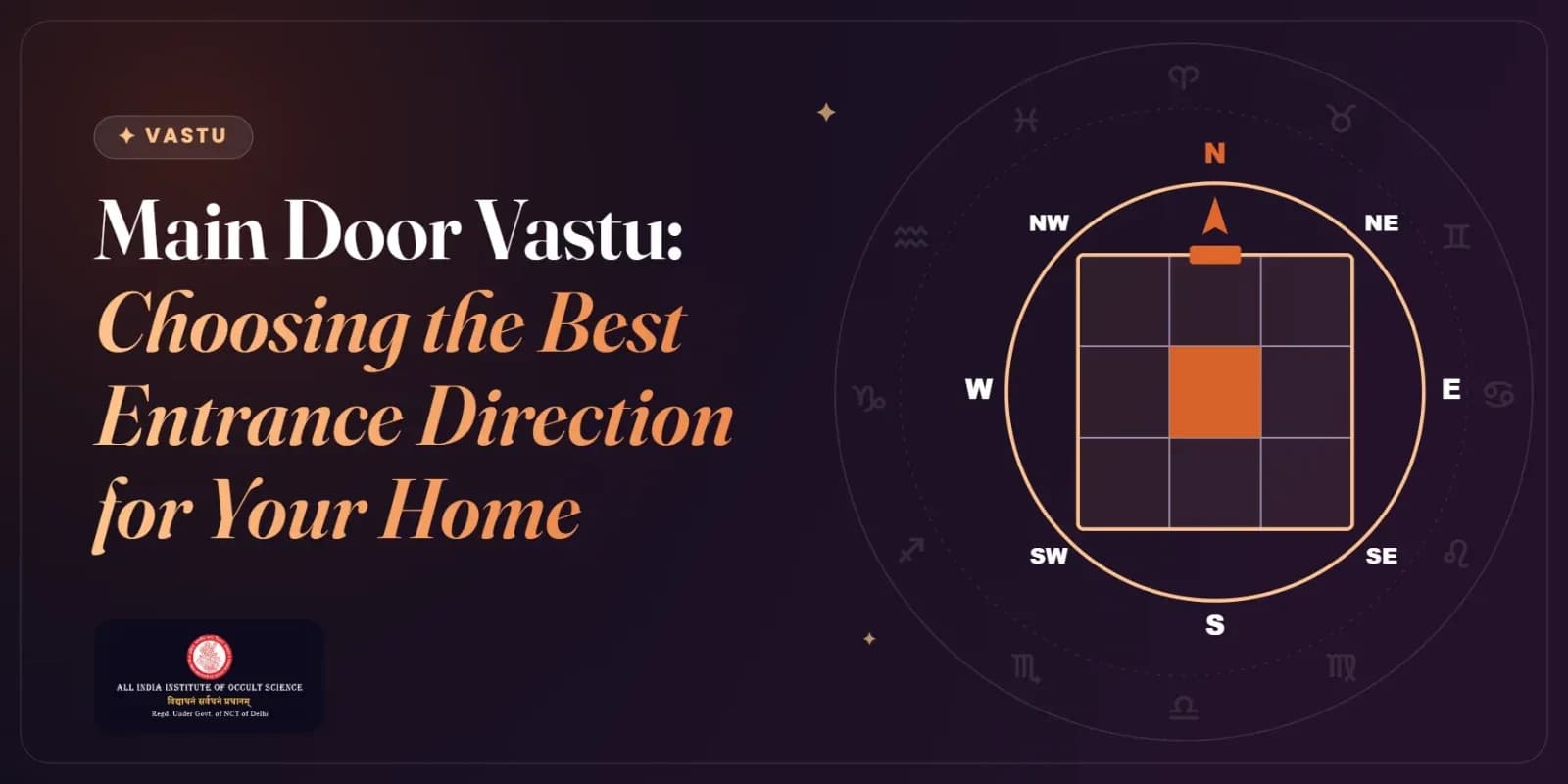
It is the square grid Vastu uses to plan a site, with the Vastu Purusha lying with his head in the north-east. The outer ring is divided among 32 deities, and those divisions (padas) are used to judge where an entrance should go.

Kitchen Vastu made simple: the best direction for the kitchen, where to place the stove, sink and fridge, and low-cost fixes for a kitchen in the wrong zone.
Written by Jyoti Chauhan, Content Writer · Reviewed by Gurudev Shrie Kashyap, Chairman & Founder, All India Institute of Occult Science · Published 18 Nov 2026
Ask anyone who has bought a flat in India what the first question was, and the answer is often the same: "Which side does the door face?" Relatives ask it, brokers advertise it, and some buyers walk away from good homes because of it.
The worry is understandable, but most of it comes from half-remembered rules. Classical Vastu Shastra has a far more practical view of the main door than the fear around south-facing homes suggests.
This guide explains how main door Vastu actually works: the direction, the more important idea of the entrance pada, the myths, and the simple things you can do if your door isn't "ideal". If you are new to the subject, our complete guide to Vastu Shastra covers the basics first.
In Vastu, the main entrance is called the mukhya dwar, the mouth of the house. Just as food enters the body through the mouth, light, air, people and opportunities enter a home through its main door. That is why the classical texts give the entrance more attention than almost any other single feature.
Texts such as Mayamata and Manasara plan every site on the Vastu Purusha grid, a square mandala where a cosmic figure lies with his head in the north-east and his feet in the south-west. The outer ring of this grid is shared by 32 deities, eight on each side. Where your door falls among them is what traditional practitioners actually read.
Architects have studied this grid too. A paper in the Nexus Network Journal describes the Vastu Purusha Mandala as a planning framework that shaped Indian temples and homes for centuries.
Here is the short answer most people are looking for. The direction of a main door is the direction you face when you stand in the doorway looking out.
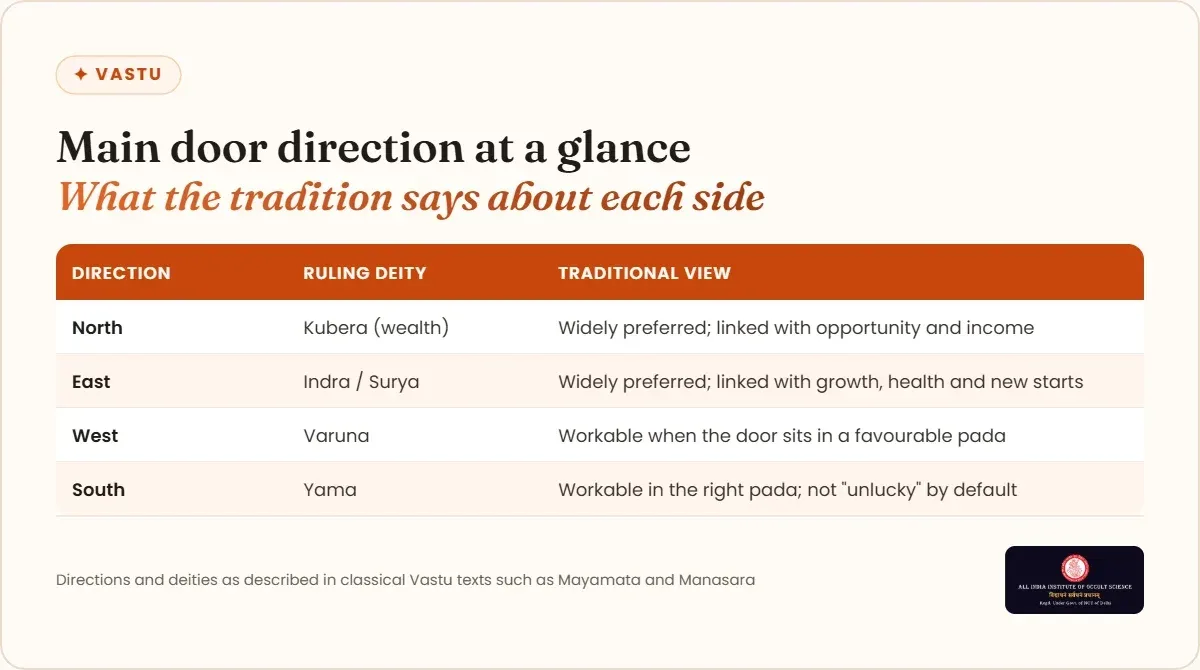
North is ruled by Kubera, the keeper of wealth, so a north-facing door is linked with opportunity, income and steady growth. It is one of the two most preferred directions. Our north facing house Vastu guide shows how the rest of such a home is usually planned.
East receives the first light of the day and is linked with Indra and Surya. Tradition associates it with health, energy and new beginnings. Like north, it is widely preferred, especially when the north-east corner is kept open and light.
West is ruled by Varuna, lord of water. Classical Vastu does not reject west-facing entrances; it simply asks that the door sit in a favourable pada. Many practitioners describe west-facing homes as good for steady, long-term gains.
South is linked with Yama, which is why the direction attracts so much fear. Yet the same classical grid lists favourable padas on the south side too. A south-facing home with a well-placed door and a balanced layout is considered perfectly liveable in traditional practice.
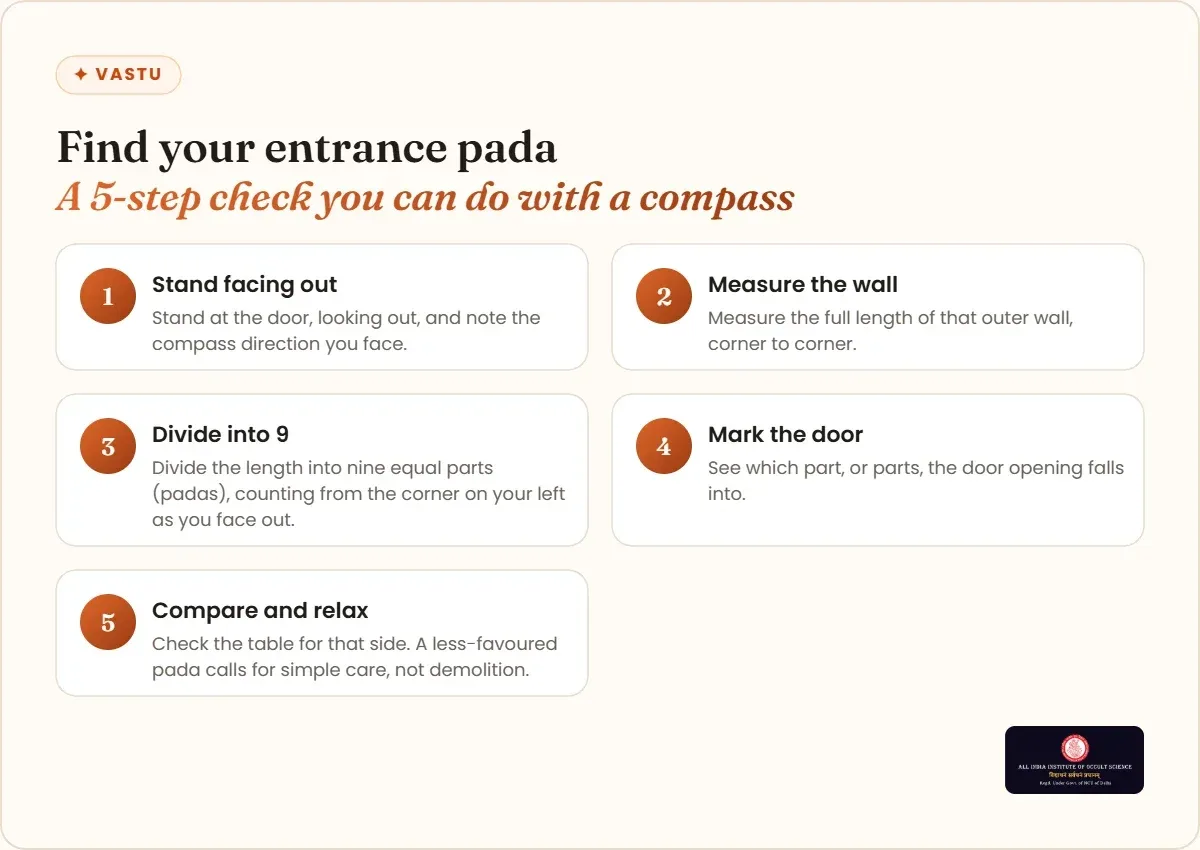
This is the part that actually decides main door placement in Vastu. Each outer wall of the plot or flat is divided into nine equal parts, called padas. In the widely taught 32-deity method, each pada has a presiding deity, and some are traditionally favoured for an entrance while others are avoided.
As a rule of thumb used by many practitioners, counting the nine parts from the corner on your left as you stand inside facing out:
Different schools number the padas slightly differently, so treat these as a starting point rather than a verdict. The key lesson is simple: every direction has good entrance positions, which is why judging a home only by its facing direction is a mistake.
Once the position is clear, Vastu texts and practitioners add a few design preferences. None of these needs expensive work.
These are the habits practitioners recommend most often, whatever direction your door faces:
Most city homes today are flats, and the rules adapt rather than disappear. In an apartment, practitioners read two entrances: the main gate or lobby of the building, and the door of your own flat. The second matters more for daily life, because it is the threshold you cross every day.
To find your flat's door direction, stand just inside the door and face out into the corridor. Note that direction with a phone compass, away from metal railings or the lift, which can disturb the reading. Then apply the same pada method to the wall of your flat that holds the door.
A few points come up again and again in apartment consultations:
Before you spend money or worry about a direction, run through this short list. It covers what practitioners look at first in almost every home:
If you can tick most of these, your entrance already follows the spirit of the classical texts, whatever its direction.
The classical grid itself contradicts this. The south wall has favoured padas just like the other sides, and the overall layout matters as much as the door.
Traditional practitioners rarely start with demolition. Lighting, upkeep and small design changes are the usual first steps.
Classical texts are about planning space, light and use. You never need to buy a product for your entrance to be considered well cared for.
Vastu is a traditional design system that aims for a comfortable, orderly home. It cannot promise wealth, health or success, and it should never replace sound advice on money, medicine or the structure of a building.
| It can | It cannot |
|---|---|
| Help you plan a bright, welcoming, practical entrance | Guarantee income, health or harmony |
| Give a traditional framework for comparing homes | Make a south-facing home "unlucky" |
| Suggest simple, low-cost improvements | Replace structural, legal or safety advice |
Reading one rule at a time is how most myths spread. Learning Vastu properly means understanding the mandala, the five elements, the zones and how they work together on a real plan. You can read more Vastu articles in our Vastu blog category, including guidance on kitchen direction.
The Institute's Vastu course is taught in two levels: a Diploma in Vastu (about 2 months) and a Master in Vastu (about 4 months), with live online classes, small batches and class recordings. It is shaped by the Institute's founder, Gurudev Shrie Kashyap, who holds a Post Graduate Diploma in Vastu Shastra. You can download the course syllabus to see the full topic list.
Main door Vastu is less about fearing a direction and more about placing and caring for your entrance well. North and east are traditionally preferred, but a door in a favourable pada on any side is considered workable, and a bright, clean, well-kept entrance is the most repeated advice of all. If you would like to read real plans with confidence, explore the Vastu course at the All India Institute of Occult Science.
This article shares traditional Vastu knowledge for educational purposes. It is not a substitute for professional architectural, structural, legal or financial advice. Please read our disclaimer.
 Login or Sign up
Login or Sign Up to Get Course Details
Enter your mobile number to continue. You’ll land on your dashboard with the full course syllabus, special offers and upcoming batches.
 By continuing you agree to our Terms & Conditions and Privacy Policy.

North facing house Vastu explained: the best entrance padas, a room-by-room layout, tips for flats and plots, colours, myths and simple fixes.

Vastu Shastra is a traditional system of planning and building construction in India. The recommendations of this system concern the site or a plot, the direction, the position of rooms, and the proportion in relation to the building and its surroundings.


