contact@occultscience.in
 +91 96724 36436
 Send Your Query
 Get Syllabus

 +91 96724 36436
 contact@occultscience.in


Loading…

 Celebrating 23 Years of Trust — Enrol Now for the upcoming demo session
 All India Institute ofOccult Scienceविद्याधनं सर्वधनं प्रधानम्
Login with your mobile number
See upcoming batches, demo classes and your syllabus in one place.
Login / RegisterLoading…
Login with your mobile number
See upcoming batches, demo classes and your syllabus in one place.
Login / RegisterAstrology
9 min readAstrology
In classical Vedic astrology, retrograde planets are generally considered strong, because they gain cheshta bala (motional strength) when appearing to move backwards. How that strength shows up depends on the planet's sign, house, lordship and the rest of the chart.
The Sun and the Moon never appear to go retrograde. Rahu and Ketu, the lunar nodes, are the opposite: in their usual mean calculation, they always move backwards through the zodiac.
Astrologers often read a natal retrograde planet as one whose themes are experienced more inwardly, revisited, or developed in an unusual way. It is still read through its sign, house and aspects; retrograde motion adds nuance rather than changing everything.
Rahu and Ketu are not physical planets but the points where the Moon's orbit crosses the Sun's apparent path. These points slowly move backwards through the zodiac, completing a cycle in about 18.6 years.
Jupiter turns retrograde in Leo around 13 December 2026 and moves back into Cancer around 25 January 2027. Astrologers read such periods as times to review and reflect on Jupiter's themes, such as learning, guidance and growth, rather than as bad times.
Astrology, numerology or Vastu? Compare what you learn, time needed, maths involved and career use, plus where tarot, Reiki and palmistry fit.
Written by Jyoti Chauhan, Content Writer · Reviewed by Gurudev Shrie Kashyap, Chairman & Founder, All India Institute of Occult Science · Published 25 Nov 2026
"Mercury retrograde" has become a popular phrase online, blamed for everything from lost phones to awkward emails. In India, questions about vakri Shani or vakri Guru come up just as often in consultations. Many people assume a retrograde planet is a bad sign.
Classical Vedic astrology takes a more nuanced view. This guide explains what retrograde motion really is, which planets go retrograde and how often, what classical texts say, how to read a retrograde planet in your own birth chart, and what the upcoming Jupiter retrograde of December 2026 means.
Planets orbit the Sun in the same direction, and when watched night after night, they usually drift slowly eastward against the background stars. At certain times, a planet seems to stop, move westward for a while, stop again and then resume its usual direction. That apparent backward movement is called retrograde motion.
It is an optical effect caused by our moving viewpoint on Earth. NASA explains it with a simple picture: when a faster planet overtakes a slower one, the slower planet appears to move backwards for a time, just as a slower car seems to slip backwards when you overtake it on a highway. The Planetary Society describes it in the same way: an effect of perspective, not a real change in the planet's orbit.
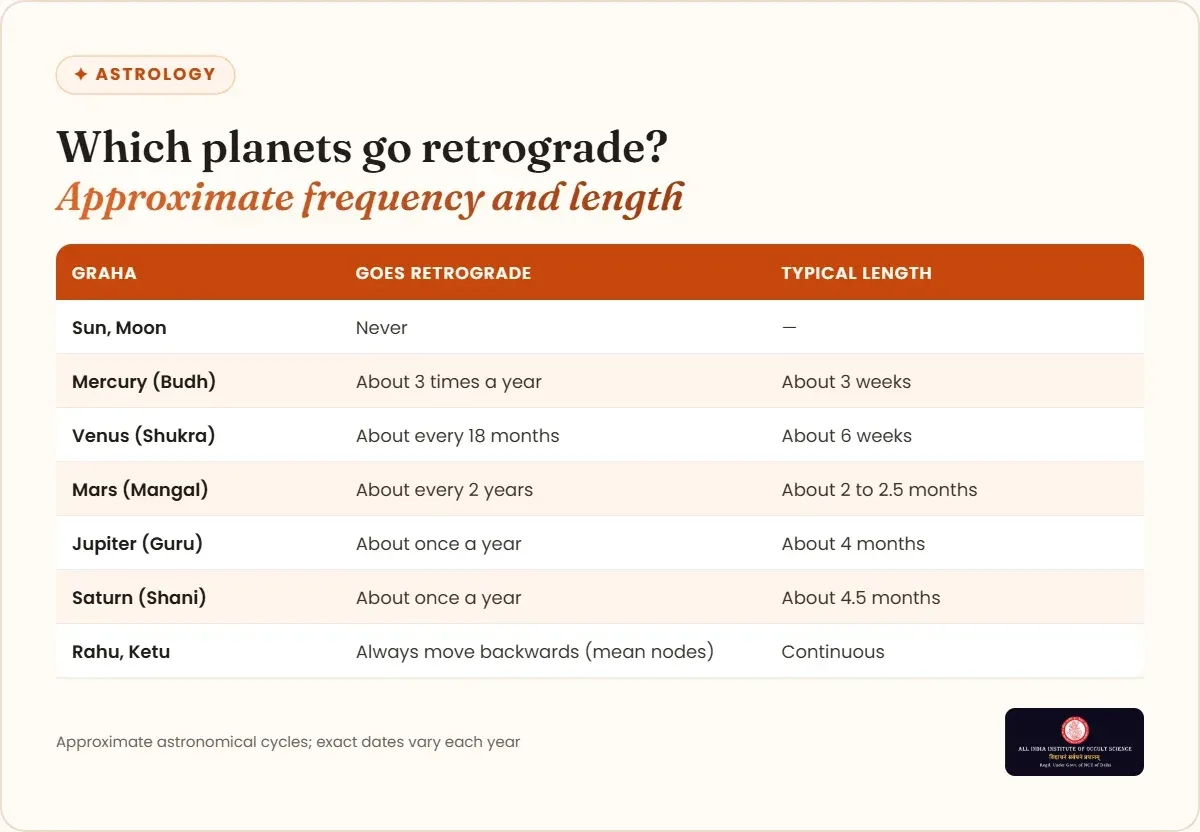
Because the Sun and Moon never appear retrograde, and Rahu and Ketu always move backwards, astrologers only speak of retrogression as a special condition for the five "true" planets: Mercury, Venus, Mars, Jupiter and Saturn.
Rahu and Ketu are not physical bodies. They are the points where the Moon's orbit crosses the Sun's apparent path, the lunar nodes. These points slowly move backwards through the zodiac over about 18.6 years. Our guide to the Rahu-Ketu transit of December 2026 explains their current movement.
Classical texts such as Saravali and Phaladeepika discuss vakri planets, and the Parashari tradition gives retrograde planets cheshta bala, a form of motional strength. A retrograde planet is close to Earth and appears bright in the sky, which ancient astrologers linked with strength and intensity.
Several traditional ideas follow from this:
Schools differ on the details, and good astrologers avoid one-line rules. A retrograde planet is always read within the whole chart.
First, generate an accurate chart with a free kundali tool. Retrograde planets are usually marked with (R), "Va" or "Vakri". Then follow these steps:
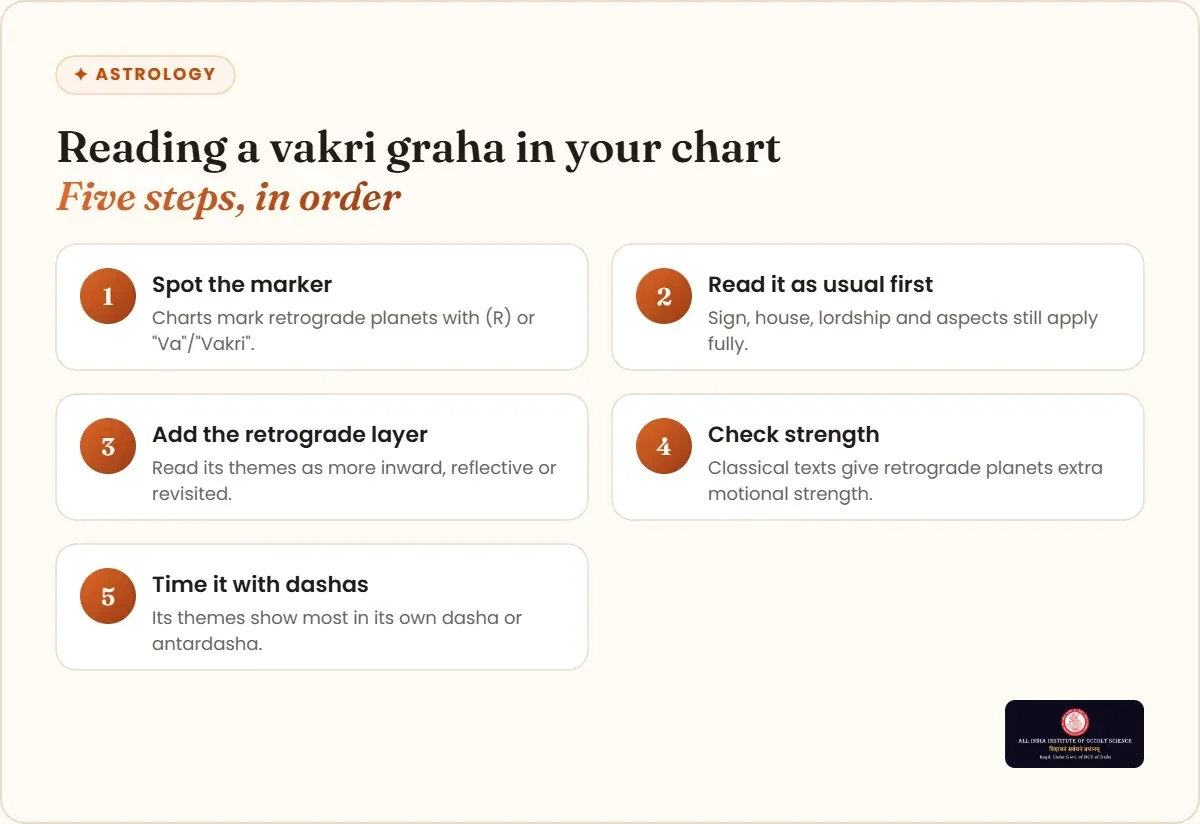
The order matters. Start with the planet's normal meaning: its sign, the house it occupies, the houses it rules and its aspects. Our guides on how to read a kundali and the 12 houses cover these basics. Only then add the retrograde layer, and use the planet's mahadasha or antardasha to judge when its themes are most active.
Just before a planet turns retrograde, and again before it turns direct, it appears to stand still for a few days. Astronomers call these stationary points. Many astrologers consider a planet especially intense when it is stationary, because its influence is concentrated on one degree of the zodiac. In a birth chart, a planet that was stationary at birth is often read as a strong, defining force in the person's life.
Consider an invented chart with a Leo ascendant and Jupiter retrograde in the 9th house, in Aries. Read normally first: Jupiter rules the 5th and 8th houses for Leo, and sits in the 9th, the house of higher learning, teachers and dharma, in a friendly fire sign. That already suggests a strong interest in philosophy, study and guidance.
Now add retrogression. Many astrologers would read this as wisdom gained through personal questioning rather than accepted blindly from others; the person may revisit their beliefs several times and develop an independent spiritual outlook. During Jupiter's mahadasha or antardasha, these themes would be expected to come forward strongly, perhaps through study, teaching or a change in worldview. Notice that the reading describes tendencies and themes, not fixed events.
Often read as a thoughtful, reflective mind that revisits ideas before speaking. People with natal retrograde Mercury may think deeply, prefer to revise their work, or learn in unconventional ways.
Linked with an inward, reflective approach to love, beauty and values. Relationships or artistic interests may develop slowly or in unusual ways.
Energy that is turned inward or released in bursts. Astrologers often advise channelling it into disciplined effort, sport or focused work.
Read as wisdom developed through personal reflection rather than conventional teaching. Many astrologers see natal retrograde Jupiter as a sign of independent spiritual or philosophical thinking.
Linked with a strong inner sense of responsibility and a tendency to revisit past duties or lessons. Results of effort may come later but tend to be lasting.
There are two different situations. A natal retrograde planet was retrograde when you were born, and it describes a lifelong quality. A transit retrograde is a temporary period when a planet is retrograde in the sky now; it affects everyone's chart in different ways, depending on the house it crosses.
Transit retrogrades are generally read as times to review, revise and reflect on the planet's themes, and to finish pending work rather than rush new beginnings in that area. They are not reasons for panic.
December 2026 brings two notable shifts. Saturn, retrograde in Pisces, is expected to turn direct around 11 December 2026, and Jupiter turns retrograde in Leo around 13 December 2026, moving back into Cancer around 25 January 2027 before returning to Leo later in 2027. Exact times vary slightly between almanacs, so check a panchang for your city.
Astrologers usually read Jupiter's retrograde as a period to revisit learning, beliefs and long-term plans, especially in the house Leo occupies in your chart. Saturn turning direct is often read as pending work starting to move again. If Saturn's transit concerns you, our guide to Sade Sati explains Saturn's Moon-sign cycle calmly.
A natal retrograde planet becomes most noticeable during its own mahadasha or antardasha. Astrologers often describe these periods as times when the planet's themes return for deeper work. For example, a retrograde Saturn dasha may bring back responsibilities a person once postponed, now with the maturity to handle them. A retrograde Mercury dasha may favour revising, editing, research or returning to an old course of study.
The quality of these results still depends on the planet's sign, house, lordship and strength. A well-placed retrograde benefic in its dasha is usually read as rewarding, while a stressed retrograde planet calls for patience and steady effort.
These are traditional suggestions for mindful planning, not rules that stop daily life.
Classical astrology gives them strength. Their results depend on the full chart, not on retrogression alone.
It only appears to, because of our viewpoint from Earth.
Many astrologers suggest care with matters ruled by the retrograde planet, not a pause on life.
| They can | They cannot |
|---|---|
| Add nuance to how a planet's themes are experienced | Decide outcomes on their own, without the full chart |
| Suggest periods for review and reflection | Predict accidents, illness or financial losses |
| Help explain a person's inward or unusual style | Replace medical, legal or financial advice |
Reading retrograde planets well needs a solid grasp of signs, houses, strengths, dashas and transits. If you prefer a self-paced start, our page on how to learn Vedic astrology outlines the subjects. The Institute's astrology course runs as a Certificate (about 2 months), a Diploma (about 5 months) and a Master (about 8 months), live online, with planetary strengths and transits covered in depth at the higher levels.
Retrograde planets, or vakri grahas, only appear to move backwards, but classical Vedic astrology treats them as strong and meaningful. Read them first as ordinary planets, then add the reflective, revisiting quality of retrogression, and time their effects with dashas. Approach retrograde transits as seasons for review, not fear. To study planetary strength and timing in depth, explore the astrology course at the All India Institute of Occult Science.
This article shares traditional astrology knowledge for educational purposes. It is not a substitute for professional medical, legal, psychological or financial advice. Please read our disclaimer.
 Login or Sign up
Login or Sign Up to Get Course Details
Enter your mobile number to continue. You’ll land on your dashboard with the full course syllabus, special offers and upcoming batches.
 By continuing you agree to our Terms & Conditions and Privacy Policy.
What is Sade Sati? Learn how Saturn's 7.5-year transit over your Moon sign works, what each phase covers, who has it in 2027, and the myths to drop.

Can you learn astrology without a guru? See what self-study does well, where beginners get stuck, how the guru tradition fits today, and how to choose.