contact@occultscience.in
 +91 96724 36436
 Send Your Query
 Get Syllabus


 +91 96724 36436
 contact@occultscience.in


Written by Jyoti Chauhan, Content Writer · Reviewed by Gurudev Shrie Kashyap, Chairman & Founder, All India Institute of Occult Science · Published 21 Nov 2026
Key Takeaways
- East facing house Vastu is widely seen as favourable because the home receives the first light of the day, a direction linked with Indra and Surya.
- The main door is traditionally best in the 3rd or 4th of 9 padas on the east wall, counted from the north-east corner.
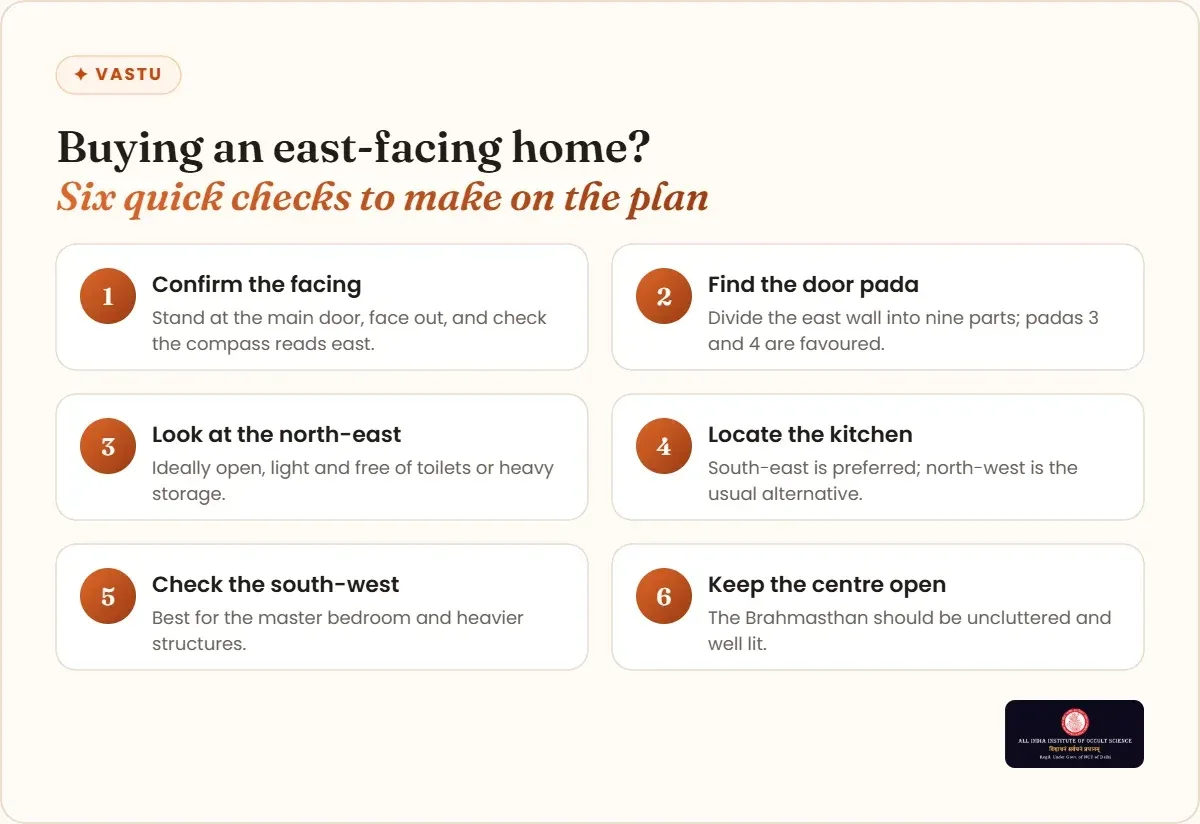
- Keep the north-east open and light, the kitchen in the south-east and the master bedroom in the south-west.
- An east-facing home is not automatically "lucky"; layout, upkeep and light matter just as much.
- Vastu is a traditional design system and never requires demolition or paid products.
Property listings in India love the phrase "east-facing". Brokers mention it first, buyers pay a premium for it, and families feel reassured by it. But what does an east-facing house actually mean in Vastu, and does the direction alone make a home good?
This guide explains east facing house Vastu in practical terms: why the direction is valued, how to place the main door correctly, where each room traditionally goes, a sample layout, myths to drop and simple fixes when your plan isn't ideal. For the foundations of the subject, start with our guide to Vastu Shastra.
What Is an East-Facing House?
A house is east-facing when you stand at the main entrance, look outward, and face east. The direction of the road or the balcony does not decide this; the main door does. Use a phone compass a few steps away from metal gates and parked cars, which can disturb the reading.
In flats, check the door of your own apartment. The building's lobby may face one way and your flat door another, and practitioners give more weight to the door you use every day.
Why Vastu Values the East
East is where the sun rises, and Vastu treats morning light as one of the most important qualities a home can have. The direction is ruled by Indra, king of the devas, and is closely linked with Surya, the Sun. Traditional texts associate it with health, energy, growth and a good public reputation.
There is also simple common sense in the tradition. An east-facing home in India tends to receive gentle morning sun at the front and stays cooler in the harsh afternoon, which architects would recognise as good passive design.
Main Door Placement in an East-Facing House
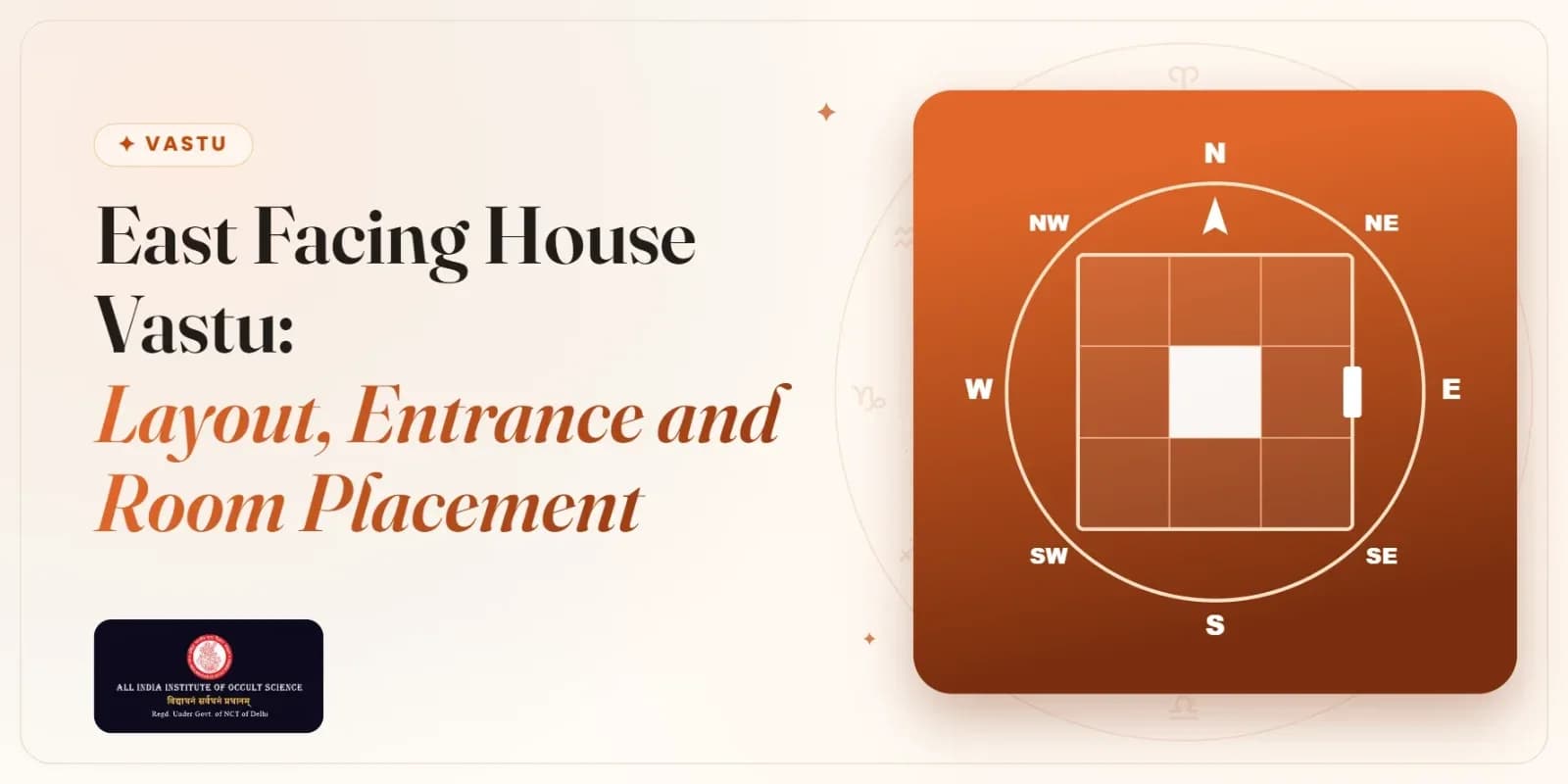
The direction is only half the story. Classical Vastu divides each outer wall into nine equal parts, or padas, based on the Vastu Purusha Mandala. On the east wall, many practitioners favour the third and fourth padas counted from the north-east corner, linked with Jayanta and Mahendra.
A door placed at the extreme south-east end of the east wall is the one position most practitioners try to avoid. If your door is already there, the usual advice is gentle: keep the entrance very bright, clean and well maintained rather than rebuilding. Our full guide to main door Vastu explains the pada method step by step.
Door design tips for east-facing homes
- Choose good-quality wood or a sturdy door in light or earthy tones.
- Make the main door the largest door in the house, opening inward and clockwise.
- Keep a clear nameplate and good lighting for evenings.
- Avoid placing shoe racks, dustbins or heavy objects right at the entrance.
Room-by-Room Layout for an East-Facing House
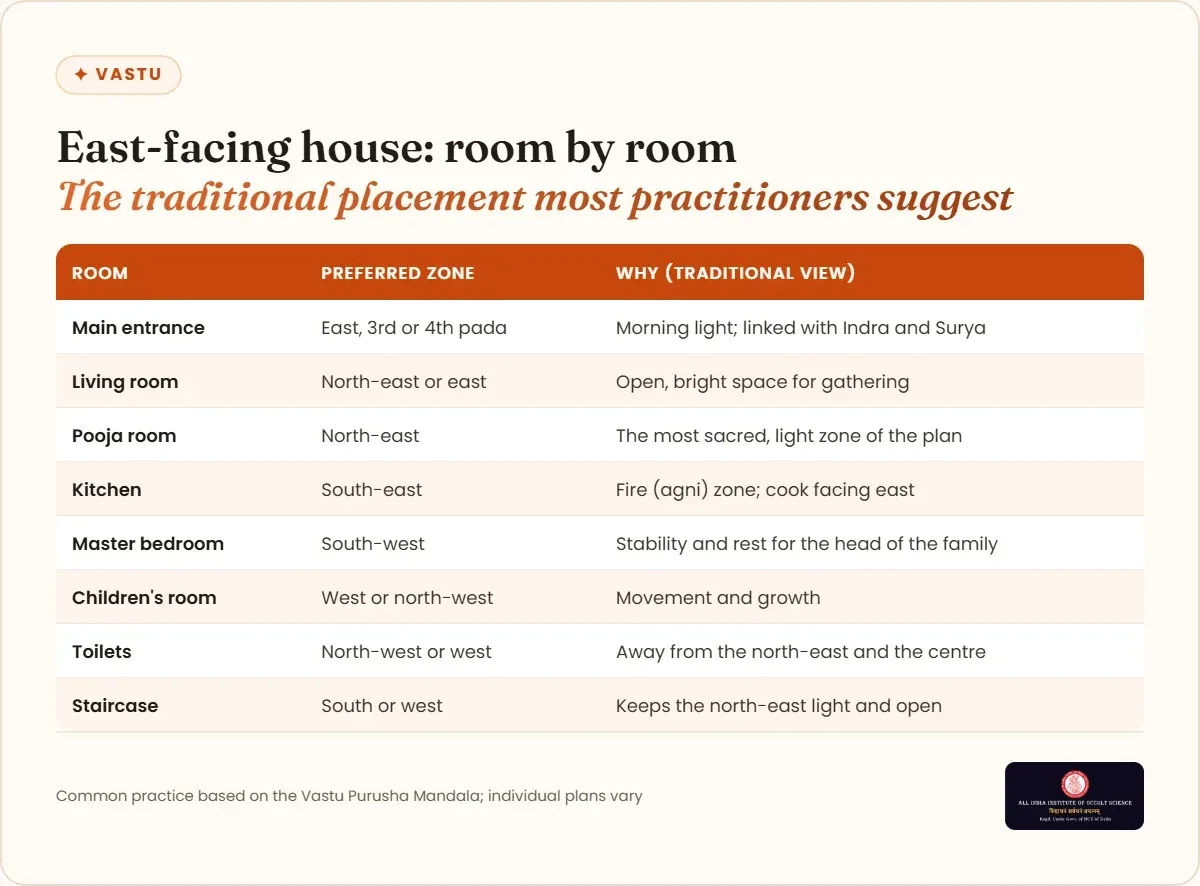
Here is the traditional placement most practitioners start from. Treat it as a guide for planning or for choosing between homes, not as a rigid rule:
Living room
The north-east or east side suits the living room, where the family gathers and guests are received. Keep it light, with heavier furniture placed toward the south and west walls.
Pooja room
The north-east corner, called ishaan, is the most sacred zone in Vastu. A small pooja space here, kept clean and uncluttered, is the classic choice. If a separate room is not possible, a shelf on the north-east wall works well.
Kitchen
The south-east, the zone of fire, is preferred for the kitchen. Practitioners like the cook to face east while cooking. The north-west is the accepted second choice. Our guide to kitchen Vastu covers stove, sink and storage placement in detail.
Bedrooms
The south-west is the traditional zone for the master bedroom, linked with stability and grounding. Children's rooms suit the west or north-west. Guest rooms also work in the north-west, a zone associated with movement.
Toilets and bathrooms
Keep toilets away from the north-east and the centre of the home. The north-west or west is the usual choice, with good ventilation.
Staircase and heavy storage
Stairs and heavy storage are best in the south or west. This keeps the east and north-east open, which is the spirit of an east-facing plan.
A Sample East-Facing Layout (Described)
Imagine a simple two-bedroom east-facing home on a square plot (sample plan for illustration). The main door sits in the fourth pada of the east wall. Inside, the living room occupies the east and north-east, with a small pooja shelf on the north-east wall. The kitchen is in the south-east, with the stove placed so the cook faces east. The master bedroom is in the south-west, the second bedroom in the north-west, and a bathroom on the west side. The centre of the home is a small open dining space, kept light and uncluttered.
This sample follows the traditional zones without any unusual construction, which is why east-facing plans are often called easy to design.
East-Facing Flats and Apartments
In apartments you rarely control the layout, so practitioners focus on what you can change:
- Use rooms well: if a south-west room exists, make it the main bedroom.
- Keep the north-east light: avoid heavy cupboards or storage there.
- Let the morning sun in: light curtains on east windows honour the main advantage of the direction.
- Arrange the kitchen: even in a north-west kitchen, the stove can often be placed so you face east.
Open Space, Gardens and Balconies
In east-facing plots, Vastu traditionally prefers more open space on the east and north sides than on the south and west. In practice, that means a front garden, parking or courtyard on the east is welcome, while the building mass sits toward the south-west of the plot.
- Gardens: lawns, flowering plants and small shrubs suit the east and north-east. Tall trees are better placed in the south or west, where they give afternoon shade.
- Water features: a small fountain, water tank or borewell is traditionally placed in the north-east, kept clean.
- Balconies: east and north balconies are favoured because they bring in light and air. Keep them uncluttered rather than using them as storage.
- Boundary walls: slightly lower on the east and north, slightly higher on the south and west, is the classic guideline.
Colours for an East-Facing Home
Colour advice in Vastu is gentle and flexible. For east-facing rooms, practitioners often suggest light, fresh shades that reflect the morning sun: soft whites, creams, light yellows and pale greens. Warmer peach or light orange tones suit the south-east kitchen, while earthy browns and beige suit the south-west bedroom. The main door itself can be a natural wood finish or a light shade that looks welcoming.
None of these colours is compulsory. If you love a particular colour, use it in a way that keeps rooms bright and calm, which is the real aim behind the guidance.
East vs North-Facing: A Quick Comparison
Buyers often choose between these two favoured directions. East-facing homes are linked with health, energy and recognition, and enjoy morning sun at the front. North-facing homes are linked with wealth and opportunity, and receive soft, even light through the day. Both are considered excellent when the entrance pada and room layout are right, so the better choice is usually the plan that fits your family's daily life.
Choosing an East-Facing Plot or Flat: What to Look For
If you are comparing homes, a few practical observations tell you more than the word "east-facing" on a brochure:
- Road position: a road on the east side of the plot is traditionally welcome, as it keeps the east open. A road on both the east and north is often considered especially good.
- Plot shape: square or rectangular plots are preferred. Irregular plots with a cut or missing north-east corner are the ones practitioners study most carefully.
- Slope: land that slopes gently down toward the east or north-east is the classic preference, with higher ground to the south-west.
- Neighbouring buildings: a very tall building directly east can block morning light; a quick visit at sunrise shows you how much sun the home actually gets.
- Water and drainage: an underground tank or borewell in the north-east and an overhead tank in the south-west follow the traditional pattern.
None of these points needs expert equipment. A phone compass, a morning visit and a copy of the floor plan are enough to judge most homes before you speak to a consultant.
A quick note on apartments facing east
In a high-rise, the flat's own door, its balconies and where the morning light enters matter more than the building's main gate. A flat with an east balcony and a bright north-east corner usually captures the main benefit of the direction, even if the tower's entrance faces elsewhere.
Common Myths About East-Facing Houses
Myth 1: "Every east-facing house is lucky."
Direction is a starting point. A cluttered north-east, a toilet in the centre or a door in the extreme south-east pada can matter more than the facing itself.
Myth 2: "Other directions are bad."
North-, west- and south-facing homes can all be well planned. Our north facing house Vastu guide shows how a different direction is handled with the same principles.
Myth 3: "Trees in front of an east-facing home are a problem."
Very large trees blocking all morning light directly in front of the door are traditionally avoided, but small plants and gardens are welcome. Shade from a tree a little way off is not a concern.
Myth 4: "Fixing Vastu needs costly remedies."
The most common advice is free or cheap: light, cleanliness, decluttering and sensible use of rooms. No product purchase is needed.
Simple Corrections Without Demolition
- Move heavy furniture and storage from the north-east to the south-west.
- Improve lighting at the entrance and in the north-east corner.
- Use a room's function wisely: a north-east room makes a better study or pooja room than a storeroom.
- Keep the centre of the home open and uncluttered.
- Repair leaks, cracks and broken fittings promptly; upkeep is part of Vastu.
What Vastu Can and Cannot Do for Your Home
| It can | It cannot |
|---|---|
| Offer a traditional framework for planning light, space and use | Guarantee wealth, health or harmony |
| Help compare homes when you are choosing | Replace structural, legal or safety checks |
| Suggest low-cost improvements to daily comfort | Require you to buy yantras, crystals or remedies |
How to Learn Vastu Properly
Reading a single plan well means understanding the mandala, the five elements, the 16 zones and how they interact. The Institute teaches Vastu as a Diploma in Vastu (about 2 months) and a Master in Vastu (about 4 months), live online with real floor plans for practice. You can download the syllabus to see every module.
Conclusion
East facing house Vastu rewards good basics: a main door in a favourable pada, an open and light north-east, the kitchen in the south-east and the master bedroom in the south-west. The direction gives you a head start; thoughtful use of space does the rest. If you would like to read real plans with confidence, explore the Vastu course at the All India Institute of Occult Science.
This article shares traditional Vastu knowledge for educational purposes. It is not a substitute for professional architectural, structural, legal or financial advice. Please read our disclaimer.