

 contact@occultscience.in
 +91 96724 36436
 Send Your Query
 Get Syllabus


 +91 96724 36436
 contact@occultscience.in


Written by Jyoti Chauhan, Content Writer · Reviewed by Gurudev Shrie Kashyap, Chairman & Founder, All India Institute of Occult Science · Published 22 Nov 2026
Key Takeaways
- Mounts in palmistry are the fleshy pads of the palm, each named after a planet: Jupiter, Saturn, Sun, Mercury, Venus, Moon and Mars.
- There are 7 mounts in most systems; Mars is often split into upper Mars, lower Mars and the plain of Mars.
- Palmists read each mount as full, flat or displaced, and give most weight to the one or two that stand out.
- Mounts show where energy and interest naturally lie; lines show how that energy is used, so the two are always read together.
- Mounts describe tendencies in a traditional framework; they do not predict health, wealth or fate.
Look at your open palm under a soft light and you will see more than lines. The surface rises and dips: a full pad at the base of the thumb, small cushions under each finger, a gentle swell on the outer edge. In palmistry these raised areas are called mounts, or parvat in Hindi, and they are some of the first things an experienced palmist notices.
This guide is a practitioner's reference to the seven mounts: where each one sits, what tradition links it with, how to read full, flat and displaced mounts, how mounts combine with lines, and a worked sample reading. If you are just starting out, our palmistry guide for beginners covers the basics first.
What Are Mounts in Palmistry?
A mount is a slightly raised, fleshy area of the palm. Both Indian Samudrika Shastra and Western palmistry name the mounts after the planets, and read each one as a sign of how strongly that planet's qualities show in a person.
Western writers such as Cheiro described the mounts in detail in the late nineteenth and early twentieth centuries; his Palmistry for All is now in the public domain. Britannica describes palmistry broadly as reading character from the lines and contours of the palm, and the mounts are those contours.
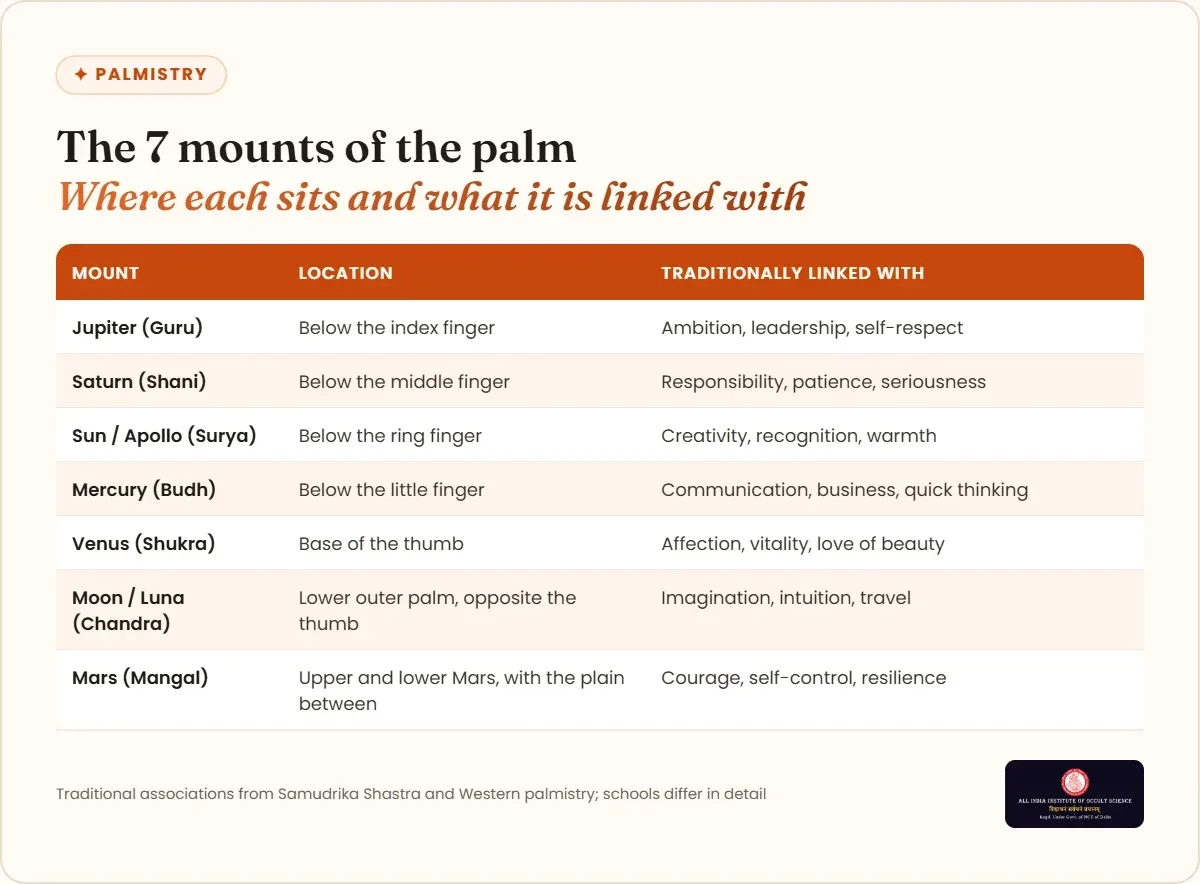
The 7 Mounts at a Glance
Each Mount in Detail
1. Mount of Jupiter (Guru Parvat)
Found below the index finger. A well-developed Mount of Jupiter is linked with ambition, leadership, confidence and a sense of dignity. People with a strong Jupiter mount are often drawn to teaching, guiding or organising others. When overdeveloped, tradition reads it as pride or a need for control. A flat Jupiter mount suggests someone less driven by status or position.
2. Mount of Saturn (Shani Parvat)
Found below the middle finger. It is usually the flattest mount, and a modest Saturn mount is considered normal and balanced. A prominent one is linked with seriousness, patience, love of solitude and an interest in research or deep subjects. Palmists read an exaggerated Saturn mount as a tendency toward caution or worry.
3. Mount of the Sun or Apollo (Surya Parvat)
Found below the ring finger. It is linked with creativity, warmth, appreciation of beauty and recognition. A well-formed Sun mount often appears in artists, performers and people who enjoy being seen for their work. Combined with a clear sun line, palmists read it as a capacity for success through talent.
4. Mount of Mercury (Budh Parvat)
Found below the little finger. It is linked with communication, business sense, quick thinking and adaptability. A strong Mercury mount is often seen in people who enjoy trade, writing, speaking or problem-solving. Small vertical lines here are traditionally called "medical stigmata" and associated with an interest in healing or service.
5. Mount of Venus (Shukra Parvat)
The large pad at the base of the thumb, enclosed by the life line. It is linked with affection, vitality, sensuality and love of music and the arts. A full, firm Venus mount suggests warmth and energy. A very flat one suggests a more reserved, private temperament. Because it sits inside the life line, palmists often read it together with the life line.
6. Mount of the Moon or Luna (Chandra Parvat)
Found on the outer edge of the palm, opposite the thumb, near the wrist. It is linked with imagination, intuition, emotional depth and a love of travel. A well-developed Moon mount appears often in writers, artists and people with a strong inner life. Palmists read an exaggerated Moon mount as a tendency to daydream.
7. Mount of Mars (Mangal Parvat)
Mars appears in three areas. Lower Mars, just above Venus inside the thumb, is linked with physical courage and initiative. Upper Mars, between Mercury and the Moon, is linked with moral courage, patience and self-control. The plain of Mars in the centre of the palm is read for how a person handles conflict and pressure.
Full, Flat and Displaced Mounts
Palmists judge three qualities for every mount:
- Full and firm: the planet's qualities are active and healthy.
- Very large or very soft: the qualities may be overdone or unfocused.
- Flat: the qualities are quieter in that person, not missing.
- Displaced: a mount that leans toward its neighbour blends their qualities. For example, Jupiter leaning toward Saturn suggests ambition tempered by caution.
Comparing mounts with each other on the same hand matters more than comparing them with another person's hand. Every hand has its own scale.
How to Read the Mounts Step by Step
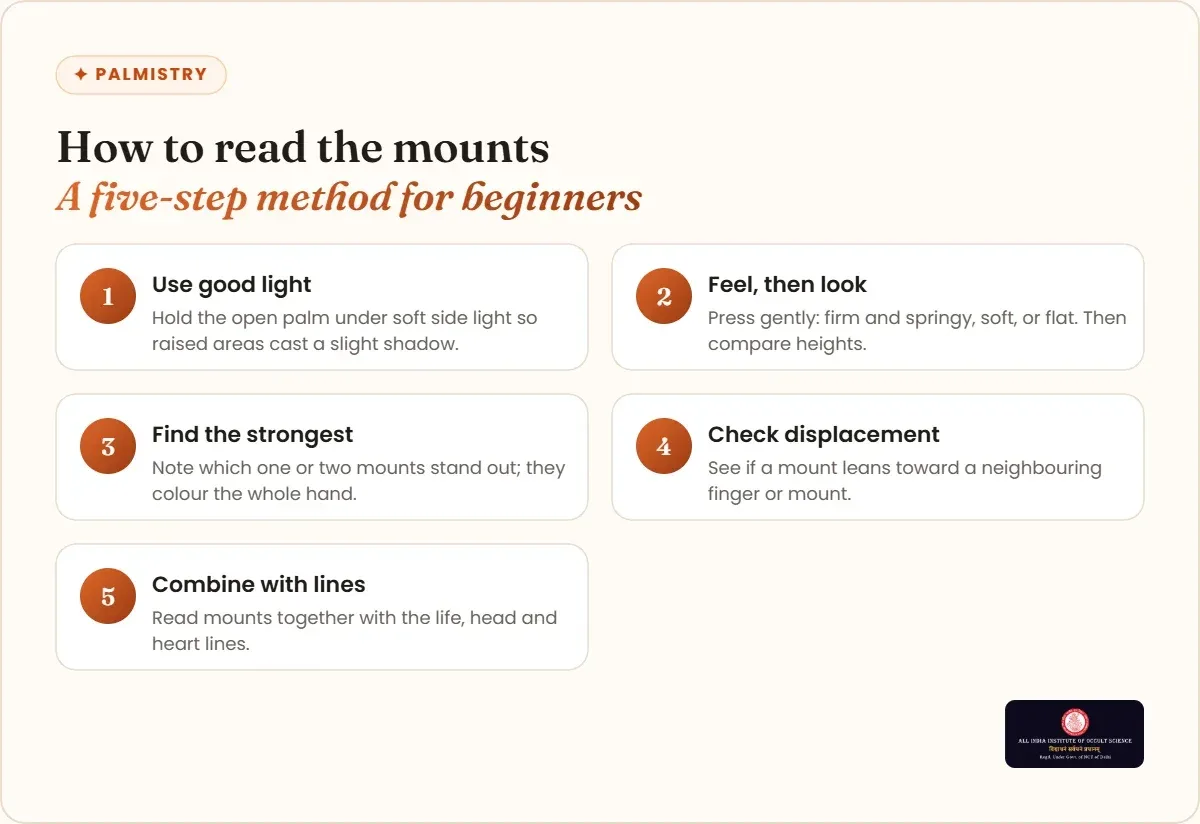
A useful habit is to note the dominant mount first and describe the person through it. A hand with a strong Mercury mount and a strong Moon mount, for example, suggests someone who combines quick communication with imagination, such as a natural storyteller.
How Mounts and Lines Work Together
Mounts show where energy naturally gathers; lines show how it flows. When a line runs toward or ends on a mount, palmists read that mount's themes as more active. A few common combinations:
- Heart line ending under Jupiter: an idealistic, loyal approach to love.
- Head line sloping toward the Moon: imaginative, creative thinking. Our guide to the head line explains slope in detail.
- Fate line rising from the Moon: a path shaped by other people or public life.
- Clear sun line on a full Sun mount: recognition through talent or creative work.
Small marks on mounts, such as stars, triangles and grilles, are read as well. Some are discussed in our article on rare palm signs.
Worked Example: A Sample Hand
Here is an invented sample for practice. The hand has a full, firm Mount of Venus, a prominent Mount of Mercury, a modest Saturn mount, and a Moon mount of average height. The Jupiter mount is slightly displaced toward the middle finger. The head line is long and gently sloping.
A palmist might read this as a warm, energetic person (Venus) with a gift for communication and practical business sense (Mercury), whose ambitions are thoughtful rather than showy (Jupiter leaning toward Saturn). The gently sloping head line adds some imagination to an otherwise practical mind. Notice that the reading describes temperament and tendencies, not events or dates.
Mounts on the Left and Right Hand
Most palmists compare the mounts on both hands. The non-dominant hand is traditionally linked with inborn tendencies, and the dominant hand with how those tendencies have been developed through choices and experience. A Mount of Jupiter that is flat on the passive hand but full on the active hand, for example, is read as confidence and leadership that a person has built over time rather than been born with.
Differences like this are often the most encouraging part of a reading, because they show change. They remind the person that a hand is a record of growth, not a fixed verdict.
Mounts and Hand Shapes
Hand shape changes how mounts look. Broad, square palms with short fingers (often called earth hands) tend to have firm, compact mounts. Long, narrow palms (often called water hands) tend to have softer, less defined mounts. Experienced palmists adjust their expectations to the hand in front of them: a modest Venus mount on a slim hand can be as significant as a large one on a broad hand.
This is one reason palmistry is learned by looking at many hands. Over time you develop a sense of what is normal for each hand type, and the mounts that truly stand out become easy to spot.
Taking Hand Prints to Study Mounts
Mounts are easier to compare on a print than on a moving hand. A simple method many students use: roll a thin layer of washable ink or lipstick over the palm with a small roller, press the hand gently on smooth white paper placed on a soft surface such as a folded towel, and lift straight up. Mounts show as darker, fuller areas of pressure, while flat areas print lightly. Label each print with the date and which hand it is, and only take prints with the person's consent. Comparing prints taken months apart is also a good way to notice how lines and contours change over time.
Common Mistakes When Reading Mounts
- Reading one mount alone: mounts only make sense in relation to each other.
- Ignoring hand type: a broad, fleshy hand naturally has fuller mounts than a slim one.
- Poor lighting: overhead light hides the contours; side light shows them.
- Reading one hand only: compare both hands for a fuller picture.
- Fearful language: no mount is "bad"; every mount describes a quality to understand.
What Mounts Can and Cannot Tell You
| They can | They cannot |
|---|---|
| Offer a traditional picture of temperament and interests | Diagnose health conditions |
| Prompt reflection on strengths and balance | Predict wealth, marriage dates or life span |
| Enrich a reading when combined with lines | Replace medical, legal or financial advice |
How to Learn Palmistry Properly
Mounts are best learned by looking at many real hands, with a teacher to check your judgement. The Institute teaches palmistry as a Diploma in Palmistry (about 2 months) and a Master in Palmistry (about 4 months), live online in small batches, with practice on hand prints. You can download the syllabus to see every topic.
Conclusion
The seven mounts in palmistry, from Jupiter to the Moon, add depth that lines alone cannot give. Feel and compare them, note the strongest one or two, check for displacement, and always read them with the major lines. Practise on many hands and your eye will sharpen quickly. To learn with structured guidance, explore the palmistry course at the All India Institute of Occult Science.
This article shares traditional palmistry knowledge for educational purposes. It is not a substitute for professional medical, legal or financial advice. Please read our disclaimer.


