contact@occultscience.in
 +91 96724 36436
 Send Your Query
 Get Syllabus


 +91 96724 36436
 contact@occultscience.in


Key Takeaways
- Missing numbers in the Lo Shu grid are digits from 1 to 9 that do not appear in your date of birth; each is linked with a planet and a quality to develop.
- Most people have 3 to 4 missing numbers; this is normal, not unlucky.
- Conventions differ: some use the date only, others also add the mulank and bhagyank. Always note which method you use.
- A missing 5 gets special attention because it sits at the centre of the grid.
- Remedies are habits, colours, prayer and charity; no paid crystals or bracelets are needed.
You type your date of birth into a Lo Shu calculator, a neat 3×3 grid appears, and then you notice the empty boxes. Within minutes you have read three websites that say your missing 5 means "instability" and your missing 6 means "family problems". It is easy to feel unsettled by a few blank squares.
This guide explains what missing numbers actually mean in Lo Shu numerology, how to find yours with a worked example, what each missing number from 1 to 9 is traditionally linked with, and simple remedies that cost nothing. The grid itself, and its planes and arrows, are covered elsewhere on our site; here we focus only on the gaps.
What Is the Lo Shu Grid?
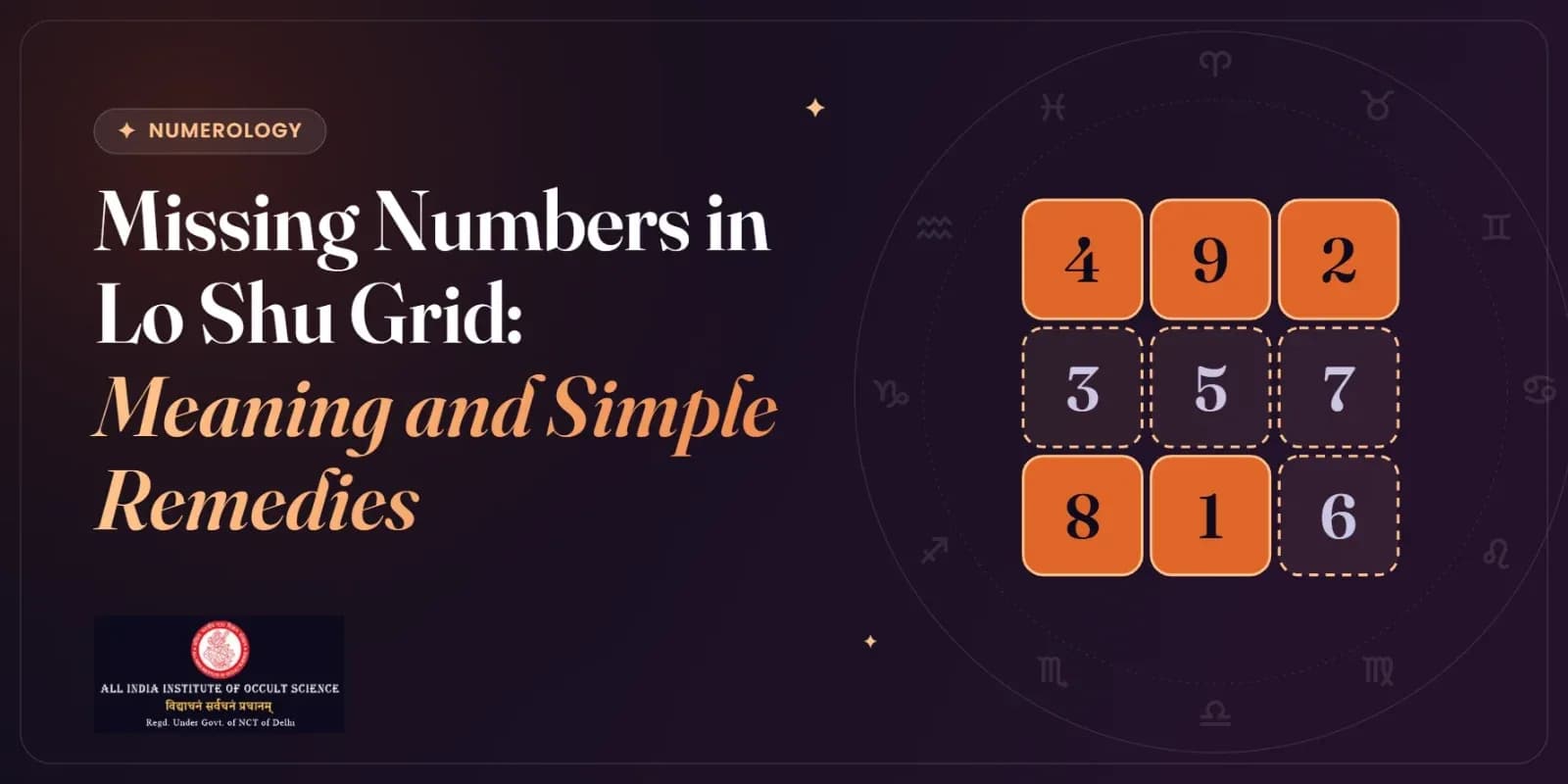
The Lo Shu grid is a 3×3 magic square in which every row, column and diagonal adds up to 15. In its standard layout the top row is 4-9-2, the middle row 3-5-7 and the bottom row 8-1-6. Chinese legend says the pattern appeared on the shell of a turtle that rose from the Lo river; Britannica's entry on magic squares describes this history.
In numerology, you place each digit of your date of birth in its box. Our free Lo Shu calculator (linked at the end of this guide) does this for you. For how filled rows and columns form "planes" and "arrows", see our page on arrows in numerology.
How to Find Your Missing Numbers: A Worked Example
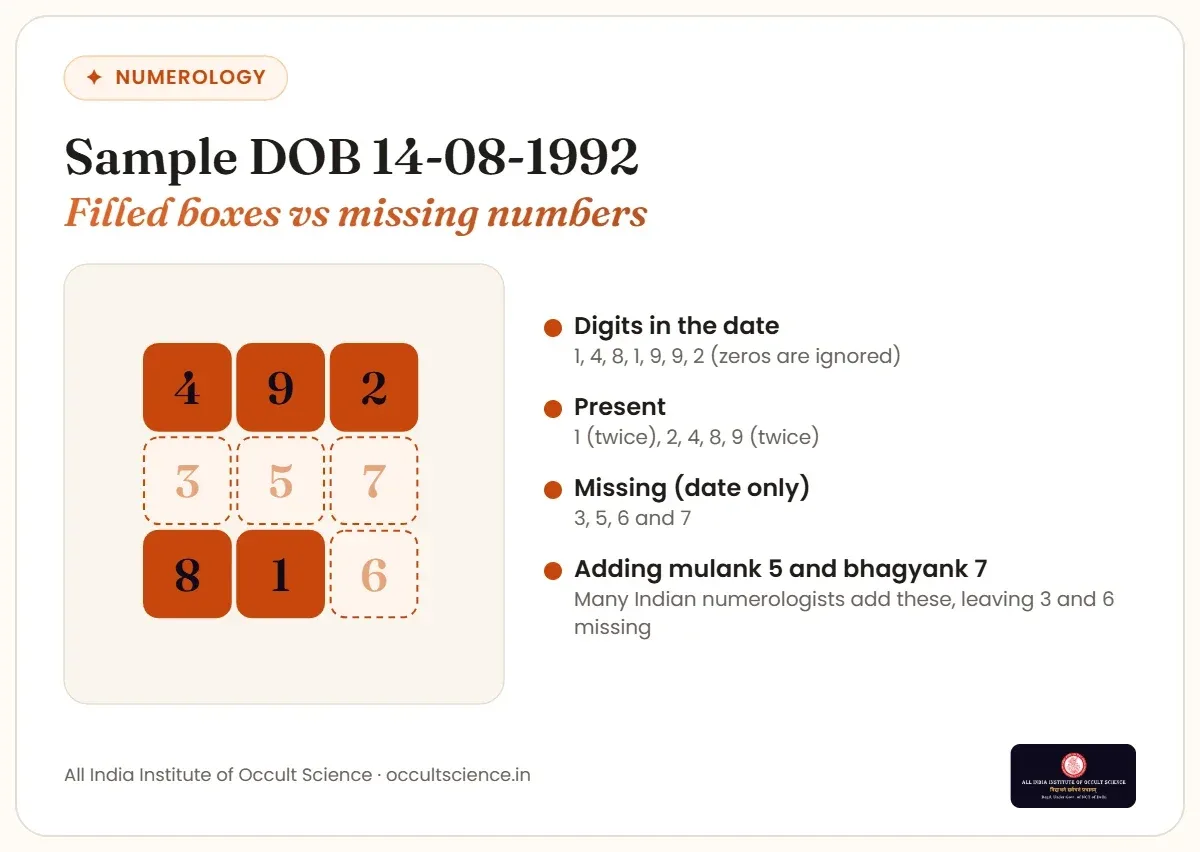
Sample date of birth (invented for teaching): 14-08-1992.
- Write out the digits: 1, 4, 0, 8, 1, 9, 9, 2. Ignore the zero, because 0 has no box in the grid.
- Place them: 1 appears twice, 9 appears twice, and 2, 4 and 8 appear once.
- List the gaps: 3, 5, 6 and 7 are missing.
- Optional step: many Indian numerologists also add the mulank (birth number: 1 + 4 = 5) and bhagyank (destiny number: 1+4+0+8+1+9+9+2 = 34, 3 + 4 = 7). With these added, only 3 and 6 remain missing.
If mulank and bhagyank are new to you, read how to find your mulank and bhagyank first.
Missing Numbers 1 to 9: Meanings and Simple Remedies
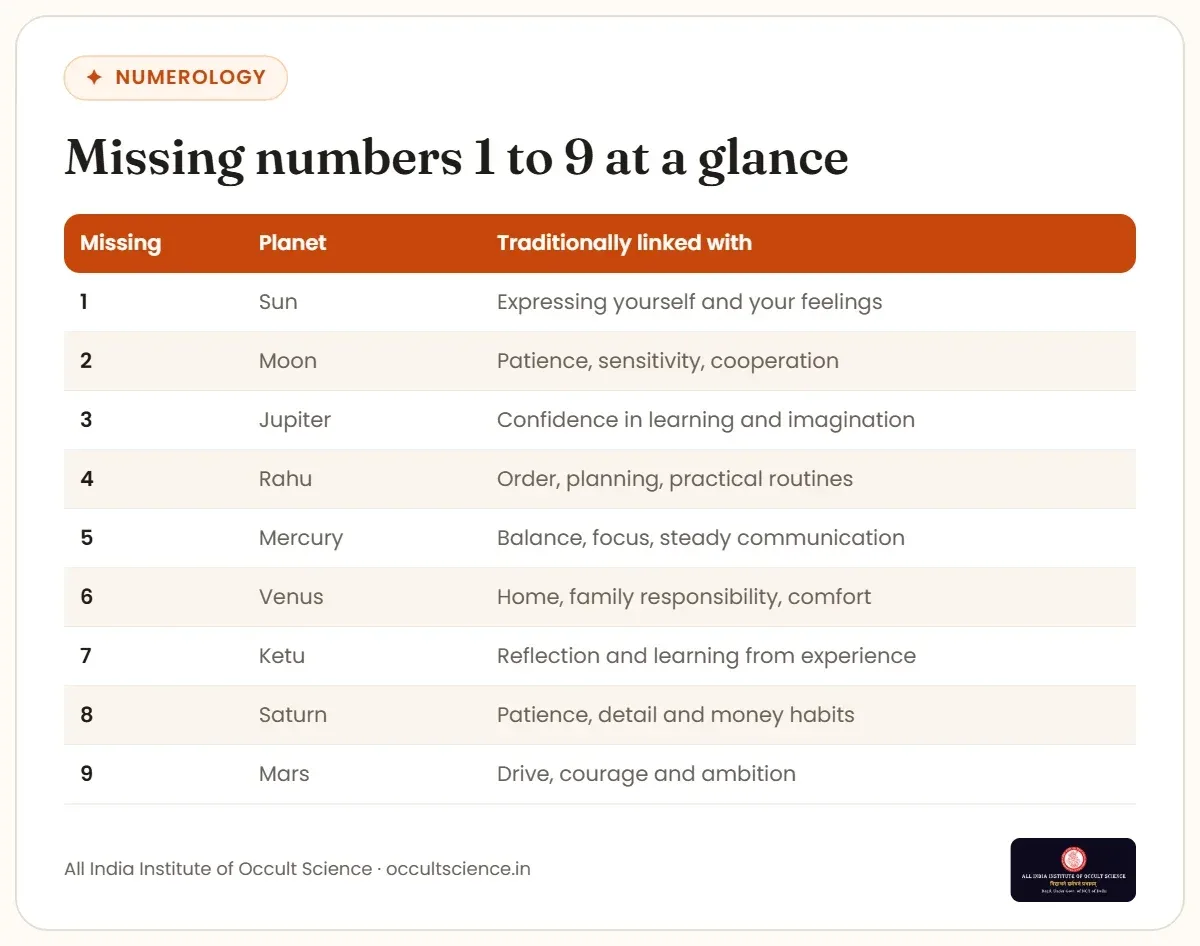
Each number is traditionally linked with a planet, following the system used in Indian numerology. For the full personality of each number, see the meaning of numbers 1 to 9. Below is what tradition says when the number is absent, and a simple remedy for each.
Missing number 1 (Sun)
Linked with expressing yourself. People without a 1 may find it harder to put feelings into words or to speak up. Remedy: write a few lines about your day each evening; greet the morning sun; take small chances to share your view in meetings.
Missing number 2 (Moon)
Linked with sensitivity, patience and cooperation. A missing 2 is read as a tendency to rush or to miss others' feelings. Remedy: practise listening without interrupting; keep a glass of water by your bed; spend time near water or in quiet evenings.
Missing number 3 (Jupiter)
Linked with learning, memory and imagination. A missing 3 is read as needing structure to study well. Remedy: use notes and revision schedules; read something every day; respect teachers and elders, a traditional Jupiter practice.
Missing number 4 (Rahu)
Linked with order and practical planning. A missing 4 is read as a tendency towards disorganisation. Remedy: keep a simple to-do list; tidy your desk at the end of each day; break big tasks into small steps.
Missing number 5 (Mercury)
Linked with balance and the centre of the grid, which connects all the other numbers. A missing 5 is read as a need for steadiness and focus. Remedy: keep regular sleep and meal times; add green to your clothes or room; practise a few minutes of calm breathing daily.
Missing number 6 (Venus)
Linked with home, family and comfort. A missing 6 is read as needing to give conscious attention to home life. Remedy: share one household responsibility regularly; keep your living space clean and pleasant; spend unhurried time with family.
Missing number 7 (Ketu)
Linked with reflection and learning through experience. A missing 7 is read as a tendency to move on without reflecting. Remedy: pause to note what each experience taught you; try short meditation; read spiritual or philosophical books.
Missing number 8 (Saturn)
Linked with patience, detail and money habits. A missing 8 is read as a tendency to be careless with details or spending. Remedy: track expenses for a month; finish tasks fully before starting new ones; help elderly people or workers, a traditional Saturn practice.
Missing number 9 (Mars)
Linked with energy, courage and ambition. A missing 9 is read as needing to build drive. Remedy: regular exercise; set one stretching goal each month; volunteer for a cause you care about.
When Missing Numbers Combine
Gaps are read together, not one by one. If a whole row or column is empty, numerologists speak of a "missing plane" or an "arrow of weakness", which the arrows page mentioned above covers. A few common combinations:
- Missing 3, 6 and 9: the top or "mental" thread is thin, so practitioners suggest deliberate learning habits and creative hobbies.
- Missing 2 and 5: read as a need for emotional steadiness; regular routines help.
- Missing 4 and 8: read as a need for planning and financial discipline.
Repeated numbers matter too. Two 1s, as in our sample, are traditionally read as articulate expression, which can balance a missing number elsewhere.
Missing Numbers and Your Mulank: How They Interact
Your mulank (birth number) is read as your everyday nature, and it can soften a missing number. For example, a person with mulank 5 and no 5 in their date of birth already carries Mercury's balancing quality through their birth number, so practitioners treat the gap as minor. In the same way, a strong bhagyank can supply a quality the date lacks. This is why experienced numerologists never read the grid alone: they look at the gaps, the repeated numbers, the mulank, the bhagyank and the name number together before saying anything.
A practical tip: write your missing numbers on one side of a page and your mulank and bhagyank on the other. Note where the birth and destiny numbers already cover a missing quality. What remains is your real list of qualities to work on.
Why People Born in the 2000s Have More Missing Numbers
A birth year such as 2005 contains two zeros, which add nothing to the grid. So people born from 2000 onwards often have four or five missing numbers. This is a feature of the calendar, not a sign of a harder life. Numerologists who add the mulank and bhagyank partly do so to give a fuller picture for such dates.
Common Myths About Missing Numbers
- "A missing number means that area of life will fail." It points to a quality to develop, not a fixed outcome.
- "You must wear a special bracelet or crystal." No classical source requires it. Habits and attention are the real remedies.
- "Change your name to fill the grid." A name change is a big decision; our guide on name correction explains why it is never urgent.
- "Missing numbers can be filled with a phone number." Phone and house numbers are read separately in numerology.
What Missing Numbers Can and Cannot Tell You
Missing numbers can be a useful prompt for self-reflection: which habits come naturally to you and which need effort. They cannot predict illness, marriage, money or success, and they should never be used to make major decisions in fear. Treat the grid as a mirror, not a verdict.
How to Learn Lo Shu Numerology Properly
Lo Shu is one part of a wider numerology system that includes mulank, bhagyank, name numbers and compound numbers. Our complete guide to numerology gives the full picture, and the Institute's numerology course teaches the Lo Shu grid with worked charts at the Diploma level (about 2 months).
Conclusion
Missing numbers in the Lo Shu grid are qualities to grow, not gaps to fear. Find yours, read them together with the numbers you do have, and pick one simple daily habit for each. To see your own grid in seconds, enter your date of birth in the free Lo Shu grid calculator.
This article shares traditional numerology knowledge for educational purposes. It is not a substitute for professional medical, legal or financial advice. See our disclaimer.