contact@occultscience.in
 +91 96724 36436
 Send Your Query
 Get Syllabus


 +91 96724 36436
 contact@occultscience.in

Written by Jyoti Chauhan, Content Writer · Reviewed by Gurudev Shrie Kashyap, Chairman & Founder, All India Institute of Occult Science · Published 27 Nov 2026
Key Takeaways
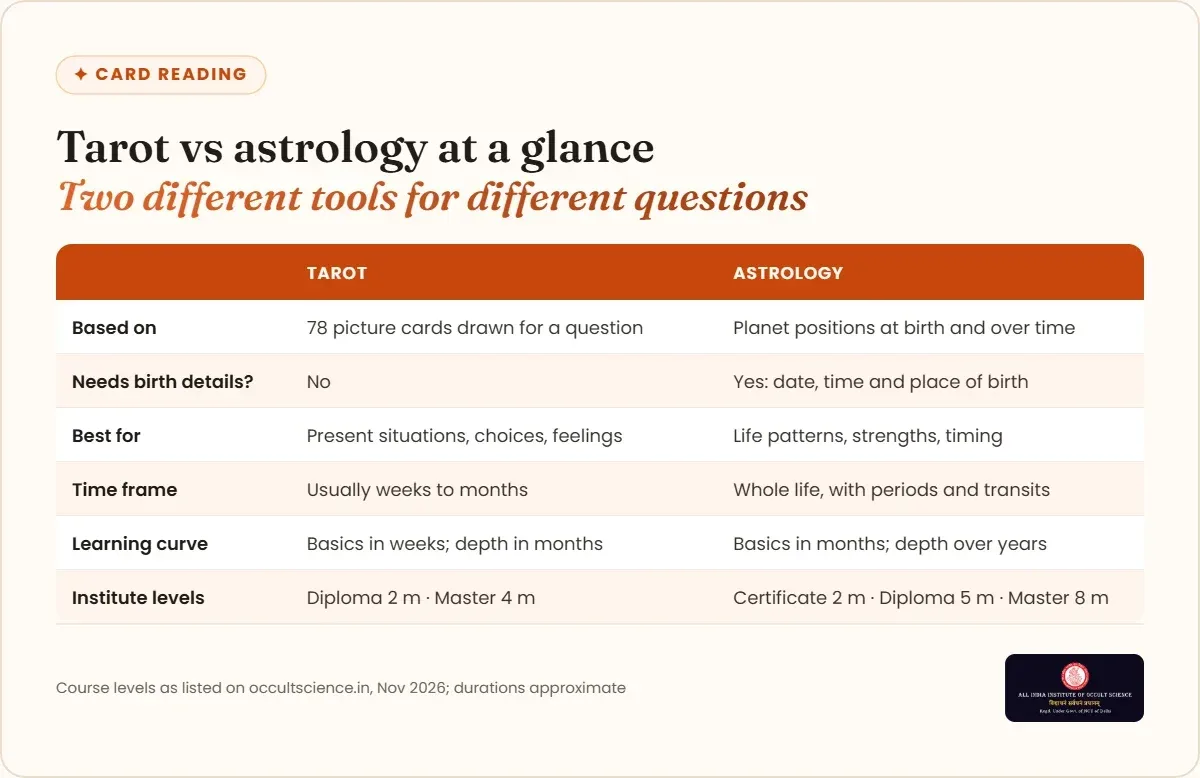
- Tarot vs astrology: tarot uses 78 cards drawn for a question; astrology reads planetary positions from your date, time and place of birth.
- Tarot suits present situations and choices; astrology suits life patterns and timing.
- Tarot basics take a few weeks; astrology basics take a few months, with depth built over years.
- Neither is "more accurate"; they answer different questions, and many readers use both.
- Both are traditional practices for reflection and guidance, not substitutes for professional advice.
"Should I learn tarot or astrology?" It is one of the most common questions new students ask. Social media is full of tarot readers shuffling cards on camera, while astrology has deep roots in Indian families, from kundali matching to muhurat. Both look fascinating, but they work in very different ways.
This guide compares tarot and astrology side by side: how each works, what questions each suits, how long each takes to learn, where they overlap, and which one might suit you first. For background, see our guide to tarot cards and our introduction to what astrology is.
Tarot vs Astrology at a Glance
How Tarot Works
Tarot uses a deck of 78 illustrated cards: 22 Major Arcana for major life themes and 56 Minor Arcana in four suits. The reader shuffles while the querent focuses on a question, lays the cards in a spread and interprets the images in their positions. Britannica traces the deck from fifteenth-century Italian card games to its later use for divination.
Tarot is flexible: it needs no birth details, works for almost any question, and gives a reading in minutes. Its strength is helping someone see a current situation from new angles. Spreads range from a single card to the ten-card Celtic Cross.
How Astrology Works
Vedic astrology (Jyotish) calculates where the nine grahas were in the sky at the moment of birth, across twelve signs and twelve houses, along with the 27 nakshatras. From this birth chart (kundali), astrologers describe tendencies, strengths and challenges, and use dashas and transits to judge when certain themes may come forward.
Astrology needs an accurate date, time and place of birth. A free kundali tool calculates the chart; the skill lies in interpreting it.
Key Differences
1. The question each answers
Tarot answers "What is going on in this situation, and what can I do?" Astrology answers "What patterns run through this life, and when are they likely to be active?"
2. Fixed map vs moment in time
A birth chart never changes; it is a lifelong map. A tarot spread reflects the moment of the question and may look different a month later.
3. Inputs
Tarot needs only a question. Astrology needs birth data, and an incorrect birth time can change a reading significantly.
4. Learning style
Tarot rewards intuition, imagery and storytelling. Astrology rewards patience, system-thinking and memory for many rules and combinations.
5. Session style
Tarot sessions are often shorter and conversational. Astrology sessions usually involve preparation before the meeting and a more structured explanation.
Where Tarot and Astrology Overlap
In the Western esoteric tradition, especially the Golden Dawn system that shaped the Rider-Waite-Smith deck, many tarot cards are linked with signs and planets. Readers who know both systems use these links to deepen their interpretations:
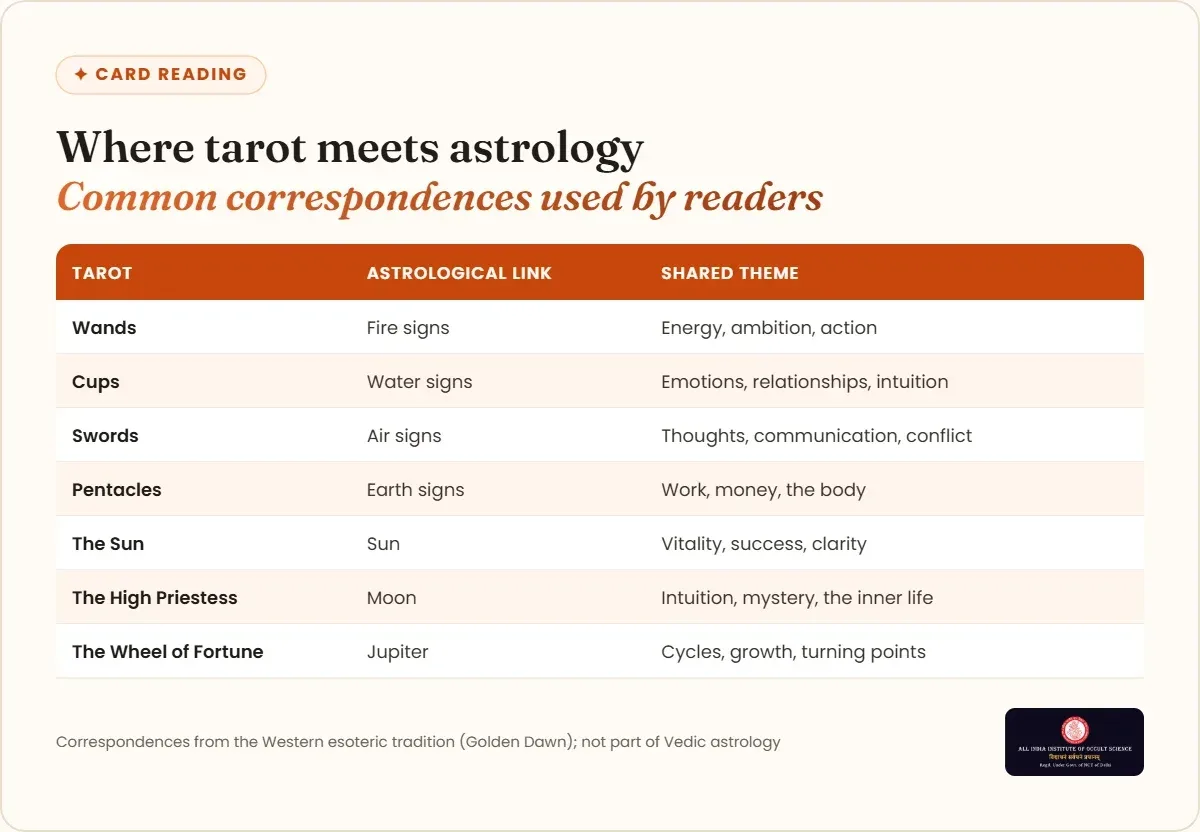
These correspondences belong to Western tarot and astrology. They are not part of classical Vedic Jyotish, so readers who combine tarot with Vedic astrology usually keep the two as separate tools rather than mixing their rules.
Using Both Together
Many practitioners combine the two in a simple way:
- Chart first: the birth chart and running dasha show the bigger life chapter.
- Cards second: a tarot spread explores a specific current question within that chapter.
- Consistency check: when both point to similar themes, the reader can speak with more confidence; when they differ, it becomes a useful conversation rather than a contradiction.
For example, someone in a Saturn period asking about a job change might see a chart that emphasises patience and responsibility, and a tarot spread that highlights hesitation and the need for a clear plan. Together, the advice becomes practical: prepare well and move steadily.
One Question, Read Both Ways (Invented Example)
Seeing the same question through both tools makes the difference clear. Sample question: "Should I start my own business next year?"
The astrology approach
The astrologer studies the birth chart: the 10th house of career, the 7th house of business partnerships, the 2nd and 11th houses of income and gains, the strength of their lords, and the running mahadasha. They then look at transits in the coming year. The answer focuses on suitability and timing, for example: "Your chart supports independent work, and the period from the middle of next year looks more supportive than the first months."
The tarot approach
The tarot reader lays a spread on the question and reads the present energy, challenges and likely direction. The answer focuses on readiness and mindset, for example: "The cards show strong motivation but some fear about money; building savings and a simple plan first would help you move with confidence."
Neither answer is the decision. Together, they give a fuller picture: when the broader conditions look supportive, and what the person needs to work on now.
What You Need to Start Each
| Tarot | Astrology | |
|---|---|---|
| Basic tools | A standard deck, a notebook, a cloth | Accurate birth data, chart software, a notebook |
| First practice | One card a day, journaled | Your own chart, studied house by house |
| First milestone | Reading a three-card spread fluently | Explaining a chart's ascendant, Moon and key houses |
Which Should You Learn First?
| If you… | Consider starting with |
|---|---|
| Want to read for friends quickly and enjoy conversation | Tarot |
| Love systems, patterns and long-term analysis | Astrology |
| Are a visual, intuitive learner | Tarot |
| Want to understand timing, matching and muhurat | Astrology |
| Have limited weekly study time | Tarot first, astrology later |
If you are also weighing numerology or Vastu, our comparison of astrology, numerology and Vastu covers those paths.
Tarot and Astrology as a Career
Both can become a professional practice, a side service or a personal interest. Tarot readers often start offering sessions sooner because the basics are quicker to learn; astrologers often build a slower but deeper practice. Either way, training, practice on real cases, clear ethics and patience matter far more than the choice of tool. Our guide on how to become a tarot card reader outlines that path in detail.
No course can promise income; earnings depend on skill, experience and how a practice is run.
Common Myths
"Tarot is just for fun; astrology is serious."
Both can be practised thoughtfully or carelessly. Seriousness comes from the reader's training and ethics, not the tool.
"Astrology is fate; tarot is free will."
Good astrologers describe tendencies and timing, not fixed fate, and good tarot readers leave decisions with the querent.
"You must choose one forever."
Many readers learn one first and add the other later.
What Both Can and Cannot Do
| They can | They cannot |
|---|---|
| Offer traditional frameworks for reflection and planning | Guarantee outcomes or predict exact events |
| Help people think through choices more clearly | Replace medical, legal, psychological or financial advice |
How to Learn Them Properly
The Institute teaches tarot as a Diploma in Card Reading (about 2 months) and a Master in Card Reading (about 4 months), and astrology as a Certificate (about 2 months), Diploma (about 5 months) and Master (about 8 months) through its astrology course. Both are taught live online in small batches with recordings. You can download the syllabus for either subject.
Conclusion
Tarot and astrology are not rivals but different tools. Tarot is quick, flexible and ideal for exploring a present question; astrology is systematic, needs birth data and excels at life patterns and timing. Start with the one that matches your curiosity and schedule, and add the other when you are ready. To begin with the cards, explore the card reading course at the All India Institute of Occult Science.
This article shares traditional knowledge for educational purposes. It is not a substitute for professional medical, legal, psychological or financial advice. Please read our disclaimer.