contact@occultscience.in
 +91 96724 36436
 Send Your Query
 Get Syllabus


 +91 96724 36436
 contact@occultscience.in


Key Takeaways
- The heart line in palmistry (hriday rekha) is the top horizontal line on the palm. It is read for how you feel, express and connect, not for the health of your heart.
- Palmists read it in 4 ways: where it ends, its shape (curved or straight), its length and its depth or marks.
- An ending under the index finger, the middle finger or between the two gives 3 different emotional styles.
- Breaks, islands and forks are read as phases and patterns, never as a fixed fate.
- Read the heart line together with the head line and life line, on both hands.
Have you ever held your palm up to the light and wondered why one line curves so boldly while another runs flat and quiet? If someone once told you that your heart line "shows heartbreak", you probably still remember it. Most of what people hear about this line comes from half-remembered tips, not from how palmistry is actually taught.
The heart line is one of the first lines every palmistry student learns, and one of the most misread. This guide explains where it sits, what classical palmistry says about its shape, length, end point and marks, and how to read your own in five steps. It also covers what the heart line cannot tell you, so you can enjoy the reading without worry.
What Is the Heart Line in Palmistry?
The heart line is the uppermost major line on your palm. It starts on the outer edge of the hand under the little finger and runs across towards the index or middle finger. In Indian palmistry, called hast rekha shastra and rooted in Samudrika Shastra, it is known as hriday rekha.
Palmists link this line to emotional life: how you love, how openly you show feelings, what you expect from others and how you recover from setbacks. If you are new to the main lines, start with our palmistry guide for beginners, which maps all of them on one palm.
One point matters before anything else. The heart line is read for emotional style, not physical health. A faint or broken heart line does not mean a heart problem. Any health question belongs with a doctor.
Where Does Your Heart Line End? The Most Important Clue
Most palmists look first at the end point, because it shapes how the rest of the line is read. The fingers are named after planets: the index finger is Jupiter, the middle finger is Saturn, the ring finger is the Sun (Apollo) and the little finger is Mercury.
| Where the heart line ends | Traditional reading |
|---|---|
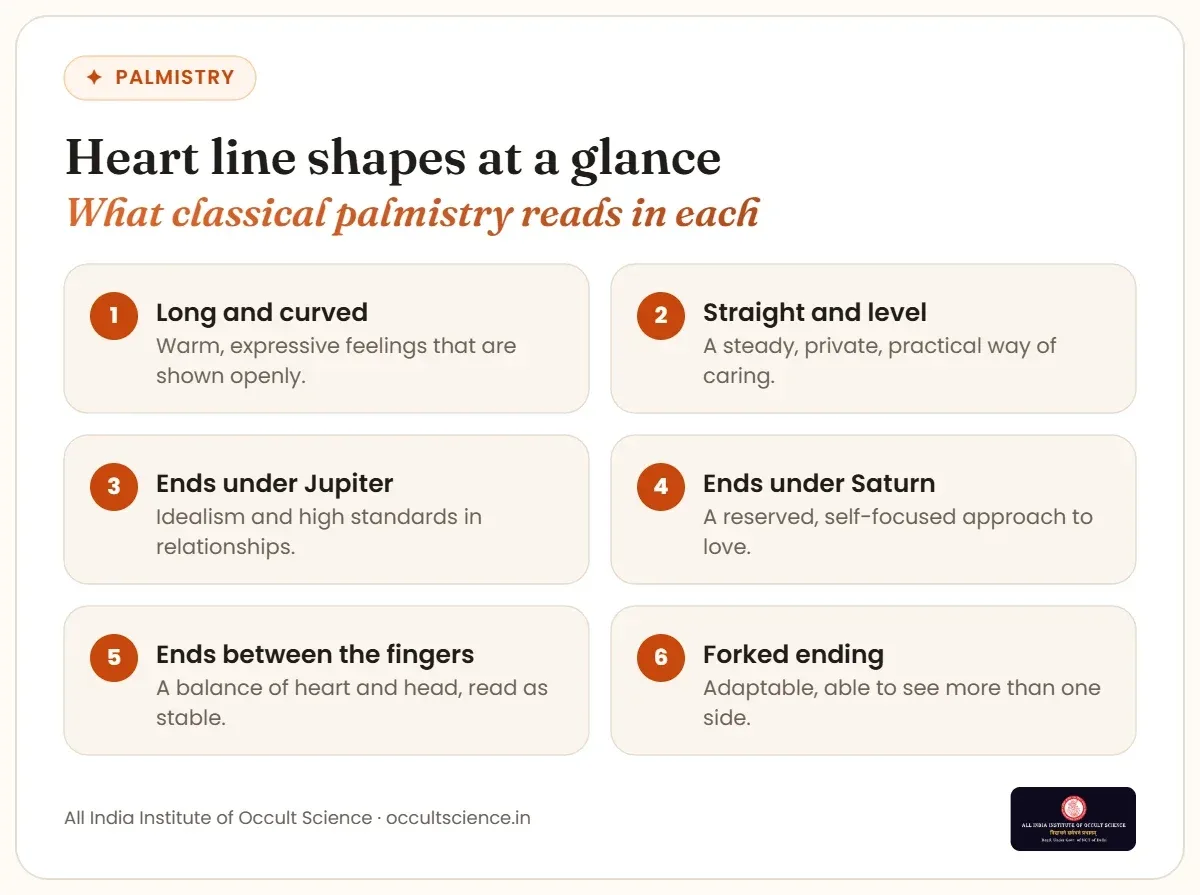
| Under the index finger (Mount of Jupiter) | Idealistic, loyal, sets high standards in love; may expect a lot from partners |
| Between the index and middle fingers | Balanced: warm feelings guided by good sense; often read as the steadiest ending |
| Under the middle finger (Mount of Saturn) | Reserved and practical; may put their own needs or work first |
| Runs straight across the palm | Calm, private expression; feelings are real but shown through actions |
| Curves up and touches the base of the fingers | Intense, generous emotions, sometimes worn on the sleeve |
Cheiro, the best-known palmist of the late 1800s, associated a heart line reaching the Mount of Jupiter with idealistic, devoted love, while warning that in excess it can make a person blind to others' faults. (Cheiro read the line from the index-finger side; most modern palmists trace it from the little finger, which changes the wording but not the meaning.) His book Palmistry for All is in the public domain and free to read. Notice how even the classics treat each ending as a tendency with strengths and cautions, not a verdict.
Curved vs Straight Heart Line: Shape and Expression
After the end point, look at the curve.
- Strongly curved: rises towards the fingers in an arc. Palmists read open, demonstrative feelings and an easy ability to show affection.
- Gently curved: a moderate arc. Read as warmth balanced with self-control.
- Straight: runs level across the palm. Read as a thoughtful, private style. People with straight heart lines often show love through reliability rather than words.
- Wavy: moves up and down. Traditionally read as changing moods or a phase of searching for what you want in relationships.
None of these is better than the others. A straight line is not "cold" and a curved line is not "weak". They describe different ways of caring.
Long vs Short Heart Line
Length is judged by how far the line travels across the palm.
- Long (reaching the Jupiter mount or beyond): read as a giving, emotionally open nature that invests deeply in people.
- Medium (ending near the middle finger): read as balanced emotional needs.
- Short (stopping under the ring finger or earlier): read as someone who keeps feelings close and values independence.
A short heart line does not mean a short marriage or a lack of love. It describes how feelings are expressed, not how much they exist.
Deep, Faint or Chained: Reading the Quality of the Line
The quality of the line adds detail. A deep, clear line is read as stable, consistent feelings. A faint line is read as a quieter emotional style, or a phase where feelings are not fully expressed. A chained line, made of small loops, is traditionally read as sensitivity: someone who feels things strongly and may need more reassurance.
Lines can deepen or fade over the years. That is one reason palmists compare the two hands and revisit a reading after some time.
Breaks, Islands, Forks and Branches on the Heart Line
Marks on the line are where most fear comes from, so it helps to know what tradition actually says.
Broken heart line
A gap in the line is read as a period of emotional change: a move, a new chapter, or a change in how you relate to people. If the broken ends overlap, palmists read a smoother transition. It is not a prediction of heartbreak.
Islands
A small oval on the line is read as a phase of emotional strain or confusion during that part of life. Islands are temporary features in the reading, not life sentences.
Forked ending
A fork at the end, with one branch towards Jupiter and one towards Saturn, is read as adaptability: the ability to balance your own needs with others'. Many palmists see it as a positive sign.
Branches
Small lines rising upwards from the heart line are read as warm connections and happy emotional experiences. Branches falling downwards are read as phases of disappointment, which are part of almost every life.
The Simian Line: When Heart and Head Lines Merge
In a small number of hands the heart line and head line join into one strong line across the palm. This is called a simian line. Palmists read it as intense focus, where thinking and feeling act together, so the person tends to commit fully to whatever they take up.
Because a single palmar crease can also appear with certain medical conditions, a careful palmist never makes health or ability judgements from it. It is simply one more pattern to read with respect.
How to Read Your Heart Line: A Worked Example
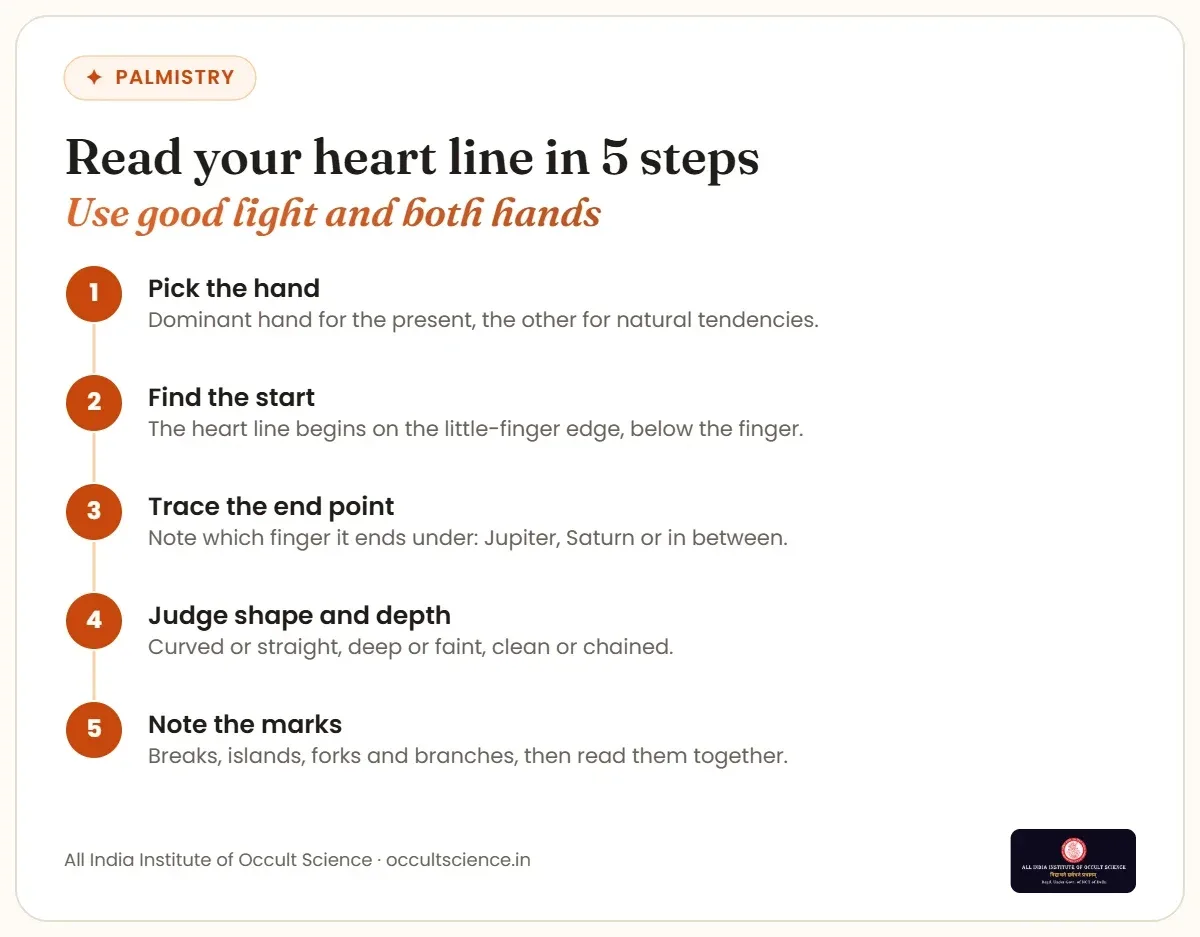
Here is how the steps come together on a sample palm (invented for teaching): right hand, dominant; the heart line is long and gently curved, ends between the index and middle fingers, is deep for most of its length, has one small overlapping break under the ring finger, and a short fork at the end.
- End point between Jupiter and Saturn: a balanced, sensible approach to love.
- Long and gently curved: warm and willing to show care.
- Deep line: steady feelings.
- Overlapping break under the ring finger: a phase of change that the person moved through smoothly.
- Fork: able to balance personal needs with family or partner needs.
Put together, the reading describes someone caring and level-headed who has lived through at least one emotional transition and adapted well. Notice there is no prediction of who they will marry or when.
Before deciding which hand to study, read right hand vs left hand palmistry. Then compare your heart line with your life line and the head line in palmistry for a fuller picture.
Heart Line and Marriage Line: How They Work Together
People often confuse the heart line with the marriage line. The marriage line (or relationship line) is a short horizontal mark on the edge of the palm below the little finger. The heart line describes your emotional nature; the marriage lines are read for significant bonds. Our post on the marriage line in palmistry explains how to read those small lines without jumping to conclusions.
Common Myths About the Heart Line
- "A broken heart line means divorce." No classical text says this. A break shows change, and change can be positive.
- "No curve means no love." A straight line describes a private, practical style, not a lack of feeling.
- "The heart line shows heart disease." It does not. Palmistry is not a medical test.
- "Your lines never change." Minor lines and marks can change over the years, which is why readings are revisited.
What the Heart Line Can and Cannot Tell You
The heart line can be a helpful mirror for reflecting on how you give and receive care, and a starting point for conversations about your emotional patterns. It cannot tell you whom you will marry, whether a relationship will last, or anything about your physical heart. Choices, effort and communication shape relationships far more than any line. Use a reading to understand yourself better, not to make major decisions in fear.
How to Learn Palmistry Properly
Reading one line is a good start, but real skill comes from reading the whole hand: shape, mounts, fingers and all the lines together. The Institute's palmistry course teaches this in live online classes with small batches, class recordings and practice on real (consenting) hands; you can download the course syllabus to see the full topic list. If you are curious about the wider palmistry tradition, Britannica's overview of palmistry gives useful historical background.
Conclusion
The heart line describes your emotional style: where it ends, how it curves, how long and deep it is and what marks it carries. Read it gently, on both hands, and always together with the other lines. Treat breaks and islands as chapters, not verdicts. If you would like to learn to read whole hands with a teacher, explore the Institute's palmistry course and start with the Diploma level.
This article shares traditional palmistry knowledge for educational purposes. It is not a substitute for professional medical, legal or financial advice. See our disclaimer.