contact@occultscience.in
 +91 96724 36436
 Send Your Query
 Get Syllabus

 +91 96724 36436
 contact@occultscience.in


Loading…

 Celebrating 23 Years of Trust — Enrol Now for the upcoming demo session
 All India Institute ofOccult Scienceविद्याधनं सर्वधनं प्रधानम्
Login with your mobile number
See upcoming batches, demo classes and your syllabus in one place.
Login / RegisterLoading…
Login with your mobile number
See upcoming batches, demo classes and your syllabus in one place.
Login / RegisterVastu
9 min readVastu
Yes. Traditional Vastu principles were written for independent houses, but practitioners apply the same zone logic to flats by finding the centre of your own flat and mapping the directions from there. Because you cannot change the structure, flat Vastu focuses on how you use each zone: furniture, storage, colours, light and cleanliness.
Classical texts do not rank floors in modern apartment blocks, so there is no single best floor. Practitioners pay more attention to the flat's entrance direction, natural light, ventilation and how the rooms are arranged. A well-lit, airy flat on any floor is generally preferred over a dark one.
Stick to reversible changes: rearrange furniture, move the bed and heavy storage to the south-west, clear the north-east, keep the entrance clean and bright, and use colours through curtains, bedsheets and cushions instead of paint. None of these needs the landlord's permission or any demolition.
Both, in different ways. The building's plot and orientation are outside your control, so practitioners mainly work with your flat as a unit, mapped from its own centre. The direction of your flat's main door and how you use each zone inside it matter most in day-to-day practice.
A south-west facing flat is not bad in itself. Vastu practitioners look at where the entrance falls, how much light reaches the north and east sides, and how the rooms are used. Many south-west facing flats work well with sensible furniture placement and a bright, clutter-free entrance. Avoid anyone who uses direction to create fear.
Is a west-facing house good as per Vastu? Learn the traditional entrance padas, where the kitchen and bedrooms go, and simple fixes without demolition.
You finally get the keys to your new flat, and within a week someone tells you the kitchen is "in the wrong direction" and the toilet is "in the worst corner". Now you are worried about a home you cannot rebuild, in a building you do not own. If that sounds familiar, take a breath. Most of Vastu for apartments is about how you use the space, not about breaking walls.
This guide explains how Vastu applies to flats, how to map the zones in your own home, and nine practical changes you can make in an afternoon, without demolition and without buying anything special. It also covers the myths that cause the most needless fear.
The classical Vastu texts, such as the Mayamata and Samarangana Sutradhara, were written for temples, palaces and independent houses on their own plots. Apartment blocks did not exist. Modern practitioners apply the same principles to flats in a practical way: they treat your flat as one unit, find its centre, and map the eight directions and the central Brahmasthan from there.
The idea behind it is the Vastu Purusha Mandala, a grid that assigns qualities to each zone. If you want the background first, read our complete guide to Vastu Shastra. For a scholarly introduction to the classical texts, D. N. Shukla's Vastu-shastra: Introduction to Indian architecture is free to read online.
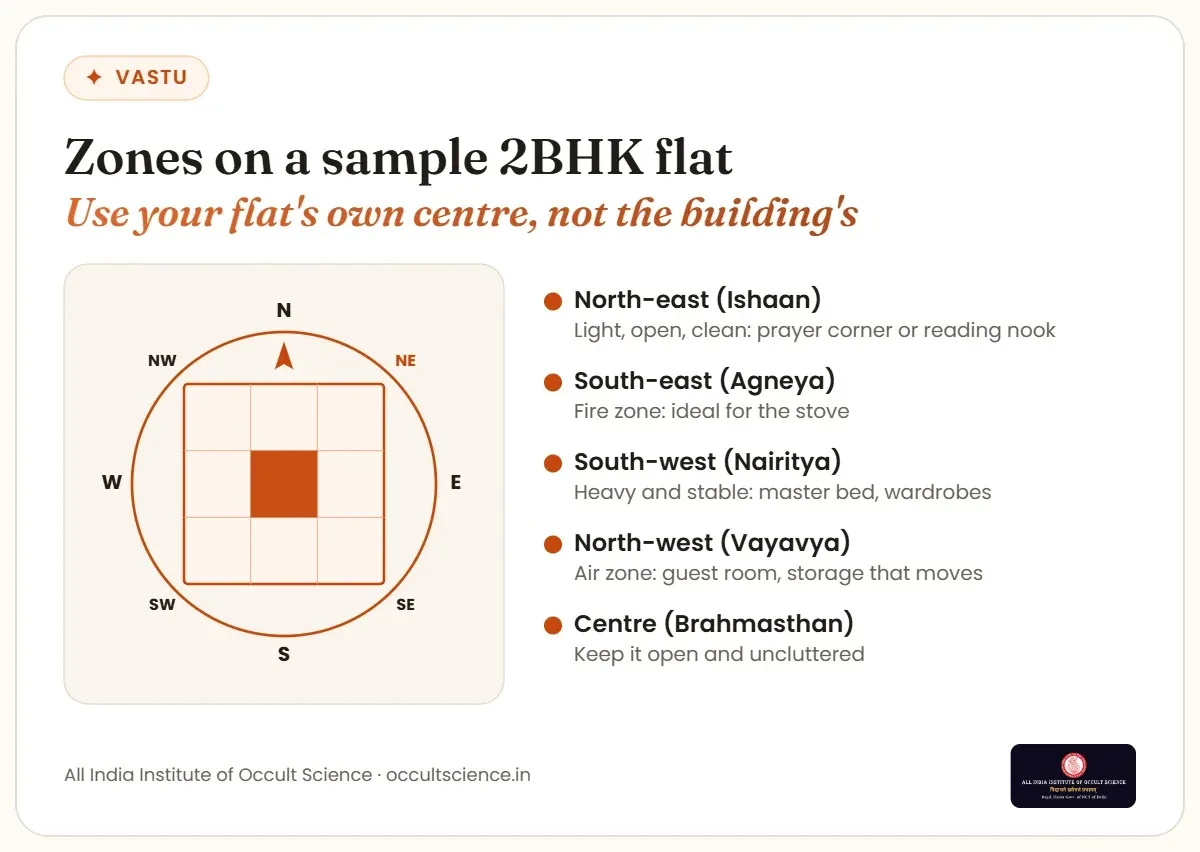
Now you can see which room falls in which zone. Do not panic if things look "wrong". In most flats something will be out of the textbook position. The changes below are designed for exactly that.
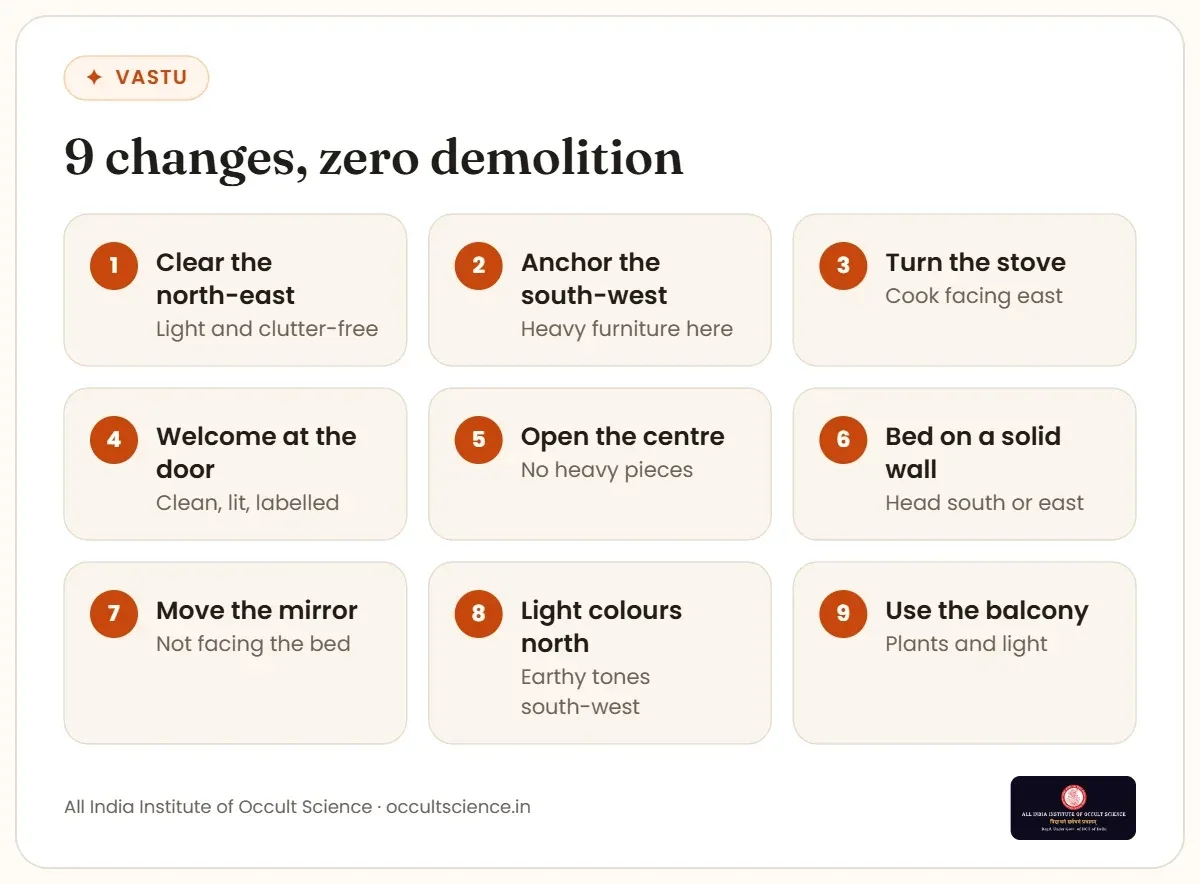
The north-east (Ishaan) is linked with water, clarity and the divine in Vastu tradition. Keep it the lightest part of your flat: no heavy cupboards, no clutter, no dustbins. A small prayer corner, a reading chair or a few plants work well here.
The south-west (Nairitya) is linked with earth and stability. Practitioners place the master bed, wardrobes, bookshelves and heavy storage here. If the south-west of your flat is a balcony or an open area, place heavy planters or a storage bench along that side.
Many flat kitchens are not in the south-east (Agneya), the traditional fire zone. You cannot move the kitchen, but you can position the stove so the cook faces east while cooking, and keep the stove and sink (fire and water) apart, ideally not directly side by side. Our kitchen Vastu guide covers this in detail.
In a flat, the main door is often the only entrance you control. Keep it clean, well lit and free of shoe heaps. Add a clear nameplate and make sure the door opens fully. Our main door Vastu guide explains why entrance direction matters less than people fear.
The Brahmasthan is the energetic heart of the plan in Vastu. In a flat, it often falls in the living room or a passage. Keep it free of heavy furniture, pillars of storage or clutter. A rug or an open seating arrangement is ideal.
Put the headboard against a solid wall rather than under a window or against a bathroom wall where possible. Tradition recommends sleeping with your head towards the south or east, and avoiding the north. If the room makes that impossible, east or south-facing alternatives are fine; comfort matters.
Practitioners avoid mirrors that directly face the bed. Move the mirror to a side wall, put it inside a wardrobe door, or cover it at night. Mirrors on the north or east walls are traditionally preferred.
Light colours (white, cream, pale yellow, light green) suit the north and east; earthy tones (beige, terracotta, brown) suit the south-west. In a rented flat, use curtains, cushions, rugs and bedsheets instead of repainting.
A north or east balcony is ideal for plants, morning light and a small seating corner. Keep it clean rather than using it as a store room. If your balcony is in the south or west, use it for drying clothes or heavier planters.
Toilets in the north-east or centre are common in apartments and cannot be moved. Practitioners suggest simple care: keep the toilet door closed, keep the room clean, dry and well ventilated, fix leaks quickly and avoid storing things there. These habits make sense whether or not you follow Vastu.
Apartments come with layouts the builder chose, not you. Here is how practitioners usually respond to the most common situations, all without construction work.
| Situation | Practical response |
|---|---|
| Kitchen in the north-east | Keep the counter clean and bright, position the stove to face east, store heavy items low and away from the north-east corner |
| Missing or cut corner | Keep the remaining part of that zone well lit and uncluttered; do not hang "corrections" out of fear |
| Main door opposite the lift or staircase | Keep the entrance bright and tidy, use a doormat and a nameplate, and make the inside welcoming |
| Bedroom in the north-east | Use it as a children's or study room if possible; keep heavy wardrobes on the south and west walls |
| Dark flat with little sunlight | Light colours, sheer curtains, good lighting and regular airing make the biggest difference |
Use this as a quick weekend checklist after you have mapped your zones.
Most families find that simply decluttering and improving light makes a flat feel noticeably calmer, which is the practical heart of Vastu.
Sample flat (invented for teaching): east-facing entrance; living room in the north-east and centre; kitchen in the north-west; master bedroom in the south-west; second bedroom in the south-east; toilet in the west.
Total cost: an afternoon of moving furniture. No walls touched.
If you are still choosing a flat, a few checks are worth making alongside price and location:
The direction of the main door alone should never decide whether you buy a home. Our guides to north facing house Vastu and the other directions explain why.
Vastu can help you arrange a home that feels calm, bright and orderly, which many people find supports their routines. It cannot guarantee wealth, health, a promotion or a good marriage, and it should never replace medical, legal or financial advice. Be wary of anyone who uses Vastu to create fear or to push expensive "corrections".
Applying Vastu to real flats, with odd shapes, cut corners and shared walls, takes practice with actual floor plans. The Institute's founder, Gurudev Shrie Kashyap, holds a Post Graduate Diploma in Vastu Shastra, and the Institute teaches Vastu in live online classes with worked plans. The classical treatise on dwellings, the Mayamata, is also available in Bruno Dagens' translation on archive.org for serious students.
Vastu for flats is about using each zone well: a light north-east, a stable south-west, an open centre and a welcoming door. All nine changes in this guide are reversible, low-cost and suitable for rented homes. If you would like to learn to read floor plans with a teacher, explore the Institute's Vastu course.
This article shares traditional Vastu knowledge for educational purposes. It is not a substitute for professional medical, legal or financial advice. See our disclaimer.
 Login or Sign up
Login or Sign Up to Get Course Details
Enter your mobile number to continue. You’ll land on your dashboard with the full course syllabus, special offers and upcoming batches.
 By continuing you agree to our Terms & Conditions and Privacy Policy.
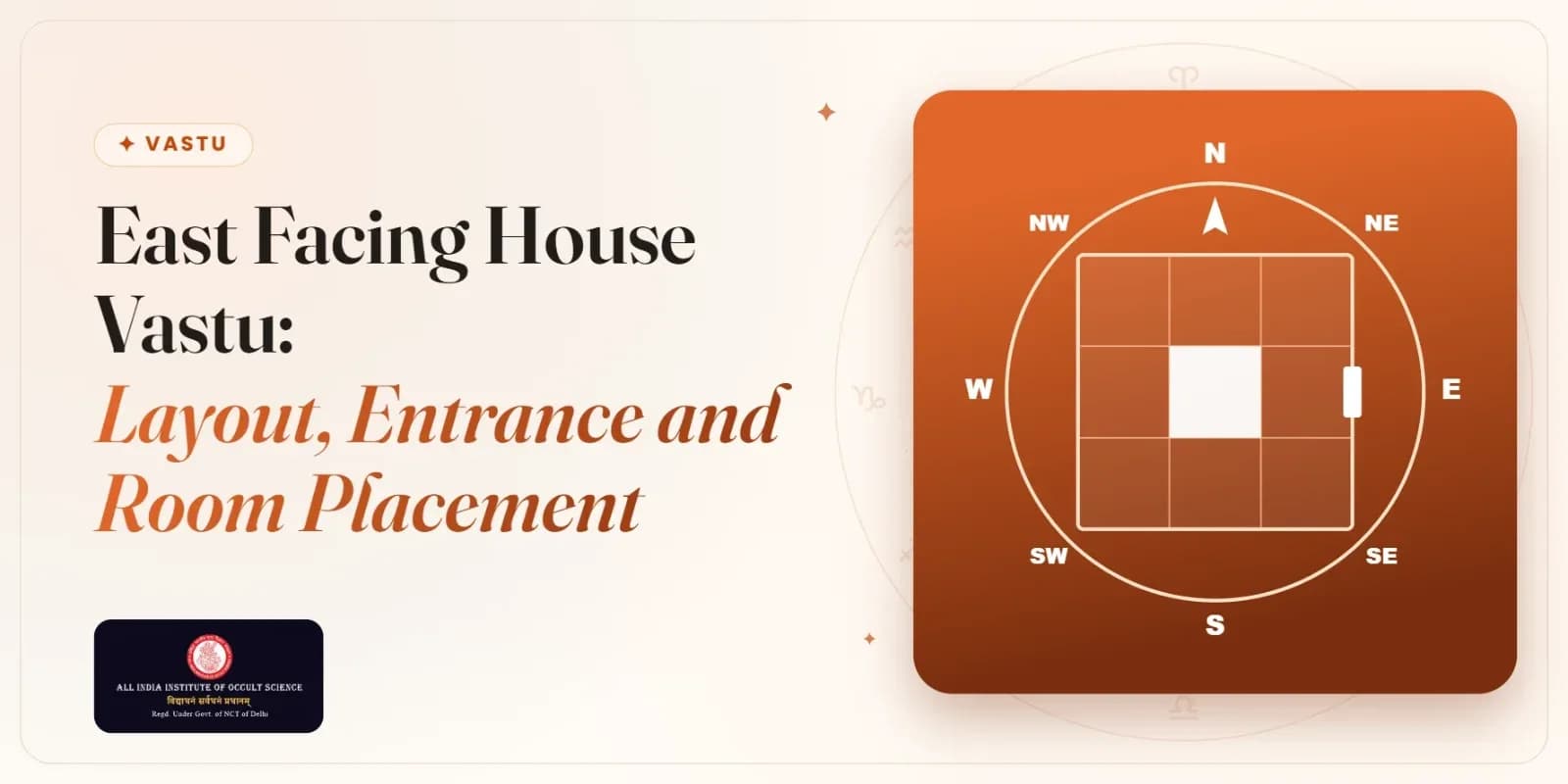
Learn the traditional Vastu layout for an east-facing house: the best entrance padas, where the kitchen, bedrooms and pooja room go, and common myths.
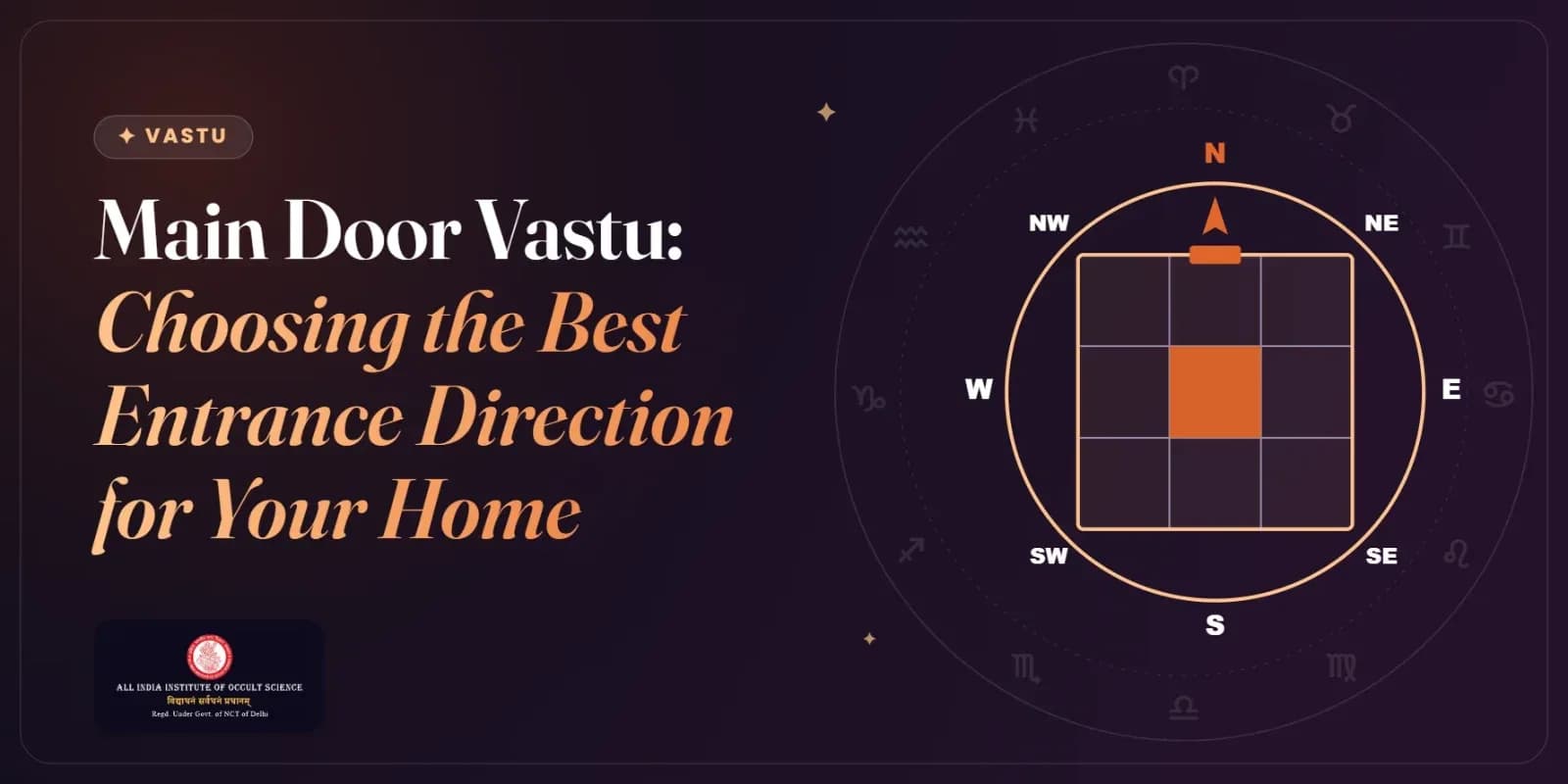
Which direction is best for your main door as per Vastu? Learn the traditional entrance zones, myths about south-facing doors, and simple, low-cost fixes.