contact@occultscience.in
 +91 96724 36436
 Send Your Query
 Get Syllabus

 +91 96724 36436
 contact@occultscience.in


Loading…

 Celebrating 23 Years of Trust — Enrol Now for the upcoming demo session
 All India Institute ofOccult Scienceविद्याधनं सर्वधनं प्रधानम्
Login with your mobile number
See upcoming batches, demo classes and your syllabus in one place.
Login / RegisterLoading…
Login with your mobile number
See upcoming batches, demo classes and your syllabus in one place.
Login / RegisterAkashic Records
7 min readAkashic Records
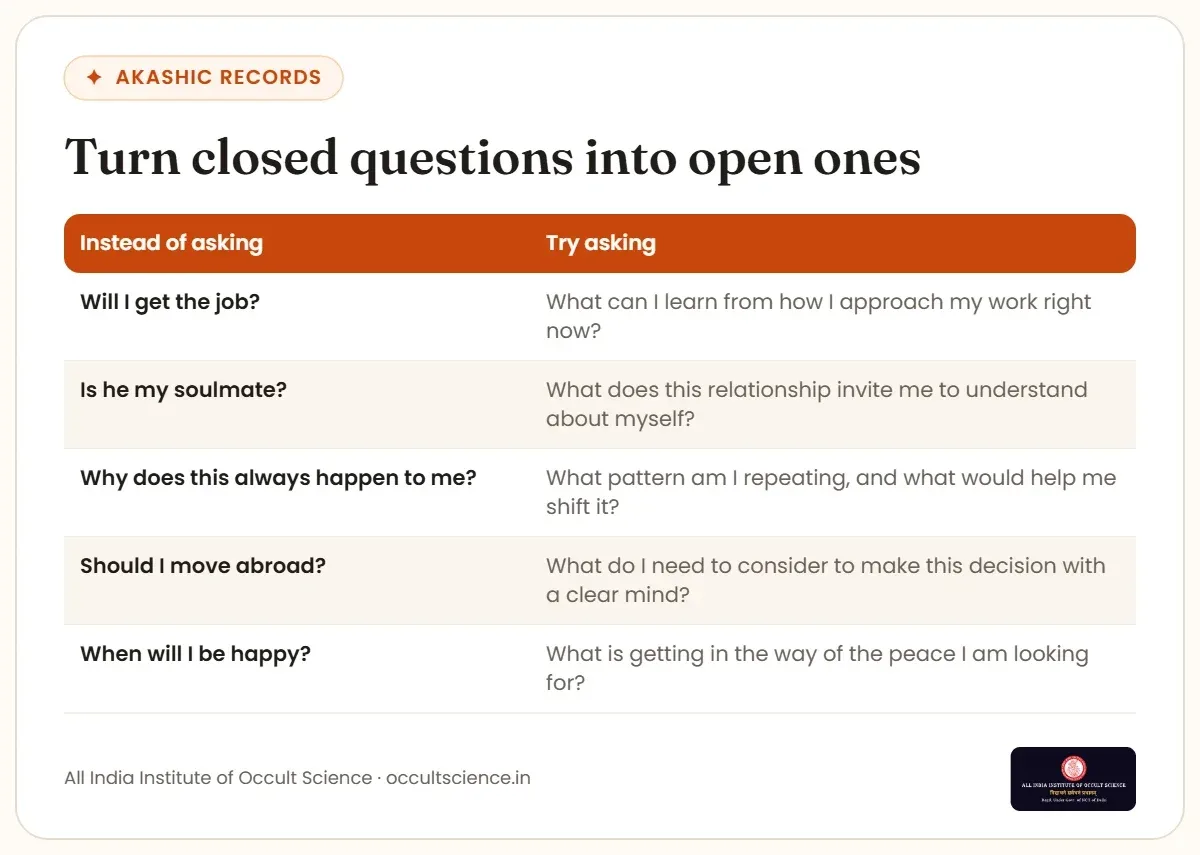
Good questions are open, personal and focused on understanding. Examples: "What is my soul's lesson in this relationship?", "What pattern am I repeating at work?" and "What strengths am I not using?" They begin with what, how or why, and they keep the focus on your own growth rather than on predicting events.
Practitioners say the Records respond with insight, not verdicts. A yes/no question invites a prediction and closes the conversation, while a what or how question opens a reflection you can act on. Open questions also keep you in charge of your choices instead of handing decisions to the reading.
You can ask about your relationship with someone and your own role in it, for example "What can I understand about my connection with my mother?" Most practitioners do not open or read another person's Records without their consent, so questions about someone else's private life, thoughts or choices are usually avoided.
You can reflect on your feelings and patterns around health or money, but an Akashic reading is not a diagnosis, a treatment or financial advice. Medical questions belong with a doctor, legal questions with a lawyer and investment questions with a qualified adviser. A responsible reader will tell you the same.
For a typical session, prepare five to ten questions and put the most important first. Many readings only get through three or four in depth. It is better to explore a few questions fully than to rush through a long list.
Learn how beginners approach their Akashic Records through meditation and intention, what to ask in a first session, and what to expect realistically.
Many people walk into their first Akashic Records reading with one burning question: "Will it work out?" Then the session ends and they feel they learnt very little. The problem is rarely the reading. It is the question. A closed question gets a closed answer, while a thoughtful question can open up an hour of genuine reflection.
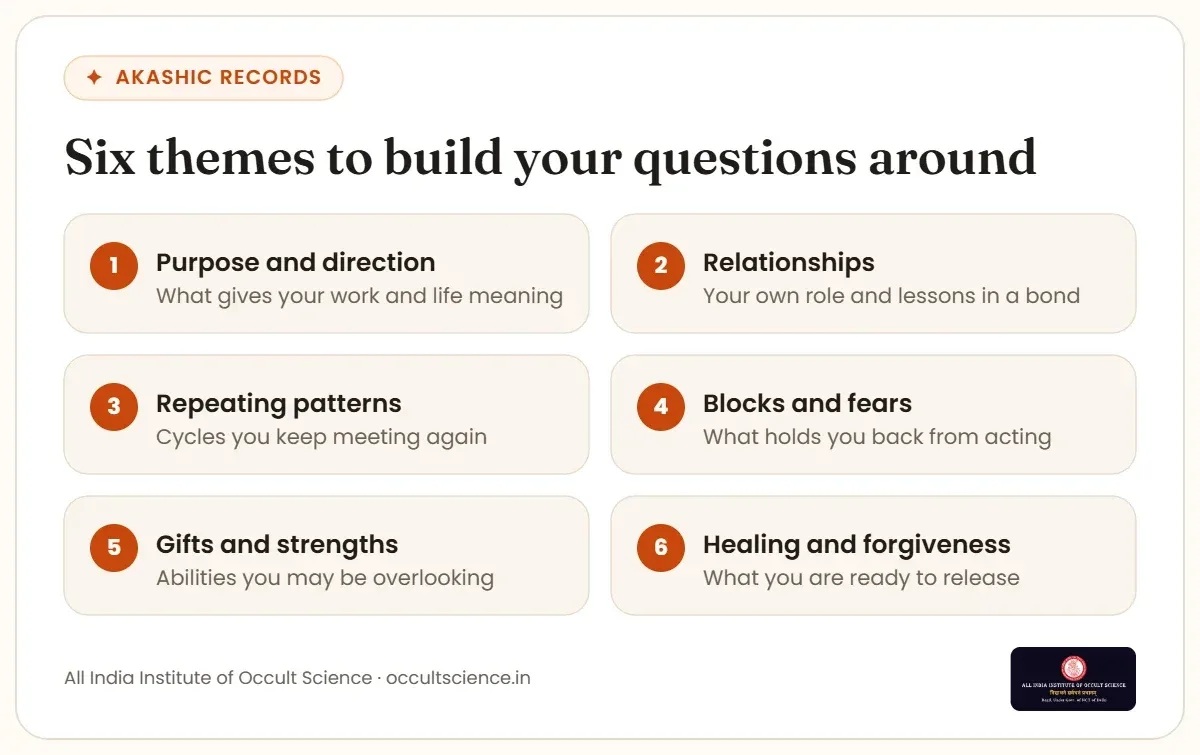
This guide shows you how practitioners suggest phrasing questions, gives example questions across six themes, and lists the kinds of questions to avoid. If you are new to the subject, start with our explainer on what the Akashic Records are.
In the Akashic tradition, the Records are described as a non-physical record of every soul's journey. The idea became widely known through the Theosophical movement of the late 1800s; Britannica's entry on Theosophy explains where it came from. Practitioners believe the Records respond to sincere questions with insight and guidance rather than fortune-telling.
That belief shapes how readers work. They encourage you to ask about meaning, lessons and choices, because those are the questions a reading is suited to. Whether you see the Records as a spiritual reality or as a reflective practice, the same rule helps: the clearer and more open your question, the more useful the session.
Our post on Akashic Records and karma explores repeating patterns in more depth.
If you plan to open your own Records, our beginner's guide to accessing your Akashic Records explains the meditative preparation practitioners use.
Sample (invented for teaching): a 34-year-old teacher feels stuck at work and keeps having the same argument with a sibling. Her prepared list:
Every question is open, personal and focused on understanding. None asks for a prediction.
Sometimes you come to a reading because of one big event. Here are open questions practitioners suggest for common situations:
In each case, the question keeps the focus on understanding and on choices you can make, not on predicting what others will do.
Insights fade quickly if you do nothing with them. Within a day of your session, read your notes and pick one small, practical step for each key insight: a conversation to have, a habit to start or a boundary to set. Revisit the notes after a month and see what has shifted. Many people find that the real value of a reading shows up in these weeks of reflection, not in the session itself.
A reading can offer a space for reflection, new perspectives on old patterns and a sense of meaning. It cannot predict events with certainty, diagnose illness, give legal or financial advice, or replace therapy. If you are struggling with your mental health, please speak to a qualified professional. Practices such as Reiki and meditation can be complementary, but they are not medical care.
Good Akashic questions are open, personal and kind: what, how and why questions about your purpose, relationships, patterns, blocks, gifts and healing. Prepare a short ranked list and leave predictions behind. If you would like to learn to open and read the Records yourself, with ethics at the centre, explore the Institute's Akashic Records course.
This article shares traditional spiritual practices for educational purposes. It is not a substitute for professional medical, psychological, legal or financial advice. See our disclaimer.
 Login or Sign up
Login or Sign Up to Get Course Details
Enter your mobile number to continue. You’ll land on your dashboard with the full course syllabus, special offers and upcoming batches.
 By continuing you agree to our Terms & Conditions and Privacy Policy.
How do practitioners link the Akashic Records with karma? Learn what karmic patterns mean in this tradition, examples, and a gentle way to explore them.

What the Akashic Records are, how the idea grew from the Sanskrit akasha to Theosophy, what a reading involves, and the myths worth setting aside.