contact@occultscience.in
 +91 96724 36436
 Send Your Query
 Get Syllabus


 +91 96724 36436
 contact@occultscience.in


Written by Jyoti Chauhan, Content Writer · Reviewed by Gurudev Shrie Kashyap, Chairman & Founder, All India Institute of Occult Science · Published 26 Nov 2026
Key Takeaways
- Kharmas 2026 begins on 16 December 2026, when the Sun enters Sagittarius (Dhanu Sankranti).
- It ends when the Sun enters Capricorn on the night of 14 January 2027, with Makar Sankranti observed on 15 January 2027 (New Delhi calculations).
- Many North Indian families pause weddings, engagements and house-warmings during these roughly 30 days.
- It is traditionally a time for prayer, charity, study and Surya worship, not a period of bad luck.
- Customs vary by region and family; check a local panchang for exact times in your city.
Every December, wedding halls in North India suddenly go quiet. Bands, caterers and decorators take a break, and families with a wedding in mind start asking the same question: "Kharmas kab se hai, aur kab khatam hoga?"
This short guide gives you the Kharmas 2026 dates first, then explains what Kharmas is, why weddings pause, what tradition suggests doing during this month, and the myths worth letting go of.
Kharmas 2026: Dates
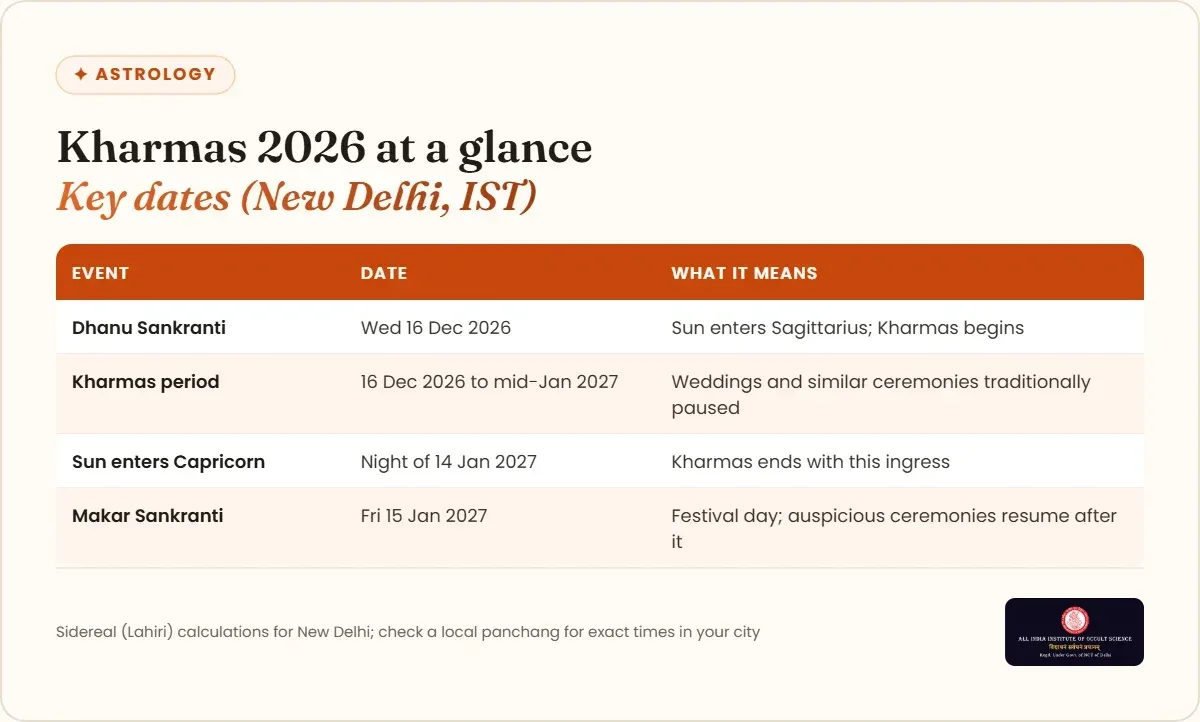
Kharmas is a solar period, so its dates are fairly stable each year: it begins around 15 or 16 December and ends around 14 or 15 January. The exact moment of each Sankranti differs slightly between almanacs and cities, so families planning a ceremony usually confirm the time with their family priest or a local panchang.
What Is Kharmas?
Kharmas is the period when the Sun, Surya, moves through Sagittarius (Dhanu) or Pisces (Meena) in the sidereal zodiac. Both signs are ruled by Jupiter (Guru). It happens twice a year: mid-December to mid-January, and mid-March to mid-April. The December period is the better known because it falls in the North Indian wedding season.
The Sun moves through all 12 zodiac signs in a year, spending about a month in each. Its entry into each sign is called a Sankranti, which is why Kharmas starts on Dhanu Sankranti and ends with Makar Sankranti.
Why Do Weddings Pause During Kharmas?
Several traditional explanations are given:
- The Sun serves the Guru: when the Sun enters Jupiter's sign, its energy is said to be devoted to Jupiter, so it is seen as less available to bless new household beginnings.
- Weaker Jupiter for muhurat: in muhurat practice, a strong Sun and Jupiter are both valued for marriage, and this period is considered less suitable.
- Season and rest: mid-December to mid-January is the coldest part of the North Indian year, and older customs naturally reduced large gatherings then.
When families do plan a wedding, astrologers usually look at the full muhurat and at the couple's charts together. Tools such as kundali matching and factors like nadi dosha are part of that wider picture.
What to Do During Kharmas
Kharmas is not an "inauspicious month" in the sense of bad luck. Tradition treats it as a month for inward and generous activities:
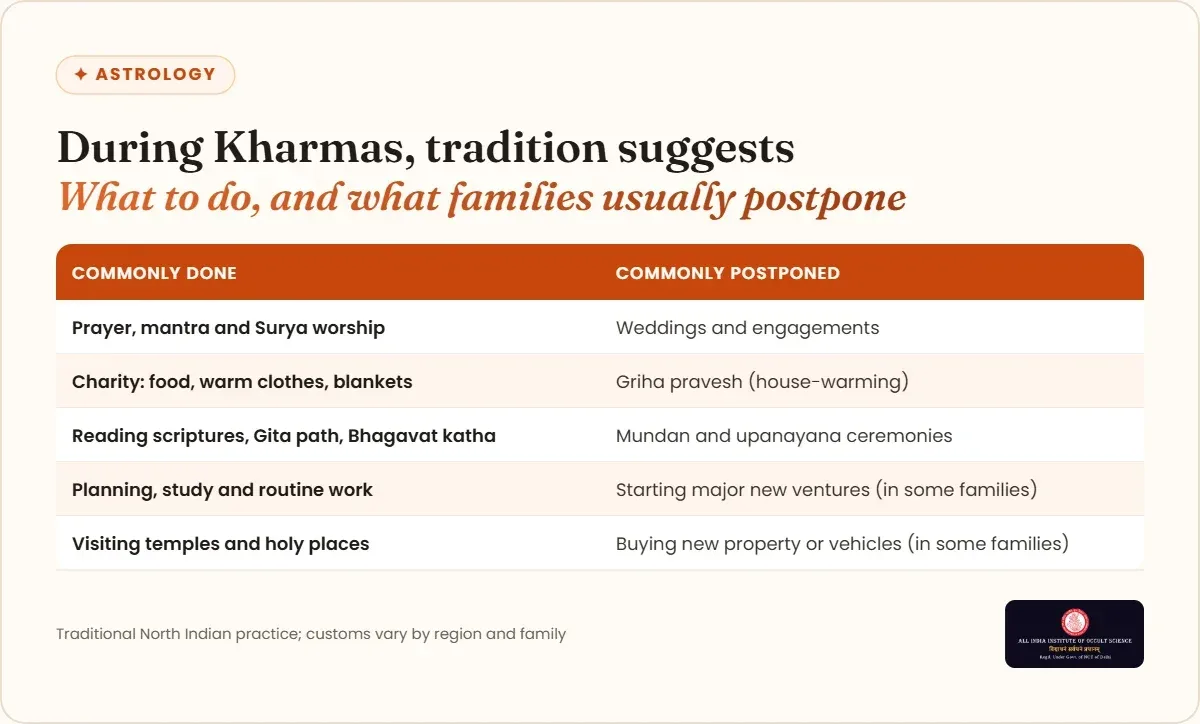
Many families also offer water (arghya) to the rising Sun each morning, read the Bhagavad Gita or the Bhagavata, and give warm clothes or blankets to people in need during the winter.
What Kharmas Does Not Stop
- Daily life: work, study, business and travel continue as normal.
- Planning: it is a good time to plan a wedding or a move for the weeks after Makar Sankranti.
- Learning: many people start courses, reading or spiritual practices during this month.
- Medical and urgent needs: treatment, surgery and urgent matters should never be delayed because of Kharmas.
Kharmas, Malmas and Other Periods
Kharmas is often confused with Malmas or Adhik Maas, the extra lunar month added roughly every three years to keep the lunar calendar aligned with the solar year. They are different calculations, though both are traditionally avoided for weddings. Other transits are discussed separately; for instance, the Rahu-Ketu transit of December 2026 and Saturn's Sade Sati are read through the birth chart, not as a calendar-wide pause.
Planning a Wedding Around Kharmas
If your family follows the custom, a little planning avoids stress:
- Book early: the weeks just before 16 December and just after mid-January are busy, so venues and caterers fill quickly.
- Use the month well: Kharmas is a good time for shopping lists, guest lists, invitations and paperwork, as long as the ceremony itself falls after the period.
- Confirm the muhurat: the first dates after Makar Sankranti also depend on other factors, such as the position of Venus and Jupiter, so a muhurat is checked individually.
- Respect differences: if the two families follow different customs, agree on the date early and kindly.
The Second Kharmas of the Year
Kharmas also occurs when the Sun moves through Pisces, roughly from mid-March to mid-April. In 2027 this falls around 15 March to 14 April, ending with Mesha Sankranti. The same customs apply in families that observe it, so anyone planning a spring wedding should check those dates too.
Kharmas in South India: Dhanurmasa
The same solar month has a very different feel in South India, where it is known as Dhanurmasa or Margazhi. It is considered especially sacred, with early-morning worship, devotional singing and temple festivals. Weddings are traditionally avoided here too, but the month is celebrated as a time of devotion rather than seen as a gap in the calendar.
Myths About Kharmas
"Anything started in Kharmas will fail."
Tradition only advises postponing certain ceremonies. It does not say that work, study or ordinary purchases started in this month will fail.
"Kharmas is observed everywhere in India."
It is mainly a North Indian custom. In South India the same month is Dhanurmasa or Margazhi, a sacred month of early-morning worship, and practices differ.
"You need a puja to protect yourself during Kharmas."
No special paid ritual is needed. Simple prayer, charity and a disciplined routine are the traditional responses.
What Kharmas Can and Cannot Tell You
| It can | It cannot |
|---|---|
| Help families plan ceremonies around a traditional calendar | Decide whether a marriage or venture will succeed |
| Encourage a month of prayer, charity and reflection | Justify delaying medical, legal or urgent decisions |
How to Learn Muhurat and Transits Properly
Choosing a good muhurat needs an understanding of the panchang, transits and the charts involved. The Institute's astrology course covers these at the Diploma and Master levels, alongside the foundations explained in our guide to what astrology is.
Conclusion
Kharmas 2026 runs from Dhanu Sankranti on 16 December 2026 until the Sun enters Capricorn on the night of 14 January 2027, with Makar Sankranti on 15 January. Families who follow the custom pause weddings and similar ceremonies, and use the month for prayer, charity and planning instead. It is a pause, not a punishment. Want to see where the Sun and other planets sit in your own chart? Generate it with the free kundali tool.
This article shares traditional astrology knowledge for educational purposes. Dates are based on published panchang calculations for New Delhi; check a local panchang for your city. It is not a substitute for professional advice. Please read our disclaimer.