contact@occultscience.in
 +91 96724 36436
 Send Your Query
 Get Syllabus


 +91 96724 36436
 contact@occultscience.in


Written by Jyoti Chauhan, Content Writer · Reviewed by Gurudev Shrie Kashyap, Chairman & Founder, All India Institute of Occult Science · Published 26 Nov 2026
Key Takeaways
- West facing house Vastu does not treat the direction as unlucky; the west is ruled by Varuna and has favourable entrance positions like every side.
- The main door is traditionally best in the 3rd or 4th of 9 padas on the west wall.
- Keep the north-east open and light, the kitchen in the south-east (or north-west) and the master bedroom in the south-west.
- West-facing homes get strong afternoon sun, so shading and ventilation matter for comfort.
- Most corrections are simple and low-cost; Vastu never requires demolition or paid remedies.
"West-facing? Hmm." Many home buyers in India have heard that pause from a relative or a broker. West-facing homes are often a little cheaper, and a quiet belief that they are "less lucky" keeps some families from even visiting them.
Classical Vastu does not support that fear. Like every direction, the west has its ruling deity, its favourable entrance positions and its own strengths. What matters is how the home is planned and cared for.
This guide explains west facing house Vastu clearly: what the direction means, where the main door should go, a room-by-room layout, a sample plan, common myths and easy fixes that need no demolition. For the basics of the subject, see our guide to Vastu Shastra.
What Is a West-Facing House?
A house is west-facing when you stand at the main entrance, look outward, and face west. The road, gate or balcony direction does not decide it on its own; the main door does. Take the reading with a phone compass a few steps away from metal gates, cars and electrical boxes.
In apartments, check the door of your own flat. The tower's lobby may face one way and your flat another, and practitioners give more weight to the door you use daily.
What the West Represents in Vastu
In the classical directions, the west is ruled by Varuna, lord of water and cosmic order, and is associated with the planet Saturn. Traditional teachers link the west with stability, gains that come from sustained effort, and the rewards of work. It is also the direction of the setting sun, which gives it a calm, evening quality.
Many practitioners describe west-facing homes as well suited to people in business, trade, sales, teaching and creative fields. These are traditional associations, not guarantees, but they show that the direction has strengths of its own.
Is a West-Facing House Good or Bad?
It is neither good nor bad by default. North- and east-facing homes are often preferred because they receive gentle morning light, but classical texts list favourable entrances on all four sides. A well-planned west-facing home with a correctly placed door, a light north-east and a heavy south-west is considered a sound home in traditional practice.
The same is true of the other directions; our guides to north-facing and east-facing houses apply the same principles to those plans.
Main Door Placement on the West Side
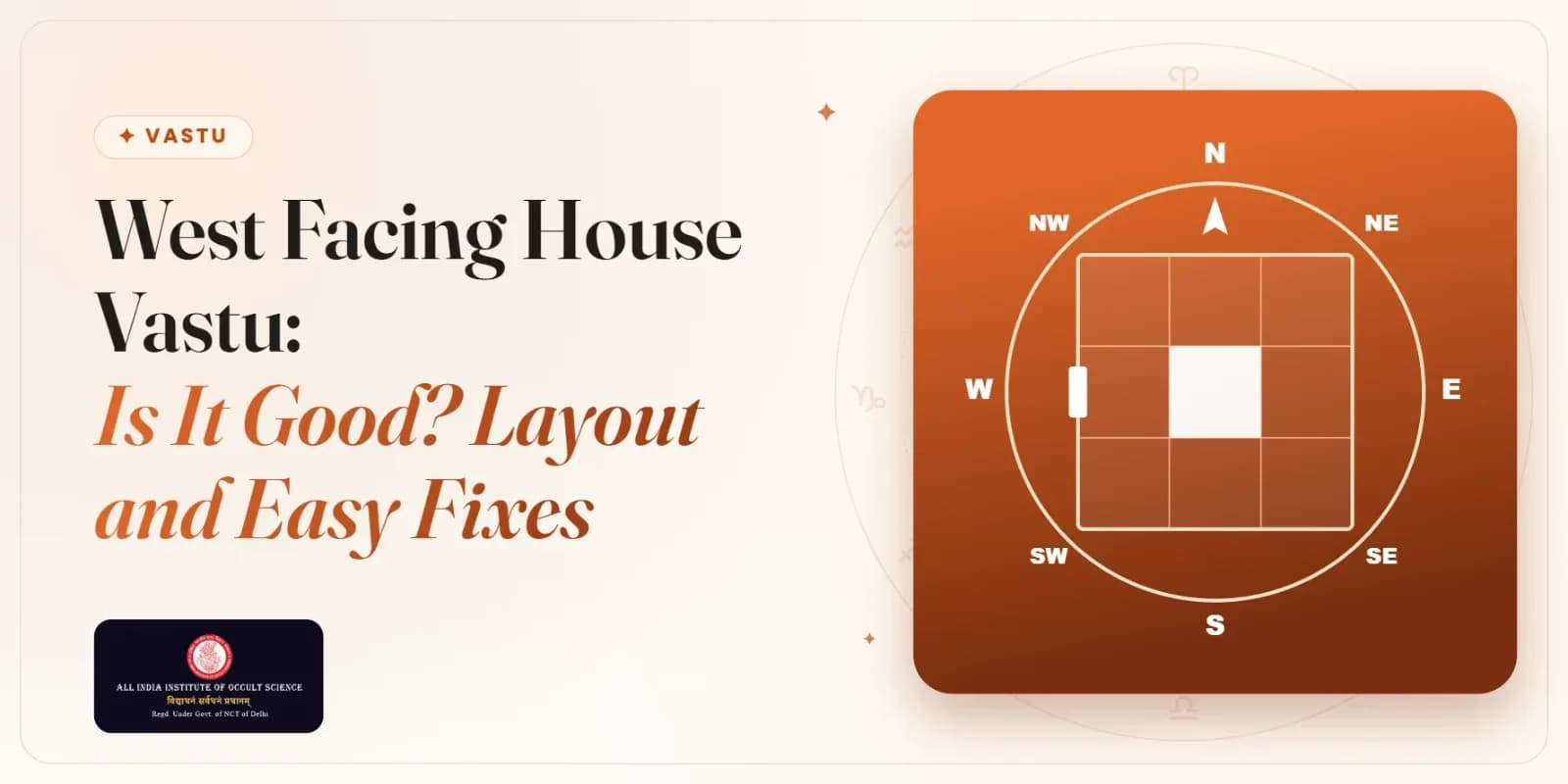
Classical Vastu divides each outer wall into nine equal parts (padas) on the Vastu Purusha grid. On the west wall, many practitioners favour the third and fourth padas counted from the south-west corner, linked with Sugriva and Pushpadanta. Some also accept the fifth pada, linked with Varuna himself.
Doors at the extreme south-west or north-west corners are the positions practitioners usually try to avoid. If yours is there already, the first advice is gentle: good lighting, a clean threshold and a well-maintained door. Our guide to main door Vastu explains the pada method in detail.
Door design tips for west-facing homes
- A sturdy wooden or metal door in white, cream, silver, light grey or blue tones is a common choice for the west.
- Make it the largest door in the house, opening inward and clockwise.
- Add warm lighting, since the entrance is often in shade by evening.
- Keep shoes, bins and clutter to one side.
Room-by-Room Layout for a West-Facing House
Living room
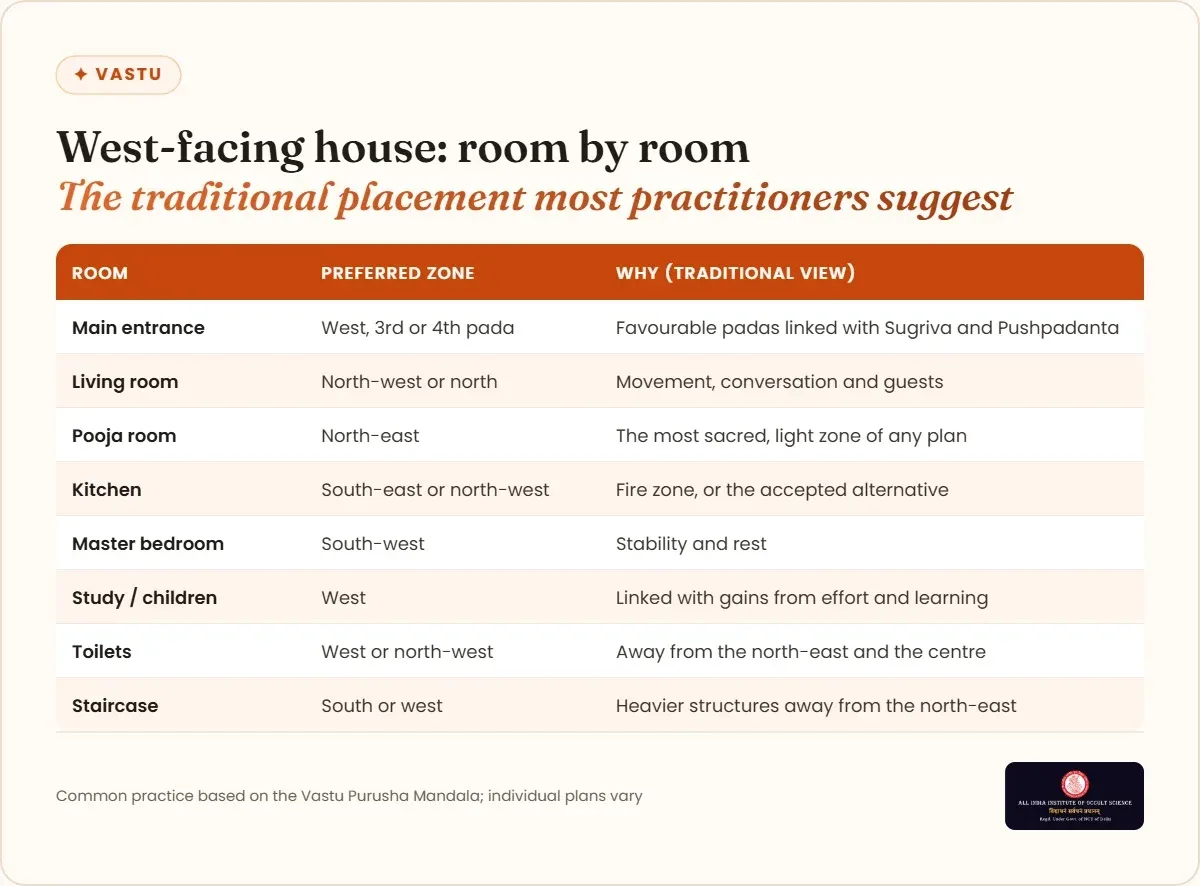
The north-west or north suits the living room in many west-facing plans. The north-west is linked with air and movement, which fits a space for conversation and guests.
Pooja room
Whatever the facing, the north-east remains the ideal zone for prayer and meditation. Keep it clean, light and free of heavy objects.
Kitchen
The south-east is the first choice, with the cook facing east. In many west-facing plans the north-west kitchen is practical and widely accepted. Our kitchen Vastu guide covers stove and sink placement.
Bedrooms
The south-west is preferred for the master bedroom. Children's rooms and study rooms suit the west, a zone traditionally linked with learning and the rewards of effort.
Toilets, stairs and storage
Toilets fit the west or north-west, away from the north-east and the centre. Staircases, overhead tanks and heavy storage suit the south and west.
A Sample West-Facing Layout (Described)
Imagine a two-bedroom west-facing home on a rectangular plot (sample plan for illustration). The main door sits in the fourth pada of the west wall and opens into a living room on the north-west side. A small pooja shelf sits on the north-east wall of an open dining space. The kitchen is in the south-east, arranged so the cook faces east. The master bedroom occupies the south-west, the second bedroom is on the west, and a bathroom is in the north-west corner. The centre of the home is kept open.
Nothing in this plan is unusual or expensive. It simply follows the traditional zones, which is all most west-facing homes need.
Managing Afternoon Sun
A practical point Vastu and modern architecture agree on: west-facing rooms receive strong afternoon and evening sun, especially in Indian summers. A few simple choices keep the home comfortable:
- Use curtains, blinds or external shades on west windows.
- Plant trees or tall shrubs on the west side of the plot if space allows.
- Use lighter wall colours to reduce heat absorption.
- Ensure cross-ventilation with windows on the north and east.
West-Facing Flats and Apartments
- Check your door pada: measure the wall that holds your flat door and see which ninth the door falls in.
- Use rooms wisely: if a south-west room exists, make it the master bedroom.
- Brighten the north-east: avoid storage there; a plant or a light colour helps.
- Cool the west balcony: plants and blinds turn it into a pleasant evening space.
Gardens, Balconies and Water in a West-Facing Home
Outdoor spaces help a west-facing home a great deal. A west-side garden with trees or tall shrubs gives shade from the afternoon sun and is welcome in Vastu, since heavier greenery suits the south and west. Lawns, flowering plants and open sit-outs are better on the north and east sides if the plot allows. Underground water tanks and borewells are traditionally placed in the north-east, while overhead tanks suit the south-west or west.
On a west balcony, potted plants, a bamboo blind and a small seating area turn the hottest side of the home into a pleasant evening space, which is exactly the kind of practical balance Vastu aims for.
Easy Fixes Without Demolition
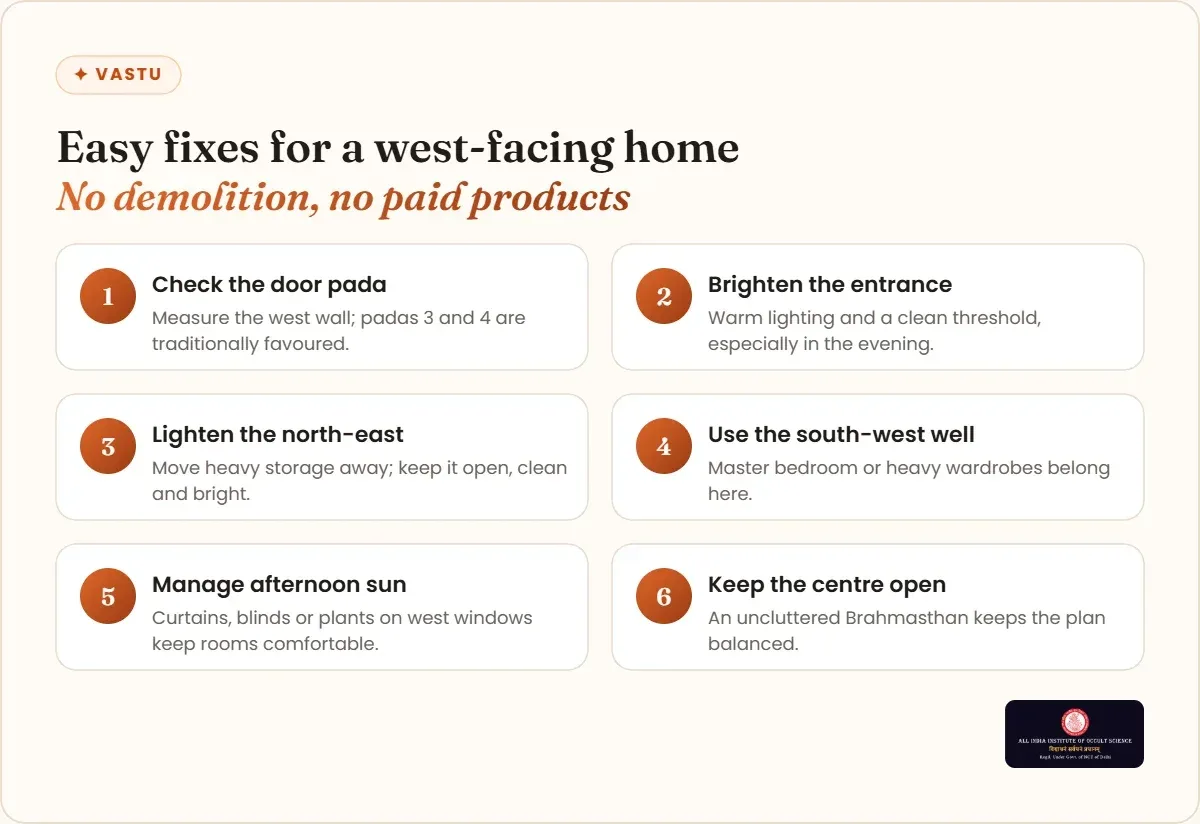
These steps follow the classical spirit of Vastu, which is about light, balance and good use of space, without buying any yantra, crystal or remedy.
Choosing a West-Facing Plot or Flat: What to Check
If you are comparing homes, these practical checks tell you more than the facing direction alone:
- Plot shape: square or rectangular plots are preferred; a cut or missing north-east corner deserves a closer look.
- Open space: more open space on the north and east sides of the plot, with the building mass toward the south-west, follows the classical pattern even when the road is on the west.
- Slope and drainage: land that slopes gently toward the north-east, with water draining that way, is the traditional preference.
- Neighbouring structures: a tall building or water tank directly in front of the west door can block light; good lighting and plants help.
- Evening visit: visit at around 4 p.m. to see how much heat and glare the west rooms receive.
Colours for a West-Facing Home
Colour guidance in Vastu is flexible. For west-facing walls and the main door, practitioners often suggest white, cream, silver, light grey or soft blue, colours linked with Varuna and with keeping a sun-facing room cool. The south-west bedroom suits earthy beige or light brown, the south-east kitchen suits warm peach or light orange, and the north-east stays light and simple. Choose shades you enjoy living with; brightness and calm are the real aim.
West vs South-Facing: A Quick Comparison
Buyers sometimes weigh these two less-popular directions against each other. Both are workable when the entrance pada is right. West-facing homes deal mainly with afternoon heat, while south-facing homes need more attention to the entrance pada and to keeping the south-west heavy and closed. In both, the deciding factors are the same: door position, an open north-east and a sensible room layout.
Common Myths About West-Facing Houses
Myth 1: "West-facing homes bring losses."
No classical text says this. The west has favourable padas and is linked with stability and gains from effort.
Myth 2: "Only north and east entrances are acceptable."
North and east are popular, but traditional practice accepts well-placed entrances on every side.
Myth 3: "You must move the door."
Practitioners rarely begin with structural changes; lighting, upkeep and room use come first.
Myth 4: "A cheaper west-facing home is a bad deal."
Price differences often reflect market belief, not Vastu. A well-planned west-facing home can be both comfortable and good value.
What Vastu Can and Cannot Do for Your Home
| It can | It cannot |
|---|---|
| Guide the planning of light, space and room use | Guarantee wealth, health or harmony |
| Help you compare homes calmly | Replace structural, legal or safety checks |
| Suggest low-cost improvements | Require you to buy products or remedies |
How to Learn Vastu Properly
Reading a west-facing plan well means understanding the mandala, the elements and the sixteen zones together. The Institute teaches Vastu as a Diploma in Vastu (about 2 months) and a Master in Vastu (about 4 months), live online with real floor plans for practice. You can download the syllabus to see each module.
Conclusion
A west-facing house is not unlucky in classical Vastu. Place the main door in a favourable pada, keep the north-east light, the kitchen in the south-east or north-west and the master bedroom in the south-west, and manage the afternoon sun. With those basics in place, a west-facing home can be a calm and comfortable place to live. To learn to read real plans with confidence, explore the Vastu course at the All India Institute of Occult Science.
This article shares traditional Vastu knowledge for educational purposes. It is not a substitute for professional architectural, structural, legal or financial advice. Please read our disclaimer.